
Barry Stebbing Art Books
| Publisher: How Great Thou ART Publications Author: Barry Stebbing |
Instant KeyPublishers InfoPricingProduct Photos |
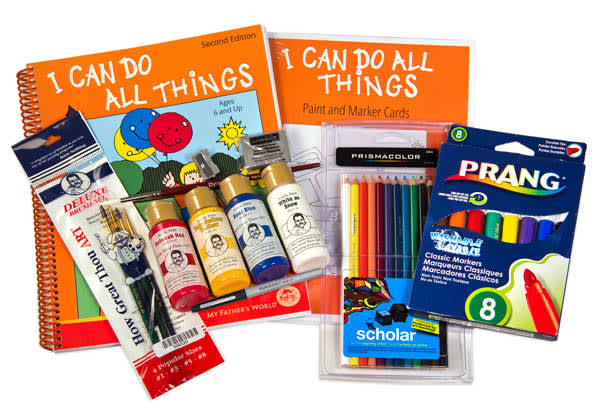
I Can Do All Things: A Beginning Book of Drawing and Painting (ages 6 – 10)
Although it is suggested for ages 6 and up, you need not limit this resource to children in the primary grades. Most activities are appropriate for anyone who wants to learn beginning techniques with drawing, colored markers, or acrylic paints. Occasional pictures or assignments do seem directed only at young children, but older students can adapt or skip those. Stebbing provides tips for the teacher. Lessons then address various skills and techniques appropriate for each art medium. Lessons mix text and black-and-white illustrations to provide step-by-step instruction. Each student needs his or her own book since many lessons are done directly on the book's pages. However, copying of the pages for multiple children is allowed within the home.
Some lessons work in a progressive order. For example, students learn to draw circles, then snowmen, faces, cans, jars, and other round things. Other lessons like shading, showing depth, drawing people, and cartoons might be used in random order.
A set of 38, 8 1/2" x 11" marker/painting cards comes with the book. These are printed on heavy card stock for use with the colored markers and acrylic paints. You will need extra sets of these cards for additional students ($7.95 each).
Those who prefer not to hunt down all the art supplies should probably purchase the complete set that includes the book, acrylic paints, brushes, watercolor markers, black fine pen, 12 "Prismacolor" colored pencils, and a kneaded eraser and sharpener. For additional students, you can purchase sets of only the art supplies for $21.95 each.
I noticed one very small problem: toward the end of the book is a small section for students to use for studying "art masters." Students are told to recreate a master's drawing in 3" x 4" box and a portrait of the artist himself in an even smaller box. This really isn't sufficient space unless the student is exceptionally skillful. The task, itself, is more suitable for older students.
The book should easily take more than a year to complete if your child is truly exploring and learning to work with each media. I expect that it will work best for families where parents are confident enough to expand upon lessons and select which lessons to use in what sequence.
Lamb's Book of ART, Books I and II, 2006 editions (for ages 8 through 12)
Books I and II cover essentially the same territory, offering two sets of lessons that can be used independently, simultaneously (maybe you want to spend more time on cartooning, so you use lessons from both books), or consecutively. You should probably use Book I first, but it is not critical.
Far more than "arts and crafts," each Lamb's Book of ART is a serious art course for teaching children about drawing, color theory, lettering, perspective, anatomy, cartooning, and graphic design. These books are geared for students in grades 3-8. Students work with colored markers, colored pencils, a drawing pencil, a fine black marker, and a brush to blend colors. Five heavy card stock pages come with each book for some of the lessons, but you will want to either use colored pencils for other lessons within the books or photocopy pages that might "bleed" through since lessons continue on both sides of each page. Most work will be done within the book, and quite a few extra blank pages are provided at the back for students to create their sketchbooks.
While children do some copying, they also learn to draw from "still lifes" in Book II—to draw what they actually see. Children also develop creativity through cartooning.
Barry Stebbing generously illustrates the books with black-line drawings. Bible verses or quotations are featured on every page, but Christian content is also integrated into some of the lessons.
There are 71 lessons in Book I and 73 in Book II. Each book might stretch over one or two years, depending upon a child's rate of progress. A single teacher's manual covering lessons in both books provides further explanation and suggestions for parents. While it is not essential, parents without artistic background will find it useful.
The principle difference between these books and How Great Thou ART's Feed My Sheep is in the length of each program and the addition of painting to Feed My Sheep.
The Wonderful Art of Drawing Horses (ages 8 and up)
This special topic course is very similar in both presentation and layout to the How Great Thou ART books for older students. Children learn basic techniques while focusing on drawing horses. It really is suitable for a wide variety of ages and skill levels, including artwork examples from young beginners to advanced experts. Art supplies required are a set of drawing pencils, a set of colored pencils, a black drawing pen, water-soluble colored markers, and a #7 paint brush. Like most of the other books, this too includes five marker cards. A bundled set of the book with all the art supplies is available.
Feed My Sheep (for third grade through high school)
This is one of my 100 Top Picks!
See the complete review in 100 Top Picks for Homeschool Curriculum.
Feed My Sheep is the most comprehensive of Barry Stebbing's art courses. It is a combined art text and workbook for teaching drawing, color theory, art appreciation, perspective, portraiture, anatomy, lettering, painting, and more to students in third through ninth grades. It is written directly to students; older students can work independently, but younger ones will need assistance and direction. This is a particularly good choice for parents without art background. As, with all Stebbing's, courses, it is written for Christians.
Since students are expected to work in the book, you should purchase one for each student. However, you are allowed to photocopy for children in your immediate family if you wish.
How Great Thou ART, I and II (for ages 12 and up)
Both How Great Thou ART books are written for teens and may be taught by an instructor or used for independent study. You can begin with either book although it seems to me that using them in order makes the most sense since some topics are developed more in-depth in the second book. Each student needs a copy of whichever book you choose since some work is done directly in the book. Also, each book comes with a set of 5 heavy cardstock cards for pen and ink drawing assignments.
As far as supplies, each course requires only a few good drawing pencils (HB, 3B, 6B), a kneaded eraser, a ruler, an extra-fine black marker pen, a calligraphy pen, pencil sharpener, and the text.
Lessons follow an orderly progression. For example, in Book I the first lesson begins with drawing lines; next, ellipses; then glasses and jars that are made from lines and ellipses; and so on. There are 68 actual lessons, but suggestions for many, many more based on the information taught. Students learn shading, texture, composition, shadows, foreshortening, nature studies, human anatomy, portraits, one-point perspective, and other topics. Some of these topics will require practice for mastery, so students should not be expected to zip through all of the lessons in a regular progression. Students are encouraged to draw from life and nature which helps develop observation skills. I appreciate the author's provision of examples of errors to avoid as well as plentiful examples of proper technique.
Book II quickly reviews a few of the fundamentals of drawing taught in the first book, then takes students through numerous still-life lessons to practice composition skills, shadows, shading, and pencil control. Students then learn how to reproduce drawings on grids, changing the scale. Next are lessons on one- and two-point perspective. Then it introduces pen-and-ink drawing, followed by extensive lessons on anatomy, and final lessons on lettering, calligraphy, and creativity.
In both books, space for each lesson's assignment is provided adjacent to each lesson, and quite a few extra blank pages are provided for practice at the back of the book for students to create their own sketchbooks.
Both books are beautifully illustrated with sketches. In keeping with the nature of sketches, there is a loose creative feel, but with elements of beauty and grace. I am impressed with these books! They have a Christian perspective; they cover skills in a logical, comprehensive order; they provide clear instruction and evaluation; and they are inexpensive. While students can work through these books on their own, parents who prefer to be more involved in art lessons can purchase the single-volume teacher's manual that covers both Books I and II. It adds background, suggestions, and tips for each lesson that go beyond what is provided in the lesson books.
Note: Also from Barry Stebbing is The Student's Guide to Keeping an ART Journal ($10.95). Stebbing explains in great detail and with many examples how to create an art journal. This practical and inspirational book is written for more serious drawing students, both teens and adults. It makes a wonderful companion to the How Great Thou ART books.
Baby Lambs (ages 3-5)
Those with preschoolers should start with Baby Lambs. It features lessons on numbers, letters, and counting in addition to drawing and basic color theory. (There are a couple of addition and subtraction problems that might be beyond most preschoolers.) Also, there are also a few cut-and-paste craft activity pages plus ABC's with Scripture. The collection of activities in this book is a bit eclectic. I wish it were more concentrated simply on art activities.
Art supplies needed are a set of colored pencils, a drawing pencil, scissors, glue, and a set of washable colored markers. You will also need a brush if you want children to learn to blend with the markers although a brush is not included in the list of essentials. The book comes with five heavy, cardstock cards to be used with the colored markers.
The Baby Lambs Special includes a book, a set of 8 colored markers, and a brush for blending—instruction on how to do this is in the book.
Many Scripture verses, retellings of biblical stories, and other Christian references make this resource appropriate for Christian families.
Art & the Bible for Children (ages 4 and up)
by Joshua Olds and Barry Stebbing
Art & the Bible for Children teaches Bible stories with drawing activities supplied to reinforce the stories. While children are told to draw certain people or things in response to each story, there is little instruction in how to draw since the primary purpose is not to teach specific drawing skills.
Children ages four and up might listen to the stories and complete the drawing activities. However, some activities such as filling in the rungs on Jacob’s Ladder will appeal only to younger children. At the same time, some activities such as drawing a donkey might be much more challenging. However, children are given instructions, sample illustrations, and drawing prompts to make it easy to complete each assignment working with a fine point black drawing pen and colored pencils.
While the drawing activities are presented in the 275-page, hardcover textbook with the stories, you will not want children to draw directly on the glossy pages of the text. The book comes with a set of lesson (drawing) cards printed on card stock. Cards have drawings to be completed, squares to fill in, and drawings to copy, each accompanied by drawing prompts such as, “Draw Zacchaeus in a tree. You can either draw him standing or sitting. Draw your picture in the figure box. Use your colored pencils and, when finished, outline your tree and Zacchaeus with your black pen.” These cards might be reproduced on other paper so that each child has his or her own.
The Bible stories are retellings of the most popular stories, presented in chronological order from Creation to Revelation. Each story is followed by “discussion questions” that primarily ask only for recall of information and occasionally ask for personal responses. Stories are illustrated with full-color reproductions of children’s artwork by children of all ages and skill levels. These illustrations should be an encouragement and inspiration for children to try their hand at their own illustrations.
I think this should work well with the whole family even though the Bible stories are simplified retellings. If you use this with the whole family, you might allow older children to come up with their own ideas for some of the drawing assignments that seem to simple.
You can purchase preprinted packs of the lesson cards, copy those from the original set that comes with the book, or purchase a downloadable PDF file.
Little Annie's ART Book of Etiquette & Good Manners (ages 4 to 9)
by Barry and Saundra Stebbing
hile this book does have some art lessons, like Baby Lambs, it's an eclectic mixture of arts and crafts, etiquette and manners, critical thinking, math, penmanship, and composition with the occasional biblical lesson and frequent Scripture verses. Children will need a set of either crayons or colored pencils, a set of colored markers, plus a large drawing pencil. Five heavy cardstock marker cards are included with the book.
Nature Drawing & Journaling (teens and adults)
Subtitled "Step-by-Step Lessons in Journaling & Drawing through Nature's Path," this guide should appeal especially to Charlotte Mason fans since nature study, drawing, and writing are among her key recommendations. Written for teens and adults, this book includes instruction in the basics of journaling, gathering your supplies, preparing your journal, and tips on working outdoors. It features inspirational drawings from Barry Stebbing's own journals and instructions for the various drawing projects. I love the way he weaves in gentle instructions that give you the sense of having a mentor alongside.
The book is presented as a series of lessons that walk you through the preparatory steps before moving out into nature itself. Lessons work through different aspects of nature: color, lines, plants, trees, vines, flowers, landscape elements, weather effects, animals, birds, and insects. Concluding lessons on "barns and shanties" teach how to draw aged and rustic constructions.
The 126 pages of text are followed by about 30 pages of a "Journal Primer." The first three pages each have a section with lines, but the remaining pages are blank for you to determine your own creative layout.
If you start to read through this book, you are likely to be inspired to gather your pens, pencils, journal, and camp chair and head for the woods to create your own journal.
Note: also see the review of the Intermediate Drawing DVD set.
Pricing
The Lamb's Book of Art II

Barry Stebbing
Baby Lambs: A Children's Art Book

Barry Stebbing
How Great Thou ART: An Inspirational Approach to Drawing

Barry Stebbing
Nature Drawing & Journaling: Step-by-Step Lessons in Journaling & Drawing Throug

Barry Stebbing
- 24.95 List Price
- $21.99 at Christianbook.com
Instant Key
- Suitable for: some need teacher direction while others are good for independent work
- Prep time needed: minimal
- Need for Teacher's Manual: optional
- Religious perspective: Christian
Publisher's Info
- How Great Thou ART
- PO Box 48
McFarlan, NC 28102 - (800) 982-DRAW (3729)
- email: sales@howgreatthouart.com
- www.howgreatthouart.com
Ordering | Submit Products for Review
All reviews and articles on this site belong to Cathy Duffy unless otherwise identified. No review or article may be copied or reprinted without permission except for a single copy of a review made for temporary use AND not shared with others.
© Copyright 2011 - Cathy Duffy Web Design by Servator Design


.jpg)