

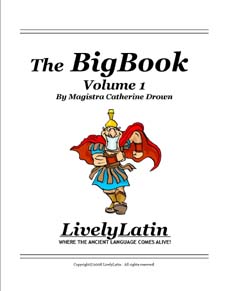
After years of teaching Latin to homeschooled students with existing curricula and doing a lot of adaptation, Catherine Drown decided it was time to create her own program for teaching Latin to students in the elementary grades.
There were a number of elements she decided were essential for her ideal program:
- Study of English derivatives so students "could use their Latin knowledge to become more articulate and attentive to meaning in their own language."
- History of Rome incorporated into the course with related activities such as maps, timelines, internet links, and review.
- Use of traditional methods for learning Latin—recitation, chanting, parsing, and translating, but with a bit more fun and variety than in other programs.
- An online component for students to play vocabulary games and connect with other students
- A program that is easy for both parents and students to use--requires minimal preparation and presentation time from the teacher and allows students to do a great deal of their work independently.
- Assumes no prior Latin study by the parent.
- Allows you to choose either ecclesiastical or classical pronunciation.
Drown was able to include all these features and sell it at an affordable price without requiring you to purchase extra components!
The BigBook of Lively Latin, Volumes 1 and 2 are available in three different formats. All formats provide students with access to additional online games and resources.
The online version includes access to the downloadable and printable PDF files for all the lessons, including answer keys (about 400 pages for Volume 1 and 600 pages for Volume 2), and access to the audio files for learning pronunciation. Access never expires!
The USB drive option has all pages from the BigBook in PDF format, including the answer key and notebook divider pages, as well as the audio pronunciation files.
The print version comes three-hole-punched with dividers and a binder—all ready to assemble. It includes the USB drive. The hardcopy version is printed in full-color throughout the book although the color printing is critical on only about 10% of the pages. Keep this in mind when considering printing it yourself. The answer key is on the USB drive.
Keep in mind, that purchase of any of these versions allows you to reprint pages for all students in your immediate family. Even with the hardcopy version, you receive the USB drive with the printable files.
Online access that comes with any course purchase allows entry to the “Study with the Magistra” section of the website where you will find vocabulary games as well as extra teaching tips and resources. It also allows you to email the Magistra with questions.
The publisher describes Lively Latin as a program for the elementary grades, with a target audience of grades three through six. However, the content is more substantial than some other programs for this level. BigBook 1 covers first and second declension nouns and adjectives. For nouns, students learn their cases and genders, but they learn the use of only nominative and ablative cases. They also learn first conjugation verbs (present, imperfect, and future tenses). BigBook 2 adds the next three declensions of nouns and teaches the use of all of the cases. The second, third, and fourth verb conjugations are covered along with six tenses. The combined content of both volumes is approximately equal to that of a first-year high school Latin course! You might use this course with students beyond sixth-grade level who need the slower pace of learning.
BigBook 1 begins with extensive background on the Latin language as well as its connection to other languages, especially to English. Even here, there are activities to reinforce the content: mapwork, timeline, fill-in-the-blanks, and internet links for further study.
Next, each student chooses a Latin name for him or herself then studies whichever form of pronunciation has been chosen—classical or ecclesiastical. Students use either the USB drive or online files to listen to correct pronunciation.
After the first few lessons, students begin each study session with a two- to three-minute warm-up session to review their vocabulary and chants. They do this out loud while using vocabulary cards they have created from either reproducible or preprinted pages.
New lesson material presented at the beginning of each lesson is written directly to students so they might work independently. Students continually encounter a variety of activities like underlining, circling, drawing, chanting, filling in blanks, and completing puzzles as they work through lessons.
Students construct a set of Mythology Playing Cards from pages in lesson three of BigBook 1. Even with the hardcopy version of the course, you might want to recopy these pages onto cardstock for easier handling and durability. Instructions are included for five different games, all of which might be played with as few as two players.
In addition to the Latin basics, Lively Latin uses stories from The Famous Men of Rome and The Story of Rome (public domain works), with activities, mapwork, and illustrations added to enhance the lessons. BigBook 1 covers Roman history from the founding of the city (753 B.C.) to the end of the Punic Wars (146 B.C.). BigBook 2 picks up from there and spans from the fall of the Republic to the end of the Empire (A.D. 476). Some full-color photos of famous artworks that relate to the history are included along with some comprehension and observation questions. Charlotte Mason methodology is evident here in these “Art Studies.” Other artwork is sometimes incorporated into the Latin lessons themselves.
Although the author of this course is a Christian, the course is presented from a secular perspective. This includes learning about the gods and goddesses, their attributes, and their stories.
Students should work on their Latin lessons two to three days per week with sessions of 20 to 30 minutes each.
While much of the illustration (aside from the works of art) in Lively Latin is clipart, the entire product is very attractive in layout and design. Lesson material and exercises are presented with relatively brief portions of text interspersed with illustrations and activities to maintain student interest. The lengthiest blocks of reading material are in stories from Famous Men and The Story of Rome; these vary from one to three pages in length. You might want to read some of these aloud with children who are reluctant readers.
Included in each course is a glossary with all the vocabulary words plus a few pages of other useful reference material for students including declension and conjugation “chant sheets.”
In my opinion, Lively Latin lives up to its name. Even though the methodology is quite traditional, the mix of multi-sensory learning methods and the use of stories, games, and art should be more appealing to most students than most other options trying to cover comparable material.