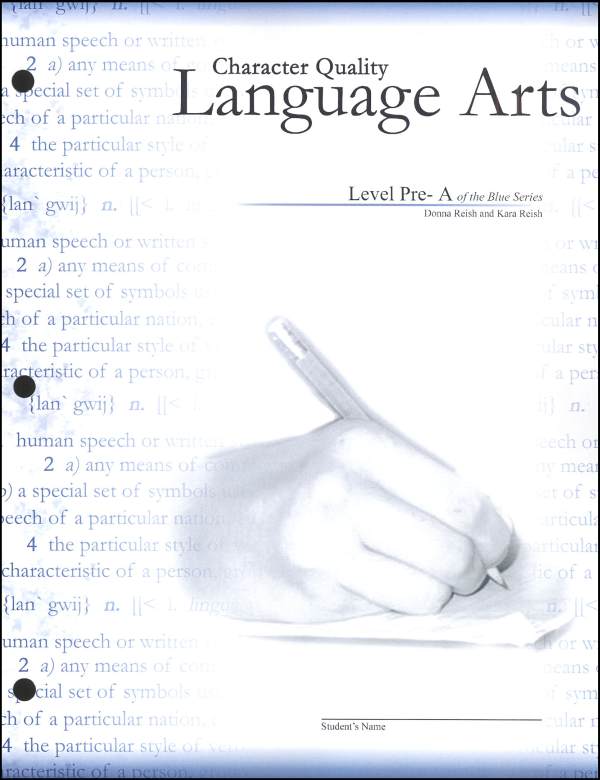


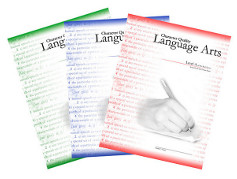
Character Quality Language Arts (CQLA) is a language arts program for students in grades two through twelve that features Christian character traits as themes for each monthly unit. According to the Teacher's Guide, character quality themes show up in "the instruction, samples, practice sentences, and writings from character, biblical, and biographical resources." Grammar is both taught directly and incorporated into writing assignments.
The curriculum has a very unusual design so that children who might be at more than one grade level might still work in one level of the program, and/or so that multiple children in one family might be in the same level together, saving Mom time in the dictation quiz, spelling test, checking of grammar assignments, etc. CQLA is presented in three volumes (Red, Blue, and Green), but for each volume there are four books or levels:
- PreA for students working at second and third grade levels
- A for those working at fourth and fifth grade levels
- B for those working at sixth through eighth grade levels
- C for those working at high school level.
In addition, there are "extension" and "further extension" and "optional" activities in each book. The extensions are more challenging, but optional, assignments that might allow you to stretch a single level to also include an older student who might actually be ready for the next level, or these and the other optional assignments might be used or omitted as you please to better tailor the program to each student.
A few other features also add flexibility to the program. "Copying and Comprehension" passages are divided into three sections. The first section should be completed by all students. More advanced students continue through the next section, and even more advanced students complete all three sections. In addition, within the lists of vocabulary words in levels B and C, key words are in bold type face while others are not bold. Vocabulary words in all levels are quite challenging, so this makes it easy to scale back on the number of words students tackle.
You might choose the Red, Blue, or Green volume according to the character traits covered. Then you would choose one or more books depending upon how many children you are teaching and their grade levels. For example, you might choose Red Level A and Red Level C if you are teaching a fifth grader and a tenth grader.
Each book is divided into eight units, and each unit should take about four weeks to complete following either a four- or five-days-a-week schedule. (Possible schedules are laid out for the teacher in the Teacher's Helps provided for each weekly lesson.) This allows for extra time to be devoted to some units when necessary.
As with most language arts curricula, skills and concepts are introduced, practiced, reviewed, and built upon with higher levels of difficulty from year to year. Skills taught for each level are repeated in each of the three books for that level so it doesn't matter which of the three volumes (Red, Green, or Blue) you choose as you begin in CQLA. You might choose the volume based on character traits on which you desire to focus. New skills and more challenging content are introduced as students move up through each level (PreA, A, B, or C) or as they tackle the more-challenging extension assignments.
The curriculum was originally developed as Wisdom Booklet Language Arts (WBLA) specifically for the Advanced Training Institute (ATI) by author Donna Reish and her daughter Kayla Reish. Character Quality Language Arts (CQLA) was adapted from WBLA to be a stand-along program that could be used by all homeschooling families.
While it does not teach reading and phonics, extensive literature study, or penmanship, CQLA does cover the rest of language arts: grammar, composition (including creative writing, poetry, and research-based reports), spelling, vocabulary, and reading comprehension. High schoolers will likely need to add a speech course and learn to write research papers. (Note: Character Ink carries products for these areas.)
Reish has tried to adapt the best methods of other programs and incorporate them all into CQLA. Thus, she borrows ideas such as copying and dictation from Learning Language Arts through Literature, the word-family spelling approach from Spelling Power, editing exercises as used in the Editor in Chief series, grammar instruction and practice ideas from both Easy Grammar and Jensen's Grammar (no diagramming), the key-word-outline technique of IEW's Structure and Style, plus essay writing ideas from Writing for 100 Days and Understanding Writing. I think Reish has done an excellent job of identifying and adapting the best techniques from these resources.
The CQLA Teacher's Guide explains how the program works and provides many important resources and tools you will need such as a sample lesson, Grammar Card pages to be copied for students, Master Checklist Challenge (writing revisions checklist), a Book Report Guide, Scope and Sequence for CQLA, helps for determining which level to order for each student, and character trait details for each unit that includes suggested resource lists for expanding on character traits with biographies, audio presentations, and other resources. A companion audio CD that comes with the Teacher's Guide walks you through a sample lesson. I think you will find the CD very helpful.
The amount of parental involvement depends upon the level. For PreA, almost all work is done one-on-one. It should take about 20 to 30 minutes per day.
Level A should require about 30 to 40 minutes per day, but students should be spending about half that time working independently.
Level B lessons expand to take about 45-60 minutes per day, and parent involvement drops to less than a quarter of that time.
For level C, students need only occasional parental involvement, and they should be working for 60 to 70 minutes a day. (Note: you do need to watch for typos and some errors in this level.)
Books look a bit overwhelming on first glance. The books range from about 700 to 1000+ pages each. There's a lot of material to cover. However, books are mostly self-contained with instruction and exercises so you do not have to reference separate teacher editions. Answer keys are included in the books, but they can easily be removed and put into a separate teacher notebook. Lessons all follow the same organizational format through all levels and volumes, so once you and your children understand how the program works, you're set for all levels of CQLA.
While the teacher's guide is spiral bound, the CQLA books each come as a bundle of shrink-wrapped pages punched for you to insert into your own binder. Character Ink recommends that you give your student one monthly unit at a time to place in a thin binder, rather than giving him all units at once.
Books are all printed in black-and-white and there are no illustrations. However, the typeface and layout are clear and easy-to-read with lots of boxes, grayed areas, and other graphic elements to make it visually interesting.
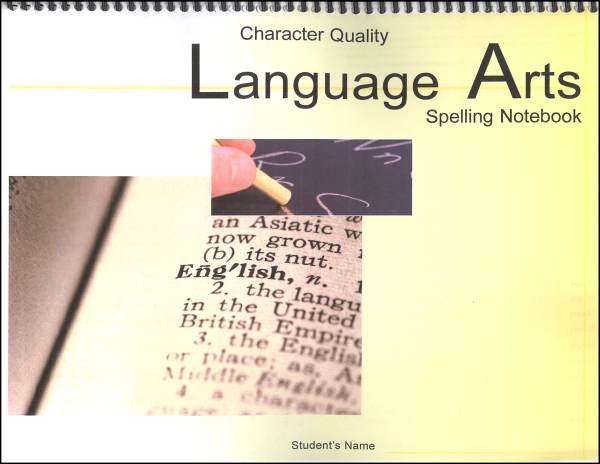
There are a few resources you will need in addition to CQLA. These include a dictionary and thesaurus, plus a copy of The Spelling Notebook for each child. (The Spelling Notebook is a worktext that includes spelling rules and sample words, and it serves as the student's workbook for each week's spelling lesson.) Students write in their CQLA books on just about every page, so each student needs his or her own book
As I mentioned above, character traits are the themes for each unit. These are often developed using Scripture, historical themes, animal topics, and biographical sketches, especially of Protestant heroes and missionaries. Most of the passages come from Institute in Basic Life Principle materials, especially their wonderful Character Sketch books, along with reading material Character Ink has developed for younger students.
I very much like the concept of CQLA. It really does simplify the job for parents by bringing together the best instructional ideas, then organizing the entire thing into fully-developed lessons. I also like the common themes running through lessons for all children in the family. And even if all children don't learn at the same pace, you can still keep the family together by using extensions and optional assignments for the quicker siblings, or you can actually skip some lessons for the slower child since skills are repeated elsewhere in the same level.
Free sample lessons are available on the website so you can explore the curriculum before purchasing it.
Those who want to focus primarily on composition skills, might be interested in Character Ink's Meaningful Composition series. This series contains all of the composition lessons of CQLA without the other language arts areas aside from a basic review of grammar in MC 4+.