


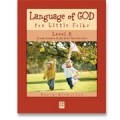
Nancy Nicholson combines traditional language instruction with Catholic doctrine and culture in Levels A through D plus Level G of the Language of God series. Christine Schintgen is the author of Level E and Sandra Garant is the author of Level F.
All of these books are self-contained worktexts. Answer keys are in the back of each book. Instruction information is presented within each lesson, which means there's really no lesson preparation.
In Levels A through D, the four books repeat many of the same concepts, adding and expanding upon skills with at each level. Among topics covered in the first book are capitals, types of sentences, singular and plural words, rhyming words, subjects, verbs, adjectives, pronouns, alphabetical order, synonyms, irregular verbs, and sentence combining. Level A might be used for an advanced first grader or average second grader.
Level B advances in difficulty, adding such topics as predicates, roots, abbreviations, letter writing, table of contents, and using the dictionary. It might be used for an advanced second grader or average third grader.
Level C, for advanced third graders or average fourth graders, deals more with verb tenses, compound subjects and predicates, adverbs, comma usage, contractions, and irregular verbs. It also introduces paragraph writing. Level C has some sample answers written in cursive, so keep this in mind when selecting the appropriate level.
Level D, for advanced fourth graders and average fifth graders introduces diagramming and continues work on parts of speech (including prepositions and conjunctions), syntax, sentence structure, punctuation, usage, and paragraphs construction.
Practice exercises at the first four levels include matching, circling, filling in blanks, underlining, and writing sentences, with minimal amounts of paragraph and letter writing. Students do a fairly minimal amount of work: 2-3 pages per week in Level A, and 3-4 pages per week in Levels B and C. The single introductory page stresses the importance of students writing to apply their English skills in formats such as notes to grandparents, letters, and journals, although such activities are not incorporated into lessons themselves other than a few instances towards the end of each book.
Overall, the books are nicely done, and they offer an effective, low-key way to provide grammar instruction. Their low cost is also a big plus. However, I must point out a few potential problems, even though they are minor. In some instances where children are instructed to write a sentence, the pre-printed blank lines are not long enough. Try to spot such instances ahead of time, and instruct your child to use separate paper instead of allowing them to become frustrated when they run out of room. Also, the treatment of capitalization is debatable. For example, "angel" is always capitalized (e.g., p. 10, Level A) and I think they take capitalizing words in relation to God too far— on p. 4 of Level A, they capitalize "name" in the sentence, "In the name of the Father, and of the Son...." Since capitalization is often debatable, make your own judgment about how far to apply it. One other possible confusion is instruction on titles of respect. "Mrs." is taught as the abbreviation for the word we pronounce "Missus." However, the other words in the column with "Missus" are all the proper spellings of the corresponding abbreviations (e.g., Mr.-mister, Fr.-father, Dr.-doctor). Since "Mrs." is short for "mistress" rather than "missus," even though we don't pronounce it that way, it might be confusing. (See p. 5 in Level A or p. 110 in Level C for examples.)
The second editions of these books have beautiful, full-color covers and sturdy plastic spiral bindings that make them much more attractive than the first editions.
The newest levels in series—Levels E, F and G—are each divided into four sections covering parts of speech, usage, mechanics, and composition. These levels shift attention toward writing skills and literature (with exercises sometimes using excerpts from literary works).