


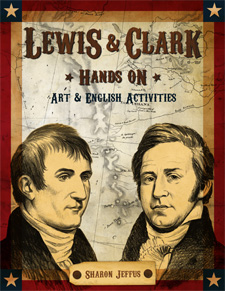
Those studying Lewis and Clark with students grades 3 through 8, whether through a traditional textbook or other avenue, should check out Lewis & Clark Hands On as a supplement. It reinforces the historical information while adding map work, art, and composition activities. Since it is written by artist Sharon Jeffus, it's not surprising that the art activities dominate—to the extent that this could be your complete art course for the year.
It includes some instruction in basic drawing skills, but lessons are not all organized in a progressive fashion. Students first draw a plant they have seen, then learn about shading, working with grids, drawing spheres, creating a still life drawing, drawing a snake, creating a "paper plate snake," and drawing faces in that order. They continue with drawing trees and landscapes, then move on to one-point and two-point perspective. Next, students draw an Indian, mimic Indian art, and draw animals and birds the explorers encountered (buffalo, dog, horse, bear, wolf, deer, beaver, squirrel, rabbit, lynx, turkey, and eagle). Toward the end, students design a symbol, make a sketch of the painting "Exhuming the Mastodon" then tackle an original composition of their own. Lessons all tie in some way to the Lewis and Clark expedition. Even the lesson on drawing dinosaurs is inspired by Lewis and Clark's discovery of the remains of a Plesiosaur. Map work also gets some attention as children make 3-D maps, create an "aged" map, and track the expedition on yet another map.
Composition work includes assignments like writing character sketches of Lewis and Clark, describing animals, describing a plant, writing "about how Lewis and Clark could promote peace" with the native tribes, writing a descriptive paragraph about a sketch, writing a poem, and writing about beaver sightings. Students are urged to create a journal as they work through the lessons. Ideally, drawing and writing activities are both done in the journal. Most work is done with a pencil but some color work might be done with crayons, markers, or colored pencils.
Note that this book fits particularly with the Trail Guide to Learning: Paths of Exploration course that has a unit on Lewis and Clark.