

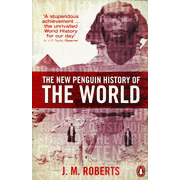
Pandia Press's selection of The New History of the World as one of their core books for History Odyssey prompted me to review it. The New Penguin History is the latest revision of this book by British historian J. M. Roberts. The original book was published in 1976, but Roberts has substantially rewritten it over the years and through a number of editions.
Written for an adult audience (although accessible for high schoolers), the book assumes a basic knowledge of historical events. Roberts explains his approach in his preface: "Perhaps my dominant concern, from the start, was to show and recall to a non-specialist readership the weight of the historical past and the importance, even today, of historical inertia in a world we are often encouraged to think we can control and manage." He goes on to explain that historical forces from distant times continue to shape present events. However, he also recognizes the ability of mankind to create change and innovation. Roberts sees the tension between the two phenomena of inertia and innovation continually at work in "all historical developments." Consequently, Roberts' history searches out the formative events of history rather than the more common approach of reporting events.
Roberts further explains, "I sought from the start to recognize, where they could be discerned, the elements of general influences which had the widest and deepest impact and not just to collect again accounts of traditionally important themes. I wished to avoid detail and to set out instead the major historical processes which affected the largest numbers of human beings.... I did not seek to write continuous histories of all major countries or all fields of human activity and believe the place for exhaustive accounts of facts about the past is an encyclopedia" (p. xiii).
So, while this book checks in at more than 1200 pages, it is far more readable than one might expect. Cause-and-effect and relations between events turn history into a significant story that helps students better understand the world. Still, the vocabulary and reading level really is that of adults, so I would recommend using this book only with teens who have well-developed reading skills and vocabulary.
Roberts, who died in 2003, was a professor at Oxford University as well as visiting professor at Princeton and Yale. His viewpoint is primarily European, but he also has an understanding of U. S. History even though it receives less attention in this history than it does in most world histories written by Americans. Despite the European perspective, The New Penguin History is truly a global history, particularly in its coverage of modern history with the inclusion of Islam and the Arab world, China, the European Union, global warming, and other topics.
Roberts has what most would consider a fairly objective and even-handed approach to history, although many Christians might find it lacking in coverage of religious events compared to other texts popular in the homeschool world. He covers some key religious people and events, but from political, cultural, and economic perspectives rather than spiritual. From Roberts' comments in chapter 7 of Book 3*, one might conclude that he believes all religions to be nothing more than mythology. Probably the most problematic area for many Christians will be the first three chapters of the book (the whole of Book 1*) that deal with prehistory. Roberts deals with this time period with an expansive, evolutionary approach.
The New History is written in a "reader's format" rather than as a text. It does not have questions, tests, or other classroom accouterments. That makes it most useful either within a designed program such as History Odyssey or for a situation where students might write chapter summaries, essays, or other evidence showing they grasp the content.
* The New History is divided into eight "Books" with chapters renumbered within each book.
[This review was originally written of the 2003 edition titled The New History of the World. All comments might not apply to the 2007 edition.]