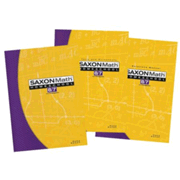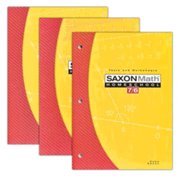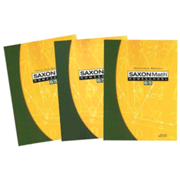
The Saxon Math series as a whole is hugely popular among homeschoolers. It is important to be aware that the Math Intermediate series (for grades three through five) and the series reviewed here (Math 5/4 and up) are very different from the Saxon program for K-3. (Note that I will use the term Saxon Math in this review to refer only to the Math Intermediate series and the series of courses from Math 5/4 through Calculus.)
Features
One reason Saxon courses are used by so many homeschoolers is that they allow students to do much or all of their work independently. The Saxon courses Math 5/4 through Math 8/7, Geometry, and the fourth editions of Algebra 1 and 2 all start each lesson with Warm Up activities. In the courses up through Math 8/7, these generally include math-fact practice, mental math problems, and a word problem. A parent or teacher should present the mental math problems orally and listen for correct responses. The Algebra 1/2 textbook does not have Warm Up activities. Warm Up activities in the high school courses can be completed independently by students.
There are no teacher editions for the Saxon program since each lesson in the student text provides the explanation of the concept to be learned. Each lesson includes an introduction and explanation of the new concept, examples and practice problems, then a set of problems that not only reinforces the new lesson content but also reviews previously learned concepts. Parents might help students work through the beginning of the lesson, but most students will be able to work through lessons independently. Parents need to check daily assignments and tests, ensuring that students are understanding what they are learning. The program requires virtually no preparation time.
A significant feature of the Saxon series that sets it apart from many other math programs is the incremental, spiral method in which concepts are taught. Once a concept is introduced it is incorporated periodically into the mixed practice that students encounter every day. In later lessons, the concept is developed more fully. Over time and through repeated exposure to a developing concept, students gain understanding and mastery. Unlike most traditional math texts where one content strand is taught and fully explained over a few consecutive lessons (and not returned to unless the content is built on elsewhere), Saxon Math has students work with a concept many times over the course of study. They revisit concepts in what is called a spiral method for frequent review throughout each course.
In addition, practice problems review concepts taught in previous lessons, and the styles of the problems vary constantly. For some students, this works to strengthen their thinking ability and keeps things interesting while it’s just confusing for others. Be aware that some students might prefer arrays of similar problems that practice fewer topics, and they might not do as well with either Saxon Math's teaching approach or the mixture of practice problems.
Saxon Math leans more toward rules in its presentation (i.e., memorizing rules and math facts) rather than a hands-on, conceptual orientation like Math-U-See or RightStart Mathematics. Even though the program is not strong on explaining concepts, thinking skills get a good workout. This means that the program works best for students who do not need manipulatives and who tend to figure out mathematical concepts without a great deal of explanation. It is also good for those who like brain teasers like those troublesome time/rate/distance problems.
The newest editions of the texts correlate highly with the Common Core math standards, having incorporated more about topics like statistics and probability, additional word problems to develop mathematical thinking skills, and topical investigations. For many years, Saxon has resisted the use of calculators at levels below Algebra 2 (third edition). But they now include calculator instruction in the fourth edition of Algebra 1.
A helpful addition in the newest Saxon textbooks is reference numbers in the mixed problems sets. If a student misses a problem, the reference number next to the problem provides the number(s) of the lesson(s) where the concept was taught. While new editions have added one color to the black-and-white presentation, Saxon Math books still lack visual pizzazz.
For extra help:
A number of publishers have produced video instruction and other support resources that make it even easier for students to use Saxon Math courses. Among them are Nicole the Math Lady, Houghton Mifflin Harcourt’s Saxon Math Teacher, DIVE Interactive Education, MyMathAssistant.com, and Teaching Tape Technology.
Summary
Overall, the Saxon Math courses are easy to use and allow students to do much of their work independently. They work well in many homeschooling situations. The continual review provided with the program’s spiral approach helps students retain knowledge, but students who need to stay focused on one concept at a time might not do as well with this incremental approach and the mixed practice problems.
Course Details
Math 5/4 Third Edition
This course should be appropriate for most fourth graders and those fifth graders who lag slightly behind grade level. Among topics covered in Math 5/4 are addition (review), subtraction, multiplication (up to multiplying a three-digit number by a two-digit number), division (dividing by two-digit numbers), time, measurement, money, area, perimeter, fractions, mixed numbers, arithmetic algorithms, geometry, negative numbers, powers and roots, two-step word problems, decimals, averaging, estimation, patterns, sequences, statistics, probability, and Roman numerals. Saxon also sells Basic Fact Cards, an optional set of flashcards for working on addition, subtraction, multiplication, and division that might be useful at this level.
Math 6/5 Third Edition
This course continues developing arithmetic skills through multiplication and division of fractions and decimals while reviewing and expanding concepts of place value, addition and subtraction, geometry, measurement, and probability. Powers and roots, prime and composite numbers, ratios, and order of operations are also taught. Extra math drills for each lesson are at the back of the book. A few students might have difficulty with this text because it requires them to work in more abstract ways than they might be ready for.
Math 7/6 Fourth Edition
Math 7/6 is especially good at providing cumulative review and expansion upon topics covered in earlier grades. Among topics covered at this level are fractions, mixed numbers, decimals, percents, rounding, estimating, exponents, working with signed numbers, square roots, beginning algebraic expressions, volume, angles, circles, prime factorization, ratios, proportions, statistics, and probability. Especially notable are word problems that cause children to think of math concepts in a number of different ways to ensure understanding. These features make this a great choice for many students at this level.
Math 8/7 Third Edition
Math 8/7 reviews material introduced in the prior courses, especially Math 7/6, and it also provides pre-algebra instruction. It covers word problems, scientific notation, statistics, probability, ratios, proportions, simplifying and balancing equations, factoring algebraic expressions, slope-intercept form, graphing linear inequalities, arcs, sectors, and the Pythagorean theorem.
Algebra ½ Third Edition
This pre-algebra course can be used after completing Math 8/7. Plenty of review, a spiral learning process, thought-provoking word problems, and clear instruction that works for independent study make Algebra 1/2 one of my favorite options available for this level, even if it is no longer needed. As is typical of the upper-grade Saxon books, the level of difficulty rises sharply toward the end of the course. If your student starts to have more difficulty in the latter part of the course, consider doing only half a lesson each day.
Among topics covered are fraction, decimal, and mixed number operations; scientific notation; exponents; radicals; algebraic expressions; solving equations with one variable; order of operations; ratios; geometry fundamentals; and graphing. Saxon Math has resisted the inclusion of calculator instruction even though most other texts for the pre-algebra level include it. While students can use calculators to solve problems when it is appropriate, they are not instructed to do so.
Saxon Math High School Options
It is important to consider the design of the entire Saxon lineup of high school math courses before starting into Algebra 1. Fortunately, Saxon now has two options with two parallel series of textbooks.
Originally, Saxon Math took an unusual approach by integrating algebra, geometry, and trigonometry into three textbooks titled Algebra 1, Algebra 2, and Advanced Mathematics. (In contrast, most high schools teach one course in algebra, then geometry, then return to algebra with some trigonometry included.) Saxon has continued to offer the integrated approach with the third editions of their Algebra 1 and Algebra 2 textbooks, as well as the second edition of Advanced Mathematics—these integrated texts are now referred to as the Classic Editions. But their fourth editions of Algebra 1 and 2 along with their relatively new Geometry textbook follow the more typical sequence. I will discuss the third editions first. The Geometry course requires more explanation, so I review it separately.
Algebra 1 and 2, Third "Classic" Editions
In Saxon Algebra 1, third edition, coverage is comparable to that in other first-year algebra courses. However, Saxon Math teaches the use of a graphing calculator sparingly compared to many other courses. The spiral method of presentation and constant review help students work fairly independently, a major advantage for parents who lack time and expertise.
Algebra 2, third edition, covers standard second-year algebra topics, although its inclusion of a significant amount of trigonometry is not a standard feature of all second-year courses. Students will need a scientific calculator for this course. You might want to invest in a graphing calculator while you are at it so it will be useful for future math courses.
Homeschool kits for both courses include the student text, an answer key (with only final answers), and a test book. A separate Solutions Manual with complete solutions and answers is available for each course. While the answer key might suffice, I recommend having the Solutions Manual in case students or parents cannot figure out how to arrive at a particular answer.
Saxon Algebra courses seem to work fine for students who grasp math fairly easily but not so well for those who struggle with the abstract thinking required. Overall, Algebra 1 is fairly easy for students to work through on their own. Interestingly, I have yet to find a text that does a better job with time/rate/distance problems than does this one, even though I know that students still struggle with them in Saxon Algebra 1.
If students have used Math 7/6 and Math 8/7, they might be ready for Algebra 1 in eighth grade. Although many eighth graders will have no problem with this book, there are many who will not be ready to begin algebra for another year or two. If you feel that your child is not ready for Algebra 1 at eighth-grade level, consider using Saxon’s Algebra 1/2 first. Or you might have your teen begin Algebra 1 in eighth grade, but move at a slower pace, taking one and a half to two years to complete it.
In the classic editions, Saxon Math does an excellent job with algebra, but the geometry is weak in my opinion. Geometry is scattered throughout Algebra 1 and 2, and it is presented very briefly in both courses. By the time students have completed both courses, they will have studied about one semester’s worth of geometry. They complete their geometry requirement with the Advanced Mathematics course. The explanation of geometry topics is fairly brief in Algebra 1 and 2 and does not begin to compare with the quality of presentation in such texts as Discovering Geometry.
A student planning to take only one year each of algebra and geometry (not recommended for college-bound students!) could use Saxon’s Algebra 1 third edition, possibly skipping over geometry instruction and problems, and then use Saxon's (or another publisher's) geometry text instead.
Students who complete both Algebra 1 and 2, but who do not intend to continue through Advanced Mathematics, will not have covered geometry sufficiently since Advanced Mathematics contains much of the geometry material. They would need to use another resource to complete geometry requirements. So this might be another instance where students might skip geometry activities within Saxon Algebra 1 and 2 if another geometry course will be used.
However, if a student is going to go through Advanced Mathematics, tackling a separate geometry course is likely to be redundant and overwhelming, so it would be better to stick with only the Saxon Math texts in that situation.
Algebra 1 and 2, Fourth Editions
The fourth editions of the Algebra 1 and 2 textbooks reflect a total rewrite rather than just modifications of the third editions. Both appearance and content are improved. The texts have added a little color with more graphic design. Each lesson begins with a Warm Up that includes one vocabulary question and five review problems. Investigations (mini lessons on specialized topics with their own problems to solve) follow every ten lessons. One of the most significant content changes is the early introduction and frequent use of a graphing calculator with graphing calculator labs. Also, probability and statistics receive far more attention in keeping with current math standards.
One feature lost in the transition over the last few editions is the tongue-in-cheek humor of some of the word problems. John Saxon, the original author, often incorporated historically anachronistic references or offbeat content such as “In a picaresque novel about the Spanish Main, the ratio of rascals to good guys was 13 to 5” (Algebra 1, second edition, p. 149). The fourth editions have plenty of word problems and real-life applications, but the humor has disappeared.
Other elements of Saxon’s methodology remain. Lessons are taught in increments followed by examples and a few practice problems. After that, students work on “Distributed and Integrated” practice problem sets with 30 problems per lesson.
The homeschool kits include the student text, a solutions manual with complete solutions for the Warm Ups and all practice problems, and a Homeschool Testing Book. The testing book has 23 cumulative tests plus reproducible test answer sheets. It also has the answers for all of the tests. In addition, a Test Analysis Form helps you identify lessons where concepts were originally taught so that students can review if needed for problems they missed. Note that the third editions have answers to odd-numbered problems in the back of each student text, but there are no answers in the fourth edition textbooks. All answers and solutions are in the solutions manuals.
The fourth edition of Algebra 1 introduces trigonometry and more extensive work with quadratic equations and functions than does the third edition. In keeping with the slightly advanced content of Algebra 1, the fourth edition of Algebra 2 does much less review in the early chapters than in the third edition. (A Skills Bank at the back of the book provides some review if needed.) Instead of a thorough review, this text jumps quickly into functions, matrices, and determinants. More attention is given to functions, while matrices and determinants are not even taught in the third edition. Geometry is reviewed through practice problems and incorporated into lessons that apply algebra and trigonometry. Students work with practical applications of concepts through word problems more than we find in many other second-year algebra courses. This text should be a great option for those who need a challenging course that will prepare them for advanced math.
The Saxon Math program has tended to be strong on skill development, but weaker on conceptual explanation and application. The inclusion of investigations in the fourth editions of Algebra 1, Algebra 2, and the new Geometry textbook (as well as in the newer texts for younger levels) reflects the publisher’s awareness of this problem. This particular feature, along with other improvements, makes the fourth editions my recommended option rather than third editions.
Advanced Mathematics, Second Edition
Advanced Mathematics should follow both the third and fourth edition courses for Algebra 2. This course is one of the easiest for most homeschoolers to work with to cover advanced algebra, geometry, and trigonometry. Originally envisioned as a one-year course, Saxon now recommends that students take at least a year and a half to complete the course unless they are very bright. However, because fourth editions of Algebra 1 and 2, as well as the Saxon Geometry course, are more advanced than the classic series, students are likely to find more material to be at a review level and might be able to get through the text in just one year.
Advanced Mathematics includes the equivalent of the second half of geometry, plus advanced algebra, precalculus, and trigonometry. In the revised second edition, much of the geometry was moved to the front of the book rather than being spread out. This should make it easier for students who need to get through the geometry lessons in preparation for PSAT tests in their junior year. In addition, geometric proofs are taught early in the course and are then used throughout the first half of the book.
Students will need a graphing calculator to use with this text, although the calculator is not used as much as in other texts for this level. Of course, parents can decide to allow students to use a calculator more than is required.
Among other topics covered are logarithms, conic sections, functions, matrices, and statistics. This text moves even further into the theoretical math realm than do earlier Saxon texts. By the time students complete Saxon’s Advanced Mathematics, they should be on a par with students who have completed a precalculus course. This course should be particularly good for preparing students to do well on college entrance exams.
Geometry
Click here for my review of the Geometry course.
Calculus
Click here for a review of the Calculus course on this website.