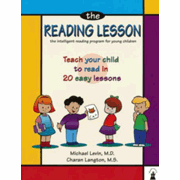


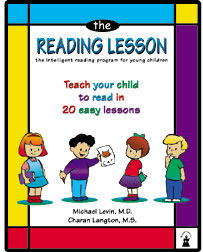
The Reading Lesson, a simplified phonetic reading program, is presented in one large, black-and-white book that can be purchased alone or with companion products. The Reading Lesson is available in print or as a PDF.
Phonetic concepts are presented in twenty lessons. Rules are kept to a bare minimum and many words are taught as sight words. For example, the sound for "ou" is taught as the sound in ouch, but the alternate sound as in would is not taught. Instead, would, could, and should are presented as sight words.
A unique marking system of underlining and other supplementary marks, such as hollow circles above vowels, is used to alert children to phonetic groupings, alternate vowel sounds, and the difference between "b" and "d." The system is fairly unobtrusive; it does not play a major role as do marking systems in programs such as The Writing Road to Reading.
Letters are taught in groups that allow children to begin reading words immediately; lesson one teaches the letters "c," "o," "s," "a," and "t," so children can begin reading words such as cat and sat. Children are not taught the alphabet in its entirety first, although it won't hurt if they already know it.
Words, sentences, and short stories are interspersed throughout the lessons for reading practice. The authors recommend that students first work through the downloaded presentation for each lesson, then the lesson as presented in the book. (If you do not have a computer, you can teach only from the book and provide adequate instruction.) In both cases, a parent needs to work alongside his or her child, providing explanations as needed, helping a child know what to do next, listening as they read, etc.
You will find numerous places where the book presents words representing a new concept, but no explanation is included. For example, contractions are presented in lesson 16 with a list of examples and no explanation. In such cases, parents should supply whatever explanation is necessary for their children to understand the concept.
Keep in mind that The Reading Lesson is a beginning reading program. While it does introduce compound words, the vocabulary is almost exclusively one- and two-syllable words. Some suffixes (i.e., ing, s, ed) are taught. The program does not try to cover everything (e.g., there's no instruction on syllabication rules), but it should do a good job of bringing children to the point where they can read first-grade readers. You can view some video demonstrations online.
Handwriting and Other Add-Ons
Capital letters are introduced beginning in lesson eleven in the book. However, writing the letters is not taught within this program. Mountcastle sells separate books for teaching handwriting, including Teach Me Writing: All Styles, a PDF with printable worksheets for ball-and-stick, slant-print, and cursive styles. You will need to work with this or other resources to teach letter formation. Also, be aware that the letter "a" in this book is printed only with the standard typeface form rather than the ball-and-stick form typical of many early reading programs. This is unlikely to pose a problem, but be aware just in case.
Giggle Bunny's Reading Lesson and Story Book download is purchased separately from The Reading Lesson. It features animations and sound, along with simple games to enhance the learning process. It is arranged in sections that correlate with the lessons. It's nicely done, but it isn't always obvious how to proceed. The publisher tells me that the interface was purposely designed very simply with only a forward and backward button and no menus to keep it simple for children to operate. I think most children who have worked with such programs are fairly proficient at figuring such things out, probably better than most adults. In any case, trial and error work quite well. Particularly helpful in the download are the animated demonstrations of blending that are accompanied by an audio track.
The Story Book features 40 animated stories that move from very simple to more complex as children learn new words in The Reading Lesson. Beginning stories are only a few pages in length and do not qualify as real stories. In the first few stories, all words are clickable for pronunciations. Children are to read these stories on their own after completing the correlating lessons in The Reading Lesson. The audio assistance helps them to read independently, but you must watch that students do not use the audio rather than work to sound out words they have forgotten. As stories progress, audio help is gradually removed for words that should be familiar to children. Stories can be printed from PDF files if you wish. As with other downloads in this series, it's not always obvious how to proceed. In this case, you need to click on the bottom right-hand corner, and a finger will appear for you to click to move to the next page.
The Reading Lesson works well with other products sold by Mountcastle, but the book alone will suffice.