
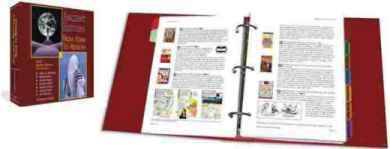
Heart of Wisdom's unit study is a multi-level, one-year program that works for students in grades 4-12. It covers Bible, history, and language arts (a good deal of literature and composition, but grammar only to a limited extent), as well as some science and art history. High schoolers can earn 1 credit each in history, Bible, and English; a ½ credit in science, and ¼ credit in art history. Of course, how many credits students actually earn will be determined by parents as they choose from among the many activity suggestions.
The study is divided into seven units: Adam to Abraham, Mesopotamia, Ancient Egypt, Ancient Israel, Ancient Greece, Ancient Rome, and The Messiah. (You can purchase the first unit on its own, either as a download or a printed book.) Downloadable files include very useful internet links, so you will probably want to keep the digital files handy even if you choose to print out your files or purchase the printed unit for Adam to Abraham.
This study differs from most others in that its primary focus is upon the Bible. According to the author, "Students spend about half the school day studying God's Word (directed studies) and half studying God's world (derived studies)." Academics are secondary to Bible study. For example, all history is presented in relation to biblical history; in studying ancient Egypt, the most attention is given to the Hebrews, Joseph, Moses, the Passover, and the Exodus, although there are also sections on pyramids and pharaohs. (The Narrated Bible is recommended for Bible reading because of its chronological presentation.) This historical approach is an unusual and important feature to note since it does not cover the same material taught in most history texts. Supplemental books (recommended titles are described in each unit) can supply additional historical information if you want your children to cover more "traditional" history.
Robin's wealth of research into Jewish roots of Christianity is evident throughout this program as she incorporates such information into the lessons. (Robin has also authored the book, A Family Guide to the Biblical Holidays.)
Beyond the "Bible first" approach, the methodology reflects a second goal of the program: to teach students a love for learning. Blending the educational philosophy of Charlotte Mason and Marilyn Howshall with the 4Mat System of learning results in what is called the "Heart of Wisdom" approach. One example in the introduction charts the four parts of a lesson: "Step 1: Motivate the student by making the lesson interesting on his/her level—not ‘dumbed down.' Step 2: Give the facts from living books, nature and humanities. Step 3: Do something with what you have learned. Copy work, dictation, adding to a nature notebook or timeline. Step 4: Narration. Tell back what you have learned; share with others."
A Bible and a writing handbook—The Narrated Bible and Writers Inc: A Student Handbook for Writing and Learning are recommended—are the only absolutely required resources, but some others are used so frequently that you will probably want to own them. Among these secondary resources are The Usborne Book of the Ancient World, The Holman Bible Atlas, Our Father Abraham, Adam and His Kin, First Civilizations, and Pharaohs and Kings: A Biblical Quest. Other non-fiction and fiction titles can be borrowed or purchased.
Each student will have a portfolio of his/her work, a timeline book that they create, and notebooks for vocabulary, spelling, and Hebrew and Greek study. The last might be part of another notebook since it will probably not be very extensive.
Science study covers creation science (young-earth perspective) and science history with limited applied science. Language arts includes many composition activities (including narration and dictation), vocabulary lists, work with roots, and the creation of individualized spelling lists. Grammar is corrected within student writing assignments by referring students to handbook rules. However, direct grammar instruction seems to be lacking and will probably need to be presented separately for younger students.
At 787-pages, the complete study is loaded with information. Nevertheless, the program requires a significant amount of preparation and presentation/interaction time. A reproducible Weekly Planner form is at the back of the book to help you organize activities and resources. The five-page Table of Contents provides a fairly good roadmap for locating information.
I applaud Robin's courage in creating a curriculum that challenges popular wisdom about what students should learn. She also offers plenty of suggestions—more than you can use in a single year—for resources and activities so you can tailor the study as you please and meet the needs of each of your children.