



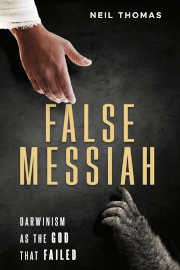
Neil Thomas’ False Messiah: Darwinism as the God That Failed explores the work of Charles Darwin from his lifetime up through its present-day influence. This is a wide-ranging book, but Thomas presents his findings in a story-like fashion that makes the book very readable.
Thomas shows that Darwin’s ideas about evolution track back to others expressing similar ideas shortly before him and even back to ancient Greeks, such as Epicurus and Lucretius. But he’s particularly interested in why Darwin’s ideas took root in the 1800s rather than 2000 years ago.
He explores the cultural milieu in which Darwin wrote, especially the growing trend toward secularization. He commented that if Darwin had published On the Origin of the Species even a decade or two earlier, it probably would have met with more resistance. However, secular trends in literature, the arts, the sciences, and other areas conspired to provide fertile ground for Darwin’s book.
This was also the beginning of the era of the eugenics movement, and the full title of Darwin’s book--On the Origin of Species by Means of Natural Selection, or the Preservation of Favoured Races in the Struggle for Life—reflected current beliefs about cultural superiority, a popular idea among colonizing nations, especially in England at the height of the British Empire. So, part of the success of the book was probably because it helped legitimize colonialism.
He introduces us to people within Darwin’s intellectual milieu and their varied reactions. This was an era highly influenced by Higher Criticism of the Bible and efforts to replace the miraculous with the scientific. However, many of Darwin’s readers discerned the anti-God implications of his theories and argued vociferously against him. Darwin published five emended editions of his book in only 13 years in efforts to address and appease his critics.
As secularism has increased since Darwin’s lifetime, Darwinian thought has increasingly provided a popular route to attempt to explain biology without the need for God. Confirmation bias paved the way for eager acceptance among many; as Thomas points out, “[T]hey welcomed the Origin as scientific vindication of a religious skepticism they had come to by a different route” (p. 123). Many modern evolutionists cling to the theory for similar anti-religious reasons, and some modern evolutionary biologists attempt to explain not only the evolution of life but stretch into the metaphysical realm to explain motivations and morality in evolutionary terms.
Beyond changes observable within species, Darwin’s ideas were entirely speculative, and the more hard-headed of his era challenged his lack of empirical evidence. Darwin hoped that supporting evidence would be discovered in the future, especially fossil evidence. Instead, fossil discoveries continue to undermine the idea of slow and gradual mutations because they usually show abrupt changes. And recent discoveries in microbiology make Darwin’s story of the accumulation of random mutations into gradually more complex biological components increasingly untenable as we learn about biology’s amazing complexity and interlocking systems.
Discussing the current state of thinking about Darwin’s ideas, Thomas says,
As G. B. Muller and S.A. Newman point out, population genetics, and thus evolutionary biology, has not identified a specifically causal explanation for the origin of true morphological novelty during the history of life. In other words, neo-Darwinism simply cannot account for nontrivial innovations (p. 67).
Even mainstream evolutionists are beginning to admit they have no scientifically defensible explanation for the beginning of life or the evolution of simple life forms into complex. More than one scientist has figured out that there’s not enough time and opportunity in all of history for the work of natural selection through random mutations to accomplish the creation of even a single typical protein.
Thomas advances arguments for intelligent design in this book, and one might assume he writes from a Christian worldview. However, in Chapter 6: Nature’s God, Thomas reveals that he is an unorthodox theist. In this chapter, he discusses 19th century poets, especially William Wordsworth, and their romanticized ideas of Nature’s God. He says,
Paradoxically, for many people Wordsworth's theology of nature formed a more effective counterforce to Darwin’s Ideas than biblical orthodoxy itself since that orthodoxy had been undermined by the biblical Higher Criticism. The Wordsworthian vision, in contrast, was invulnerable to the kind of attack suffered by orthodoxy since the poet did not have recourse to miraculous or mythological elements or claim them as empirical fact (p. 165).
This quote seems to reflect Thomas’s own belief in a god located within the natural world. The concluding sentence of his book reveals some of his spiritual journey:
There is surely considerable irony in the fact that Darwinism, when subjected to an unblinking rationalist critique, reveals itself to be so uncommon so completely unconvincing as to propel a (historical) secularist like myself in the direction of theistically oriented meditations on life's ultimate realities (p. 180).
An intriguing admission like this at the conclusion begs for further explanation. So, in an online addendum, “False Messiah: An Addendum on Darwin and Theism,” Thomas expands on his spiritual journey from agnosticism to a form of theism that he describes as close to that of Anthony Flew. In that article, he further observes that “the Darwinian grip on educated minds is beginning to lose much of its force” and “there is slowly arising a wedge between practitioners of conventional biological science and the intelligentsia in the wider sense.” Ultimately, Thomas claims that some significant scientists and thinkers are identifying problems with neo-Darwinian theory because of science, and some of them are finding intelligent design and theism more credible explanations for the existence of life.
The growing rejection of neo-Darwinian thought among leading thinkers and scientists has led many scientists to try to come up with alternate explanations that still maintain a secular foundation. Thomas describes “disputes among evolutionary biologists” as “spilling into the public square” when they convened a meeting of the Royal Society of London in 2016 to come up with an acceptable alternative to Neo Darwinism—an attempt that failed (p. 39).
The general public is largely unaware of the cracks within neo-Darwinism, and in False Messiah, Thomas pulls back the curtain like Dorothy’s dog Toto did when he revealed the Wizard of Oz as a feeble old man.