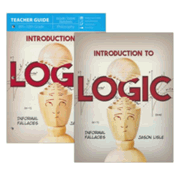

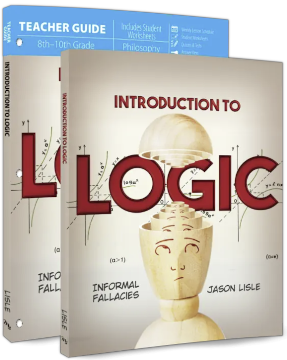
Introduction to Logic: Informal Fallacies, written for grades eight to ten, should take one school year to complete, spending 30 to 45 minutes per day.
The course teaches students to recognize informal fallacies, particularly within the context of a biblical Christian worldview. The course description says, “This logic course will both challenge and inspire high school students to be able to defend their faith against atheists and skeptics alike” (Teacher Guide, p. 5). While the course covers content we expect in an introductory logic course, such as inductive and deductive reasoning, propositions, arguments, syllogisms, and various logical fallacies, it also prepares students for apologetics. Chapter titles that reflect this intent are Chapter 1: Logic and the Christian Worldview, Chapter 2: All Knowledge is Ultimately from God, Chapter 6: The Biblical Basis for the Laws of Logic, Chapter 7: Logical Failure of the Unbiblical Worldview, Chapter 8: Is the Christian Faith Illogical?, and Chapter 9: Is Faith Contrary to Reason?
The course consists of a student book and the Teacher Guide. The student book serves as a reader and is printed in full color with plenty of graphics and illustrations. I love the way wooden artist mannequins are posed on pages throughout the book. Vocabulary words to be mastered are highlighted in the text and defined in Key Terms sidebars. Students are told to either create cards or use an online tool for studying the words. At the end of the book is a combination glossary/index, a two-page chart that divides informal fallacies into three categories, and a brief Quick Reference Guide to some of the most important concepts. All student writing is done on worksheets and practice sheets found in the Teacher Guide.
The Teacher Guide has two pages explaining how to use the course, and several pages showing daily schedules. The bulk of the book consists of student worksheets and answer keys. There are two worksheet pages for each of the student book’s 38 chapters. The first of the two worksheets has a chapter review summary at the top. Most questions require answers in the form of a phrase or sentence, although some require lengthier answers. Often students are asked to explain what type of fallacy a statement reflects and why, but there are also questions about some of the fundamentals of logic and questions related to apologetics, such as, “Why can the Muslim god Allah, as described in the Quran, not be the basis for laws of logic?" (p. 29).
Also in the Teacher Guide are five quizzes and a final exam, one or two pages long each. Before taking the final, students are to complete 10 practice sheets, also included in the Teacher Guide with their answer keys. These are scheduled to be used over a span of seven days.
The course’s author, Jason Lisle, presumes a Christian audience that accepts the validity of the Bible. He frequently uses scripture to illustrate and prove points. The following excerpt from a paragraph on page 21 of the student book is a good example:
Perhaps a Christian is doubting his own salvation. But then he reads in the Scriptures that if someone believes that Christ rose from the dead and professes Him as Lord, then that person will be saved (Romans 10:9). That’s a premise—and an established fact from the Bible. The person then reasons, “And I believe that Christ rose from the dead and I profess Him as Lord.” That’s a second premise; this person knows this to be a fact from experience. “Therefore, I am saved.” That’s the conclusion.
Throughout the course, Lisle also presumes agreement with creationism and rejection of evolution, and he draws upon many example arguments from the creation-evolution debate.
While the course is suggested for grades eight to ten, I see no reason not to recommend it for older students who have never studied logic.
Note that Master Books Academy offers this course online, taught by the author.
Summary
Introduction to Logic: Informal Fallacies does a fine job of teaching beginning logic, but it will appeal most to those who want to defend the Christian faith. Even more particularly, it should interest students who believe in creation rather than evolution, since it uses many origins-debate arguments to teach concepts.