

Journeying through the Classics is a complete literature program for four years of high school, and it can also be used with advanced students in grades seven and eight. Amazingly, it’s free.
The program might have sufficient coverage of language arts for high school students. The program’s Essay Writing Guide (included) provides students with guidelines, basic instruction, and checklists for writing essays, literary analysis, research papers, and creative writing (the types of assignments included in the course), but some students might need additional instruction in composition skills and/or grammar. Optional art lessons are integrated throughout the program.
How It Works
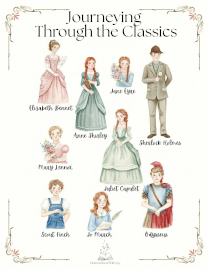
The program has files (accessed through Google Drive) for the teacher that are used for all units: a Curriculum Overview, Teacher’s Guides, Book List, Essay Writing Guide, Scope and Sequence, Student Progress Checklist Templates, Notes Pages, a Character Guide (artwork and bios for literary heroes), and an Art Study Guide.
The program is taught through 34 individual unit studies of classic books and essays, most of which should take four to six weeks. The literature draws from many genres as well as from British, American, and world literature. For example, among the literary works studied are The Odyssey, The Iliad, Romeo and Juliet, Anne of Green Gables, The Blue Fairy Book, Pride and Prejudice, Great Expectations, Sherlock Holmes, The Count of Monte Cristo, The Great Gatsby, To Kill a Mockingbird, The Screwtape Letters, and The Fellowship of the Ring. The selected literary works are likely to appeal to many homeschoolers, especially to classical educators and those following Charlotte Mason’s methods. However, it doesn’t use Socratic discussion and is more structured than Charlotte Mason purists might wish.
While most of the unit studies have few or no mentions of Christianity, many raise questions about virtues and character. A few, such as the studies of The Screwtape Letters and Surprised by Joy, address ideas about God, faith, and Christianity.
Homeschoolers can access the entire program (more than 700 pages) but can print out the units individually as needed. Lovely, artistic dividers for each part of the course with watercolor images are provided in their own file, and similar illustrations are included elsewhere in the program.
The program’s Book List file arranges the units in chronological order and by genre, but the separate Scope and Sequence file includes a Suggested 4-Year Plan that provides students with a mix of genres from different time periods each year. (Note that the Book List is also included with the Teacher’s Guides file.)
Grammar and editing skills are taught throughout the program, but they build cumulatively if you use the units in the recommended sequence of the Suggested 4-Year Plan. Nevertheless, units can be used out of order.
Students should usually complete eight or nine units per year. Four of the studies are for essays (essays are included with the course), and those units take only one or two weeks.
Two versions of a Student Progress Checklist Template are included. The first breaks down unit assignments over four weeks with one page per week of tasks and checkboxes. The second version has three pages with fewer details, but spreads tasks over five weeks.
What's in the Individual Units?
A file for the study of each book includes several elements: the author’s biography, historical and cultural context for the literary work, unit length, genre, grammar and editing focus, links to the literary work online when available and to Amazon for purchase, a weekly reading schedule, vocabulary words and definitions (for each week), spelling practice worksheets, reading comprehension questions, discussion questions, links to art lessons, instruction and exercises on grammar and editing, an essay assignment, a unit test, a student progress checklist, and an answer key. I’ll expand on the elements that need further explanation.
Weekly reading schedules break reading into manageable chunks.
Vocabulary words include helpful pronunciation keys. Some vocabulary words are included as spelling words, but not all, and other commonly misspelled words are added to the spelling words. Spelling words have two blank lines under each word. Students are to write each word three times, then use it in an original sentence to demonstrate their understanding of its meaning.
Reading comprehension questions go beyond simple who, what, and when questions. For example, a question for A Wrinkle in Time asks, “3. Explain what a tesseract is, using the explanation given in the novel. What analogy does Mrs. Who use to describe how it works?” (p. 10).
Discussion questions are outstanding and can be used for written responses or oral discussion. There are generally 10 discussion questions for the entire study. Written responses should be 3 to 5 sentences long, and the suggested answers in the answer keys should help parents evaluate responses. These questions are great for oral discussion, but that requires a parent or teacher be familiar with the work. For example, this question for The Once and Future King delves into character traits at a deep and universal level, using King Arthur as the jumping off point: “4. Discuss the character of Arthur. Is he a successful king? Is he a good man? Are these the same question? What does his failure suggest about the limits of good intentions?” (p. 12).
Art Integration lessons explain the connection between the reading and art projects. Art projects are provided via weblinks through You Are An Artist Clubhouse, which requires a paid membership. These lessons use chalk pastels and watercolors.
Grammar and editing sections take a narrow focus for each study, relating in some way to the genre of the literary work. For the study of the Essay “On Reading” by Henry David Thoreau, the grammar and editing focus is “Sophisticated Essay Construction and Varied Sentence Structure.” Students look at three types of sentences used in sophisticated essays, practice identifying them, then practice writing and revising a 5- to 7-sentence paragraph in Thoreau’s style. For A Wrinkle in Time, the focus is on science fiction terminology and speculative language. One of the five points within this focus is about using invented language sparingly so as not to confuse readers. Practice exercises follow, such as writing about an invented scientific concept, using at least one real-science term and one analogy to explain it.
Essay assignments also tie to the genre of the literary work. For instance, in response to Thoreau’s essay “On Reading,” students write a personal reflective essay. Students can choose from the provided prompts, and they are given specific requirements for length and elements to include. Essays might be three or four pages long for shorter units and four or five pages for the month-long units.
Parents, Teachers, Co-ops
Everything a parent or teacher might need is included, along with extras you didn’t realize you would appreciate, such as the beautiful unit divider pages.
Flexibility is another big plus for Journeying Through the Classics. Homeschoolers can use as many elements of the program as they wish. They can select which books to study and which elements of each study to have students complete. Parents can also decide how much time they want to invest themselves. A student can work through a unit independently, submitting written work that a parent or teacher can check using the answer keys. However, students will probably benefit greatly from discussion if that’s possible. That leaves it up to parents to determine how much time they need to spend—a lot if they want to read the books and discuss them or minimal if students work independently. The studies should also be great for co-op groups.
Summary
Journeying Through the Classics would be phenomenal if it were a program for purchase, but it’s free! This program really scores high in every area: great content, ease of use, academic excellence, flexibility, and affordability.