

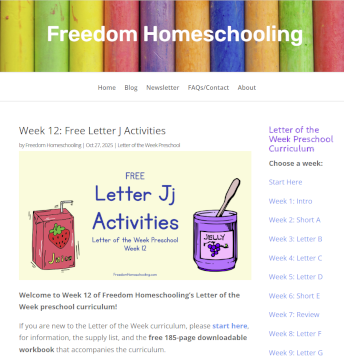
Letter of the Week Preschool Curriculum is a free pre-kindergarten program with lesson plans for the use of read-aloud books, videos, and a downloadable 185-page workbook. Daily lesson plans are online, and the read-alouds are either ebooks or YouTube® videos, although you can read physical books if you prefer them to ebooks or videos.
Children will learn:
- to identify and write both upper and lowercase letters
- the sounds of each letter (both long and short vowel sounds)
- to identify and write numbers through 20
- to count to 20
- to identify colors and shapes
- to recognize patterns
In addition, they will develop an appreciation and interest in reading by listening to classic children’s literature and poetry, learn rhymes and songs, learn about science and social studies topics, complete arts and crafts projects, and develop fine motor skills.
Supplies used frequently are pencils, crayons, dot markers, and small stickers. In addition, you will need other art and craft supplies, plus snack and recipe food items.
Lesson Plans
A parent follows the online lesson plans for each day. Most weeks concentrate on one letter of the alphabet and one number, and long vowels are introduced during the last three weeks. Six review weeks are included, and optional review is suggested if time permits each week. Lesson plans for some days might take no more than a half-hour, although coloring, crafts, and recipes will extend lesson time.
Additional activities listed at the end of each week’s lesson plans can be used as time permits. These include snack ideas, recipes, STEM activities, science experiments, arts and crafts, sensory learning, field trip ideas, and more. Links are included to other websites for instructions and recipes when needed.
One song is taught each week via a video, although parents might already be familiar with songs like “Head, Shoulders, Knees, and Toes” and “Twinkle, Twinkle, Little Star.” The song is repeated all five days. Other videos, such as the “Alphabet Song,” might also be repeated several days of the week. Instruction is provided via links to free websites like Starfall, where students watch short animations that teach a letter and its sound with a keyword and image, and Turn & Learn ABCs, with lengthier, animated lessons. Videos are also used frequently to teach counting through simple songs, such as “Here is the Beehive: Count to Five.”
Links to online books in the public domain, such as The Story of the Three Bears with both black-and-white and color drawings by L. Leslie Brooke, or video readings of newer books, such as The Berenstains’ B Book and Brown Bear, Brown Bear, What Do You See? The public domain books usually need to be read aloud by parents.
Science and social studies activities are sparse and are sometimes included among the additional activities. A few examples are Dissolving Jelly Bean Science Experiment and Jumping Experiment (both for the letter J).
There are five worksheets per week—two for letters, two for numbers, and one for shapes, colors, or another topic. The second worksheet on the letter or number for the week might be skipped since they are very similar in format to the first ones. Worksheets require coloring, tracing, writing, drawing, matching, completing patterns, and counting. (Counting is often done in ten frames on the pages.) In the latter part of the course, children write their names, fill in missing numbers in sequences, and identify vowels among letters of the alphabet.
Here’s an example of one day’s lesson for the first day of Week 5: Letter D. Students watch and sing along with the “ABC Song Speeding Up,” learn about D on Starfall, learn to write both lower and uppercase D, complete the letter D worksheet, and watch and sing “Hey Diddle Diddle.” It also suggests choosing one idea from the additional activities. Most days also include a link to a storybook.
I encountered a few non-functional links, but a quick internet search brought up plenty of other options for those topics. Author, Sarah May, tells me she has a schedule to check and update links for upcoming weeks about two months before a family would reach that week if they began the curriculum in August or September.
The curriculum is secular, although a few of the read-alouds and videos mention religious holidays and ideas. Those who want to include a Christian component can add ideas from Sarah May’s free Bible Curriculum page.
Overall, the course is super easy to use, and it does much of the work for busy parents. There’s flexibility when it comes to the activities that require more resources and planning, so you can use them as time permits.
Summary
Letter of the Week Preschool Curriculum is another surprisingly good resource for homeschooling that is available for free!