

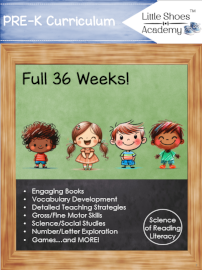
Little Shoes Academy™ provides complete programs for PreK and kindergarten via PDF files. Weekly online group sessions with the curriculum’s authors also allow parents to ask questions as they arise.
The lessons intersperse instructional pages with student activity sheets. Most student pages need to be printed out—many in color, and some need to be cut apart. You shouldn’t need to print the instructional pages. Photos and other illustrations throughout the curriculum are colorful and fun.
Many lessons use manipulatives, a whiteboard, or other resources, so plan ahead to make sure you have everything on hand.
Free scope and sequence files are available for both PreK and K.
PreK
PreK includes the following files: a one-page file of instructions, pre- and post-tests, a set of beginning readers, and 36 themed files with each week’s curriculum. Examples of the wide-ranging weekly themes are All About Me, Camping, Dinosaurs, Pond, Emotions, Spring, In the Kitchen, and Oceans. The themed week’s lessons should be used in order since they develop beginning math and reading skills sequentially.
Within the themed weekly lessons, the essential components are those for the morning meeting, math, and language arts. Optional activities for science, social studies, art, and motor skills can be used as desired. In addition, there’s an optional, free Bible curriculum supplement.
I’ll use the themed lesson on Camping to explain lesson components. This one-week lesson has 68 pages, brimming with activities, printable pages, flashcards, and images. There’s more than you can accomplish in one week!
“Thoughts on Teaching…” introduces each week’s lesson, explaining (and repeating each week) that the approach is somewhere between a rigidly scheduled program and unschooling. It has structure with many options.
Next, “Setting the Scene” lists several optional ideas that help introduce the theme through the environment and activities. These are a few of the 13 suggestions for the Camping lesson:
- Set up a small tent for the week or drape a blanket over furniture to create a “tent.”
- Have a flashlight near the books so your child can “read in the dark.”
- Attach cotton to the end of sticks for “marshmallows.”
- Add a blue blanket that has been shaped to be a pond or a river.
A few pages with visual aids are included such as a sign that says, “Please do not feed the bears.”
With the scene set, you can start the morning meeting. At the beginning of the instructions for the morning meeting is a box that identifies the letter, number, color, and shape to be focused on that week. In this case, these are both capital and lowercase I, the number 4, the color orange, and the rectangle.
You’ll start with a “Hello” song (found on YouTube). Letter recognition is taught with flashcards, which you will most likely access by clicking on the links to go to the “slides” within this same file. Instructions tell us to teach the letter’s name, sound, and the name of the image used to illustrate it. Children skywrite both uppercase and lowercase forms. Then both parent and child think of other words that have the /I/ sound.
Math is next, and this week teaches the number 4. Again, you will use linked pages with flashcards with numbers and sets of four images, pictures, cut-out pages, and manipulatives. The letter and number lessons are repeated each day for the week.
Several hands-on activity suggestions are given for learning shapes and colors. You choose a few to use each week. Flashcards are provided to use along with both shapes and colors. A poem about the color orange is included, but this isn’t a regular feature for teaching colors.
The next part of the lesson, titled “Songs, Poems, and Fingerplays,” suggests singing the campfire songs “Michael Finnegan” and “Kookaburra,” but you are welcome to use others.
The Language section begins with a list of recommended picture books related to the camping theme. The lesson includes very important short articles, “Tips for Reading to Preschoolers” and “Guided Reading Suggestions.” Supportive language activities focus on the letter I, such as “Build an igloo out of marshmallows or sugar cubes.”
Shifting back to the camping theme, children learn about nursery rhymes using the poem/song “Walking in the Woods.” The lesson suggests different ways to use the poem each day.
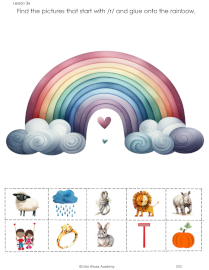
Some lesson pages need to be printed out. An activity with compound words has you cut apart compound words and help children physically put them together. Another one has you cut out a “nine-patch” with pictures in 8 squares surrounding the center square with a phonogram. Children identify pictures whose names begin with that sound. Pages for a small book titled “Looking for a Bear” are also cut out and collated as a book, and children can personalize the book with pipe-cleaner worms, cotton-ball snow, a red-thumbprint ladybug, and other creative ideas. The Language section concludes with a printable activity page for students to practice following directions.
Science and social studies support the camping theme with activities like a “Camping Scavenger Hunt,” "Watching Pinecones Open and Close,” and “Packing for a Camping Trip.” Colorful activity pages and cut-out pages are used along with most activities.
Gross motor skills activities are likely to be used several times (and beyond the week) since they include bean bag games, a paw-print trail for children to jump along, and hide-and-seek using a teddy bear.
Among the suggested art activities are creating a camping trailer from a paper plate, construction paper, and other decorations; making a tent with popsicle sticks; and using marshmallows as stamps to make the letter I.
Printable charts of letters and numbers are at the end of each lesson.
Free Bible Supplement for PreK
The free 282-page Bible supplement includes lessons from both the Old and New Testaments. Students create pages each week that will be put together as their own hand-made Bible. Lessons include games, activities, crafts, and snack ideas.
The lessons include simple retellings of Bible stories, sometimes with accompanying hand motions. The hand-made Bible pages can be glued into a composition notebook or a 7” x 10” sketchbook. It will be substantial when it’s finished since it will include pages with Bible stories along with arts-and-crafts pages. Pages added to the hand-made Bible include some with featured verses, but these are not used for memorization unless you choose to do so.
Kindergarten
 The complete kindergarten program covers math, language arts, science, and social studies, all with separate files. You can purchase the full curriculum or only the literacy (language arts) component, or individual files for science (four files) and social studies (five files).
Both math and literacy courses are presented in sets of four files titled Woodland Fun, In the Savannah, Ocean Fun, and In the Garden—the same titles for both math and literacy. Each file should take a quarter of the school year. Math files have from 76 to 102 pages, and the much larger literacy files range from 270 to 336 pages. All math and literacy files must be used in order since skills are scaffolded. Numbered lessons make clear the correct order.
The starting place for daily lessons is the Math for Me file that comes with the math course. This is your guide for Morning Meeting Time. During this time, students recite the Pledge of Allegiance, become familiar with the calendar and calendar-related songs, and work on number concepts such as “This is the second day of school.” Visual aids and cut-outs are included in this 14-page file. You should add to the morning meeting time, an activity from the 99-page Daily Flash file that also comes with the math course. These activities review coins, shapes, colors, patterns, directions (left, right, middle), telling time, and positions in a 9-square grid.
Literacy
Each Literacy file begins with a two-page table of contents, a page of instructions, a two-page suggested reading list, Guided Reading Suggestions, Tips for Reading to Kindergartners, and Vocabulary (tips for teaching vocabulary). The last three articles are particularly important because they explain teaching methods to be used throughout the course.
In addition to the files, you will need a whiteboard, a dry-erase marker, two sets of lowercase magnetic letters, dice, clothespins, popsicle sticks, paper cups, and counters.
Literacy lessons teach phonics, reading, composition, handwriting (printing letters and numbers), and beginning grammar. More specifically, among the skills taught are recognizing phonograms and their sounds, reading words with short-vowel sounds, recognizing sight words, sentence writing, identifying syllables, capitalizing, identifying singular and plural words, and categorizing. Children also learn “book” skills: identifying parts of a book, main ideas, characters, and settings; making inferences; analyzing; and discerning between reality and fiction. In the fourth quarter, children start to write their own sentences on graphic organizer pages that include squares for one or more drawings.
Lessons are taught interactively, with parents guiding and assisting students as needed. The program is fairly advanced for kindergarten, and you should slow the pace of the lessons if a child needs more time to assimilate the material.
By the fourth quarter, children read short stories with sentences like, “He can quiz the fox.” (p. 198), trace complete sentences, write their own name (frequently), and compose one or two sentences.
Math
Kindergarten math stresses number fluency with a variety of learning activities that build on one another, using games, worksheets, manipulatives, and discussion. In addition to the files, you will need Base Ten Blocks, Unifix cubes or similar stacking cubes, small manipulatives (e.g. buttons, pom poms), large paperclips, clothespins, cardstock, index cards, playdough, pipe cleaners, pony beads, one die, a softball, and standard school supplies, such as scissors, glue, and crayons.
Lessons are much briefer than those for literacy, often with only one or two short paragraphs of instruction. Activity pages and/or manipulatives are used to work through the lessons.
Math covers topics such as counting forward to 30 and forward to and backward from 20, place value to 20, addition and subtraction up to 10 (including work with math equations), identifying coins up to quarters, telling time (to the hour on both digital and analog clocks), identifying shapes, sorting and measuring, working with patterns, and solving word problems.
The concept of subtilizing was introduced in preschool and is further practiced in kindergarten with the use of ten frames and other visual tools.
Science and Social Studies
Science and social studies files can be used in whatever order you wish. These subjects are of lower priority at the kindergarten level and can be taught on a more sporadic basis than math or literacy. Some of the studies recommend additional children’s picture books and occasionally a field trip.
The four files for science are:
- Animal Habitats
- Life Cycles
- Vocabulary
- Weather
The science files have fewer than 50 pages and function like mini unit studies. A few pages near the beginning have brief instructions for a series of activities, followed by student activity pages and images. Aside from school supplies, you will need very few extra items--only a paper plate, ice cubes, and food coloring.
The five files for social studies are:
- American Symbols
- Around the World
- Landforms
- Maps and Globes
- Then and Now
These files have more pages than the science files but still serve as mini unit studies. You will need popsicle sticks, construction paper, playdough, an eggshell or plastic egg, dried beans, ribbon, chopsticks, tissue paper, vegetable shortening, ice, latex gloves, a reclosable bag, cardstock, a paper plate, markers, and paint. Most activities use the student pages in the files rather than the extra resources.
The American Symbols study teaches about our flag, the Pledge of Allegiance, the Liberty Bell, Mount Rushmore, the White House, and other symbols that promote appreciation for our country. Around the World teaches about Mexico, Greenland, China, and Nigeria. The other file titles are self-explanatory.
Summary
Little Shoes Academy is a thoroughly developed program much like what children might experience in a classroom setting. It requires quite a bit of work from the parent or teacher in preparation and presentation. On the other hand, children learn concepts through several types of activities that are engaging and address different learning styles.