


The Country Name Game, LLC has produced two Country Quest card games: The Country Name Game and the U.S. States & Canada Provinces Name Game. No prior knowledge is required, but I suspect that players familiar with only a few states or countries will find play frustrating. I recommend that U.S. and Canadian citizens start with the U.S. States & Canada Provinces Name Game, since those regions should be more familiar, and it’s a smaller deck of cards. Students learn as they play, and no player is likely to already know all of the places, especially in The Country Name Game.
U.S. States & Canada Provinces Name Game
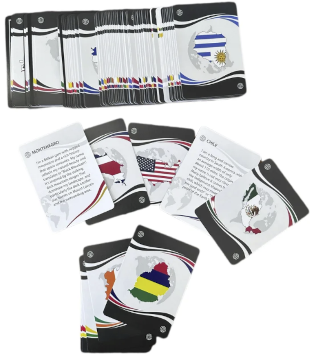
The 75 cards in the U.S. and Canada deck use stories, images, and riddles to help students learn about the individual states and provinces of North America. The U.S. and Canada deck also includes cards for the United States, Canada, and six continents, which serve as “Action” cards as described below.
On one side, each card has a lengthy riddle, full of clues that help players guess the name of the state or province. For example, the card for the state of Georgia reads:
I was chartered as a colony in 1732 and was named after King George II of England. As one of thirteen original colonies, I was among the first to join the Union. Known as the Peach State, I take pride in my sweet fruit and southern charm, carrying the legacy of my royal namesake into modern times.
On the reverse are visual clues. For continents, a collage of all the continent’s countries’ flags is shaped like the continent itself. For states and provinces, their geographical outline is cut out of their flag, giving players visual clues from colors and elements of the flag that are shown, as well as the shape.
World Countries
The 225 cards in The Country Name Game are primarily for countries, although there are a few for territories as well as several for continents. They are designed like those for the cards in the U.S. States & Canada Provinces Name Game. An example of a country’s riddle comes from the card for Finland:
I’m a Northern European nation with a long boundary with Russia. I am one of the world’s most northern and geographically remote countries. My name may derive from the ancient Fenni people who lived in northeastern Europe.
Most countries’ flags show a significant portion, even with them being cut out in the countries’ shapes. However, island nations’ flags often show only as dots of color because of the cutouts.
I found some of the territory cards especially interesting. For instance, Macao, a special administrative region of China, has its own flag. And the Isle of Man, a self-governing British Crown Dependency with its own flag, sits between Great Britain and Ireland but is not part of the United Kingdom. I did some online searches for more information on a few of the territories about which I knew next to nothing, and you might want to have online searches available as you play to satisfy players’ curiosity.
Playing
The games are best for three or more players but work with two. Groups can play as teams. While it’s not mentioned in the directions, I can also envision an individual student working through a deck on their own to test themselves.
The games’ instructions add elements that make them more than a flashcard exercise. Players strive to earn the most points by identifying the name of the country, territory, state, or province within 30 seconds. (I’d give younger players more time.) If a moderator reads the riddles, players can compete to see who answers more quickly. With only two players, they take turns reading riddles to each other and guessing. The flag and country shape on the reverse can be covered to make it more difficult. Players can gamble by “betting” they can give the correct answer to two cards in a row. If they lose, the other players get those points if they can answer correctly. (I’d change that rule to automatically award the bet points to the other team.)
Continent cards are “Action” cards once they’ve been correctly identified by players. They can be swapped for five points. They can allow the player to take a pass on a riddle and choose who must answer it, and they can use it to double points on other answers.
The directions are the same for both games. They are a little too brief, not spelling out exactly how things like betting work. But that leaves room for us to adapt the rules to suit our situation or even make up our own. For instance, when players have gone through the game several times, they should be able to answer most of the riddles, and you might use rules that reward speed.
Summary
Games can be great learning tools, and these two games meet my criteria both for having educational value and being fun to play.