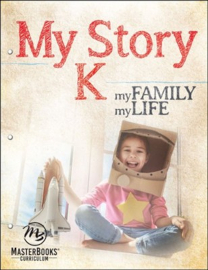
The My Story social studies series was written for Christian students in kindergarten through second grade. A single book for each course includes teaching instructions, lessons, worksheets, removable activity pages, and answer keys. The books are printed in full color, and pages are perforated for easy removal.
Titles of the three courses are:
- My Story K: My Family, My Life (342 pages)
- My Story 1: And the World Around Me (419 pages)
- My Story 2: My Country, My World (421 pages)
My Story courses provide an introduction to social studies, beginning at the personal and family level. The kindergarten course focuses primarily on personal development, the family, and the local community, introducing the broader world briefly in the second semester. The first- and second-grade courses continue with personal development and expand much further into the cultures of other countries through stories with titles such as “On a Junk to China” and “My Taxi in South America.” The second-grade course adds specific information about each country: its capital, type of government, and flag (with an image to be colored). While the kindergarten course has little geographical content, it increases gradually in the next two courses.
The courses emphasize God’s creation and His love for all people through the instructional material, scripture passages, memory verses, and discussions. Consequently, the lessons encourage students to grow in their love for God and all people, while also developing virtuous character traits such as kindness, peacefulness, diligence, and faith. The courses also address topics such as healthy nutrition and conflict resolution, and they teach children how to say “Thank you,” “Good Morning,” and other short sentences in other languages.
The courses incorporate learning methods for the eight types of intelligences as identified by Dr. Howard Gardner: intrapersonal (introspective), verbal-linguistic, visual-spatial, musical, body-kinesthetic, interpersonal (interacting with others), logical-math, and naturalist (experiences, particularly in nature). Explanations for instructors about these multiple intelligences are at the end of each book. Because of the multiple-intelligences approach, as well as the currently popular inclusion of social-emotional development across the curriculum, the lessons focus as much or more on personal development (such as positive character traits, making good choices in food, and cooperating with others) as on social studies information. This tilt toward social-emotional development is much less in the courses for first and second grade. The publisher describes the My Story courses as “Charlotte Mason inspired,” but the multiple-intelligences approach seems much more dominant.
Each quarter of these courses is designed as a quest, and near the beginning of each quarter’s lessons is a one-page Quest Collector Card that students are to remove so they can write on it as they work through the next nine weeks.
In all three courses, vocabulary words are highlighted within the lessons and should be written on cards or paper for review.
Lessons should take about 30 minutes per lesson, two days a week for 36 weeks.
All three courses are available as printed books and ebooks, and they also have companion audiobooks that will save on teaching time.
Kindergarten
As I mentioned at the beginning of this review, the primary focus for kindergarten is on children, families, and the community, and many lessons focus on personal development goals, such as understanding “how God’s guidance and laws help us know the difference between right and wrong” (Lesson 12) and making good choices (Lesson 31)—these are the only goals for those lessons. The goals of other lessons often address topics other than traditional social studies, such as recognizing basic words and building vocabulary (Lesson 8). More closely linked with social studies are lessons with goals like recognizing uniforms worn by different first responders and cultural clothing (Lesson 6), understanding why we have rules and laws (Lesson 11), and understanding that people around the world prefer to eat different things (Lesson 25).
Children are taught how to say “Thank you” in many different languages, and lessons suggest coloring in the country related to each language on the maps at the back of the book. Sections at the end of each quest include discussions of cultural foods and a recipe.
Children create their own storybook using pages 263 to 300. Each lesson has students complete one of these pages as they write in (or dictate) personal information and draw pictures on predesigned pages.
The course includes several coloring pages. Flashcards on pages near the end of the book include memory verse cards, cards for saying “Thank you” in many different languages (pronunciation keys included), Word Collector cards (vocabulary words with definitions), and illustrated landform cards with descriptions. Following the flashcards are several continent maps and the answer key.
Quests at this level are very simple. The four Quest Collector Cards each present nine statements or Bible verses, with one bolded word per statement. Students are to circle these bolded words as they come across them in the quarter’s lessons.
Parents can review flashcards and memory verses with students, but there are no quizzes.
First and Second Grade Courses
The courses for first and second grade are similar to each other. Quests include world maps that are referred to from time to time. The quests pose questions mostly related to social studies, such as those about time zones, continents, the largest lake in Central America, the world’s tallest waterfall, and the location of Mount Ararat. Children will find answers for each quest within each quarter’s lessons.
These courses still have some coloring and drawing, and they add word-search puzzles, copywork (printing rather than cursive), and many open-ended questions followed by lines for students to write their responses, such as, “What does your mom or dad do that you most appreciate?” (My World 1, p. 24).
First- and second-grade students create a “My Story Journal” by completing a page at the end of each lesson. These pages ask personal information and open-ended questions such as “What might it be like to live on an island?” (My World 1, p. 270). Second graders also write on colored-cardstock leaves about things for which they are thankful. (Parents supply the leaves and a cardstock tree on which they are mounted.)
Both courses have plenty of scriptural content, and second graders are encouraged to pray for the leaders of each country they study.
The instructor is to lead children through a review on Friday each week by discussing a question, such as, “What would you like to do if you lived in a city where the streets were canals?” (My Story 2, p. 163), and by reviewing the vocabulary word (or words) taught that week. A review lesson at the end of each quarter has a similar discussion question, a review of the week’s vocabulary word(s), a review of foreign language words, and the completion and review of the Quest Collector Card. Quarterly quizzes present the same questions as those on the Quest Collector Cards. A short quiz on types of governments is added in second grade.
Summary
The My Story courses can be used in both class and family settings. Building on a biblical base, they combine social-emotional development with an introduction to social studies through activities that address all learning styles.