


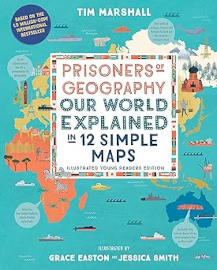
Prisoners of Geography: Our World Explained in 12 Simple Maps, Illustrated Young Readers Edition is based on the best-selling book for adults, Prisoners of Geography. The premise of both books is that geography has an outsized influence over cultures and world events. For instance, mountain ranges limit mobility, rivers provide key transportation routes, and natural resources can shape the economy of an area.
The Illustrated Young Readers Edition, with illustrations by Grace Easton and Jessica Smith, provides a visual explanation with bubbles of information overlaid on maps and introductions and sidebars adding more details. Major mountain ranges, some rivers and railway lines, and a few other critical elements are included, but the maps are not meant to be comprehensive. “A Note from the Author” on page 6 says, “Please note that the maps in this book have not always been drawn to scale, but have been designed to tell a story.” While the maps illustrate some details, they do not accurately identify exact locations and fine details.
The 12 maps are of Russia, China, the USA, Canada, Europe, Africa, the Middle East, India and Pakistan, Korea and Japan, Latin America, Australia, and the Arctic. As you can see, only a few countries have their own maps, while others are lumped together with others. A map introduces each section of the book and, in most cases, is followed by one- or two-page articles that highlight and explain particular regions or features. The maps of Canada and Australia don’t have any articles.
The map of China on pages 16 and 17 provides a good example of how this works. It identifies many of the extremely diverse areas within China, highlighting the location of larger, metropolitan cities in the west, and the mountains and deserts in the east. In the southwest, a bubble near a mountain range says, “The Himalayan Mountains run the length of the border between China and India, providing a useful defense.” A train route is shown from Lhasa (near the Himalayas) to Beijing, and a bubble explains, “The train journey from Lhasa to Beijing takes three days, traveling at an average altitude of 11,086 feet (3,379 m). The highest point is 16,640 feet (5,072 m), which is more than 15 times higher than the Eiffel Tower!” The next six pages provide more details about China and its history. Two of those pages, titled, “Why is Tibet So Important?”, explain that the area of Tibet, now within China, includes the Himalayan Mountains. Those mountains provide a barrier against invasion from the direction of India and Pakistan, while also serving as the source of water for three of China’s major rivers, The Yellow, the Yangtze, and the Mekong. This article explains the long-standing resistance by Tibetans against Chinese control as well as the Chinese interest in maintaining that control.
While this book is intended for a younger audience than the original book, it provides a visual way for even adults to understand historical and political events. For example, the section on the Middle East explains the Sykes-Picot Agreement, made before World War I, that predetermined how Britain and France would carve up the former Ottoman Empire if they prevailed in the war. This agreement has contributed to many of the current problems we now face in the Middle East. Articles like this also make the book most appropriate for students who already have some knowledge of world history.
Even so, many homeschoolers have used it with children as young as kindergarten. I can envision using the maps and images to introduce geography and some major features to young children, while older students take the time to peruse the printed information. While this version of Prisoners of Geography can be read aloud and discussed, I expect that students will want to explore it individually, taking time to absorb details and read the supplemental articles they find most interesting.
The book is available in hardcover and Kindle editions, but I don’t recommend the Kindle version because the ability to view the two-page spreads is important.
Summary
The point of the Illustrated Young Readers Edition of Prisoners of Geography is to introduce geopolitics. This focused approach makes it more understandable than children’s pictorial atlases I’ve seen that try to include a lot of information but with no coherent way to interpret that information. I find this approach far more useful and easier to learn from.