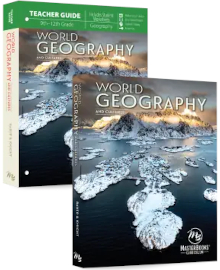
World Geography and Cultures from Master Books, a two-semester course for high school students, teaches from a biblical worldview. The 378-page textbook and 522-page Teacher Guide use the same unique format Master Books uses for many of their courses—a format I really like. The non-consumable, full-color textbook provides information and illustrations, while the slightly less colorful Teacher Guide has brief information for the teacher, 360 student worksheets, and 84 pages of maps for students to label (with map answer keys). The teaching information includes a course description, a suggested daily schedule, assessment and grading options, and answer keys for both exercises and reviews. Student pages can be reproduced for members of the same household. Both books are available as either paperback books or PDFs.
How the Course Works
The course is presented in 36 lessons, each with five exercises (labeled for each day in the Teacher Guide) to be completed over four days. The fifth exercise, titled Review, concludes each week’s lesson with questions on new material, review mapwork, and questions based on previous lessons.
The first week of the course covers geography basics: plate tectonics, types of maps, how geography influences economics, cultural and ethnic differences, the religious makeup of regions, and oceans. After that, lessons are arranged geographically by continent under six headings: Africa, Asia, Europe, North America, South America, and Australia and Oceania (which includes Antarctica). The number of lessons under each heading varies from three in the last section to 11 for Asia. Several countries are usually covered within each week’s lessons.
Information is sometimes presented in charts, labeled diagrams, and bullet points. Key terms are bolded, and subtopics are often presented in colored boxes. A textbook page within each lesson has a timeline titled “Events That Have Impacted the Region.” The timelines include political events, natural disasters, and other culture-shaping events. This visual organization on the pages makes the wealth of information easier to assimilate.
Exercise Worksheets
Each exercise in the Teacher Guide has one or two worksheets and identifies the pages to be read in the textbook for that day. Students don’t have to search elsewhere or be told what to do each day since it’s clearly stated on the exercise pages.
The exercises have reading comprehension questions that are typically multiple-choice or matching columns; map work to complete (on exercise pages or on the maps near the back of the Teacher Guide), and critical thinking questions that require analysis and reflection. For example, a critical thinking question on page 139 asks, “How does Southeast Asia’s warm, rainy climate influence farming and settlement patterns?" Another on page 293 asks, “Costa Rica abolished its army in 1949 and instead invested heavily in education and health. How might this decision affect a country’s economy, stability, and quality of life over time?” Reviews include questions that require students to fill in blanks with short answers and sentences.
The fourth exercise for each lesson explores religion and social issues of the region. Students also choose a people group or country from the region, find a scripture verse related to a need or challenge they face, and write a prayer for them. Lines are provided for all three parts. Overall, the course integrates Christian worldview content in a sensible fashion that helps develop prayerful compassion in students.
Boxes with several Teacher’s Discretion assignments are presented frequently, but these are optional. Parents can check off “yes” or “no” boxes to let students know which to complete. These might involve mapwork or research that can be presented in writing, orally, or in an illustrated format. Some discretionary assignments have to do with missionary work or the impact of faith (or lack of faith). The critical thinking questions and Teacher’s Discretion assignments are the most interesting and allow students to apply deeper levels of thinking and creativity.
Each week includes a Review Day, where a small amount of new information is presented in the textbooks, and worksheets have a few questions on the new material, followed by review mapwork and questions based on previous lessons. Review questions and mapwork can be used for reinforcement or assessment. If used for reinforcement, students might check answers themselves. Alternatively, they might serve for assessment since there are no tests for the course.
Students should be able to work independently, with parents checking answers and mapwork. Teacher’s Discretion assignments need to be selected by parents, and students might need guidance or oversight for research. But overall, the teacher’s work is minimal for this course, making it ideal for homeschooling teens with busy parents.
Summary
Master Books’ World Geography and Cultures should be a great course for homeschoolers who want students to learn geography and cultures through a Christian worldview lens. In addition, the course is interesting, academically solid, and easy to use.