
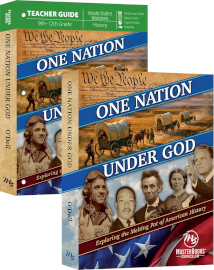
One Nation Under God: Exploring the Melting Pot of American History teaches U.S. history at the high school level from a patriotic and Christian point of view. Published in 2026, this course covers the beginning of President Donald Trump’s second term.
The course consists of a 434-page teacher guide and a 522-page student textbook. Both are available as printed books or PDFs. As is becoming the common format for many Master Books courses, the textbook does not include questions or activities. Student worksheets with questions and assignments are on pages in the teacher guide.
Student Textbook
The non-consumable student textbook presents the history content, preceded by a table of contents and followed by a section of primary source documents and a glossary. The text is supported with plentiful illustrations and colored call-out boxes that expand on topics, present short biographies, and show maps, artworks, and primary source documents. While some historical images are black and white, most are full color.
Among several positive points I want to raise about this textbook are its engaging writing style, bolded vocabulary words that are defined in the glossary, mentions of geography's influence on history, and connections between events and worldviews.
This paragraph from page 163 is a good example of how author Angela O’Dell connects historical events and a biblical worldview:
The world watched as the new American nation formed its government and learned to stand alone. Ancient European powers doubted a fledgling country run by elected leaders could survive. The United States had to prove itself against powerful nations like England, France, and Spain, who were used to dominating weaker nations. America lacked the negotiating power of these empires, which had long fought for global dominance. Still, God’s hand was evident as the young country faced foreign threats and internal struggles. This era reminds us how difficult it is for smaller nations to protect their interests. Despite the challenges, the nation grew.
Making connections in this way certainly helps students make sense of history and understand the bigger picture.
Also along this line, every chapter in the textbook concludes with a two- to four-page article headlined Cultural Development and Biblical Worldview Analysis. These pages tie together events and ideas, sometimes labeling a section as “Chain-Links of Culture.” They address one or more topics such as the motivations of explorers, polarized views of Christopher Columbus, missionary work with native Americans, the “melting pot,” failures of King George III of England, Unitarianism and Transcendentalism, Christianity’s role on both sides in the Civil War, state government vs. federal government, immigration, Japanese American internment camps, the space race, changes in entertainment, and social media.
As I have mentioned, the viewpoint is conservative and Christian (mildly Protestant), and O’Dell doesn’t hide her biases. On the political front, conservatism shows up in the treatment of topics such as the New Deal, the administration of President Ronald Reagan, and discussions about societal changes from the 1860s onward that have harmed families. For instance, O’Dell includes an article on page 446, titled “Sanctity of Life,” which begins: “President Reagan is one of my three favorite American presidents. One of the reasons I admire him so much is how he spoke out about the sanctity of life.” Content like this, combined with worldview issues and faith-based topics addressed in the Cultural Development and Biblical Analysis sections, heavily weights the textbook with viewpoint content.
The text includes coverage of faith-related events and issues. I appreciate that O’Dell includes topics sometimes omitted from Protestant textbooks, such as the Catholic Church’s protection and copying of the Bible during the Middle Ages, French exploration of North America, and the first permanent Spanish settlement in Florida. So while some content reflects Protestant interpretations, the textbook is usable by Catholics with a conservative political outlook.
My only point of concern is that ideas are occasionally presented in a disjointed fashion. For instance, page 29 explains the concept of charter colonies, and the next page discusses the Mayflower Pilgrims who had been given a charter for land in what became northern Virginia. It tells how they were blown off course and ended up far to the north and far from the land granted to them. The connection of the charter as a governing document to the Mayflower Compact, which the Pilgrims created as a form of self-government (and replacement for the charter) is not made until page 35. This is not a major issue, but I thought it worth noting.
Teacher Guide and Student Worksheets
The teacher guide has a scope and sequence, a suggested daily schedule for 180 days, a course description, lists of course features and five broad objectives for the entire course, two pages of course information for the teacher, student exercise worksheets (the bulk of the book), cumulative reviews, and answer keys for exercises and cumulative reviews.
Lessons are laid out clearly for independent study, although the course can be used in a classroom setting. Optional discussion questions at the end of some exercises would require interaction with a teacher or other students.
Students are to complete one lesson per week. The teacher guide has five exercises per lesson, each with one or two student worksheets to be used each day. The assignments for reading from the student textbook are at the top of each exercise page. After reading from the textbook, students match terms in a glossary exercise and possibly receive extra credit for using a glossary term in an original sentence. After that, the exercises vary to include matching, answering true-false questions, sequencing events, filling in the blanks, filling in a chart, searching for locations on a map or globe, labeling a map, solving a puzzle, drawing or sketching (e.g., their own political cartoon on page 70), and providing lengthier written answers. Students might be asked to write short-essay answers, paragraph-long answers, page-long essays, biographical sketches, scripture verses, or their comments on a portrait study. They also answer questions based on maps, primary source documents, and political cartoons that are found toward the back of the textbook. Many exercises require critical thinking skills, making this an excellent course for developing those skills. Also, note that many questions are faith-based, such as this question on page 28:
Read the “From a Biblical Worldview Perspective” section on page 20 in your Student Book and think about how God used the Renaissance and Reformation in His overall plan for mankind. Write a short paragraph about it.
Optional questions and assignments at the end of some exercises can be assigned by the teacher. These might include discussion questions, creative writing, essay writing, research and writing, or role playing. Occasionally, options are offered for either an individual or a group activity.
Two weeks, one at the midterm and one at the end of the course, are dedicated to review and cumulative tests.
Summary
One Nation Under God should work well for families looking for high school U.S. history from a Christian and conservative point of view, and students are likely to find the well-written textbook and variety of exercises engaging.