

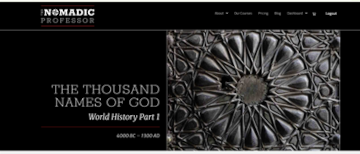
World history is covered in two, semester-long, online courses titled World 1: The Thousand Names of God and World 2: From a Far Country. Both courses taken together should provide students with 1 credit for world history and an optional humanities credit. World 1 covers up through 1300 A.D., and World 2 continues up to the present. World 2 is still under development as I write this review in January 2026,
Lessons are presented in 10 units, divided into numbered sections (like chapters), each with several subsections. Each subsection teaches three to seven topics and includes a summary, a quiz, and a Document Lesson. The Document Lessons provide work toward the humanities credit, and I’ll describe its requirements later in this review.
Everything is provided online. Students watch videos or listen to audio, read course material, and take quizzes online, and they will download PDFs for a 22-page course handbook, flashcards, notes, mapwork, schedules, rubrics, and document lesson resources. Some resources can be downloaded all together at the beginning of the course or they can be downloaded at the beginning of each section.
Audio and Video Instruction
The courses feature audio presentations by the Nomadic Professor, Dr. William Jackson, and 68 videos he has filmed on location. Nate Noorlander, developer of the supporting materials, also explains the course and the document lessons in videos. Each of Dr. Jackson’s lesson presentations begins with a leading question. For example, subsection 3.4 uses four leading questions as titles for the topics to be covered:
- Who were the Medes, Neo-Babylonians, and Persians (and what was the Babylonian captivity?)?
- Where did Zoroastrianism come from (and what is it?)?
- What was the Achaemenid Empire?
- Who inhabited Central Asia between 1000 and 500 BC?
This subsection has a 44-minute audio track in which Jackson answers all four questions and summarizes the entire section. Alternatively, students can read through the online text (divided into four sections) with the same content. If students listen to the audio track, they should also visit the four pages with text to view maps and images that illustrate the lessons. (Ideally, students will both listen and read.) While there are no videos in this section, there are some in other sections. More videos were gradually added to the Nomadic Professor’s American History courses after they were first created, and that will happen with these two courses as the Professor is able to film at various sites.
I wanted to mention an interesting point regarding the audio tracks: In at least one case, the course tells us that an “audio track was recorded by cloning the NP’s voice.” They say they intend to replace it with a real human voice as soon as they can. They ask that we excuse any oddities in pacing and pronunciation in the meantime. One example of this that I caught was the AI’s mispronunciation of the word read with a short-e sound rather than the long-e. Still, I wouldn’t have identified this recording as voiced by AI without that notice! The content was written by the NP, so I don’t see any problem with the use of AI in this case.
World History Coverage
In these courses, Dr. Jackson divides the world into 16 regions, systematically and chronologically developing the history of each region as the course progresses. This means the course hits events, periods, and regions that usually get short shrift in other texts. For instance, in Lesson 2.1, students learn about the Olmecs in Mesoamerica (circa 1200 to 400 BC), the many people groups across North America from about 5000 to 1000 B.C., and people groups in Australia and the rest of Oceania prior to 1000 BC. The course is truly international in scope, although it can’t possibly cover every people group on every continent. The selected topics provide students with a wide view of world history while also narrowing the focus to specific times and places to anchor learning in concrete information.
Structure Terms
Students work on vocabulary under the heading Structure Terms. Both online and downloadable/printable vocabulary cards have preprinted information, and the printable cards identify the section of a lesson where the term is taught. “Structure Terms” implies that something more than typical vocabulary study happens in the course, which is clear when students are taught how to create some sort of structure—3D, paper, or digital—in which they connect all their vocabulary terms for the course through relationships to one another. Students must understand both the meanings and relationships to be able to create their structures, and this exercise requires deeper processing than would probably occur otherwise.
Guided Notes
Guided Notes reinforce lesson content, while also requiring students to think critically and make connections. Pages downloaded for each lesson include questions to answer, graphic organizers to complete, timeline activities, and map work. The Guided Notes also tell students when to work on timeline entries and what features to label on their maps. Some pages are used over several lessons, with students returning to a page to add more information.
Students can print and fill these pages in by hand, fill them in as editable documents, or import them into another program and edit them as they wish. The Guided Notes and other ancillary items are sophisticated in allowing for various technological options.
The timeline entry pages are not figures to be put on timelines. Rather, pages for specific places and eras have blank squares to be filled in with key information, artifact ideas, and pertinent observations. When creating the World History Museum described below, students should draw some of their ideas from their timeline entries.
Document Lessons
Every subsection concludes with a Document Lesson with coursework that can be used for the humanities credit. Students not working toward that extra credit can skip them, but I would encourage all students to try to complete them, even if they have to modify the number of artifacts or simplify in some other way.
This part of the course allows students to focus their study wherever they want in conjunction with world history. They will construct a virtual “World History Museum” filled with 60 to 80 self-selected artifacts, such as images and drawings. In effect, students serve as the curators of their own museums. They will label and organize the artifacts by themes and explain them. They can present their museum in a physical format, but most will find it easier to use Canva, Miro, or another presentation program. Each semester requires 50 to 60 hours devoted to this project to earn the humanities credit.
Students are provided with models and instructions that walk them through the process. They can focus on one or more aspects of the humanities, such as language, culture, religion, art, literature, history, philosophy, or technological influence on culture. Along the way, students learn how to support their selections and interpretations with historical information, and they also learn about the inevitable bias that can creep into historical interpretations. As explained on page 11 of the course handbook, “In the process they’ve learned what makes up the humanities, and they’ve learned to make comparisons, judge relative significance, judge cause and effect, synthesize ideas, argue conclusions, and make connections across time and space.”
Students can draw from course content to support their selections of artifacts, and some images are labeled as potential artifacts they might use. Some other sources are recommended, but students are free to research beyond them.
Students are provided with a multi-page Exhibit Curation Form that will be used throughout both courses to plan and organize their work. The courses also include other forms for this project, such as the Museum Exhibit Rubric that helps students evaluate potential items and templates they might use as interpretive artifact labels.
Early in the first course, students decide which themes to pursue for the World History Museum, so they gradually accumulate the information they need. Because of the Document Lessons, students are likely to find that they approach the course as a research project with a goal in mind rather than as assigned information to be learned.
At the end of the second course, students spend 15 to 20 hours on an essay assignment; six possible topics are provided. They are to draw evidence from the courses to defend their essay thesis. As with the World History Museum, students might want to choose their topic early in the first course and begin collecting information for the essay as they work through both courses.
Differentiation
The course handbook describes options for differentiating the difficulty of the course. The first choice is whether to pursue the optional humanities credit. Skipping it means eliminating the World History Museum project. Those pursuing the humanities credit have three tracks from which to choose, although parents can customize the course even further. All students will read, watch, and listen to online course material; take online quizzes, and review vocabulary, but the three tracks differ in these ways:
- Basic: Students skip vocabulary structure assignments. World History Museum assignments are completed at the “amateur” (easiest) level.
- Standard: Students complete vocabulary structure assignments once per unit and work at either “amateur” or “professional” level on their World History Museum.
- Advanced: Students complete daily vocabulary structure assignments and work at either “amateur” or “professional” level on their World History Museum.
Notice that the biggest difference in the tracks is the time spent on vocabulary structures.
Overarching Comments
Instructors have access to all student resources, plus answer keys. Students should be able to complete the coursework on their own, but instructors must grade and evaluate other work. Rubrics are provided. The course handbook says, “Instructors should expect to spend 45-90 minutes a week grading student work.” (p. 20).
These courses are well-developed with many downloadable resources, plenty of guidance, and thorough instructions. The combination of “regular” lessons with Document Lessons is unusual, but it adds a valuable dimension to the course that I would skip only if absolutely necessary.
This is a secular course that treats the resurrection of Jesus as a historical event in the same way it treats the conversations between Zarathustra and Ahura Mazda as real or the placating of the Nazca gods as real. The course is presented with conventional dating and includes some speculative prehistoric and early civilizations coverage.
Summary
I was so impressed with the quality of The Nomadic Professor’s courses for American History that I wasn’t surprised to find the same excellence, innovation, and attention to detail in their courses for World History. I also like the Document Lessons’ focus on the World History Museum because it trains students to think like historians.