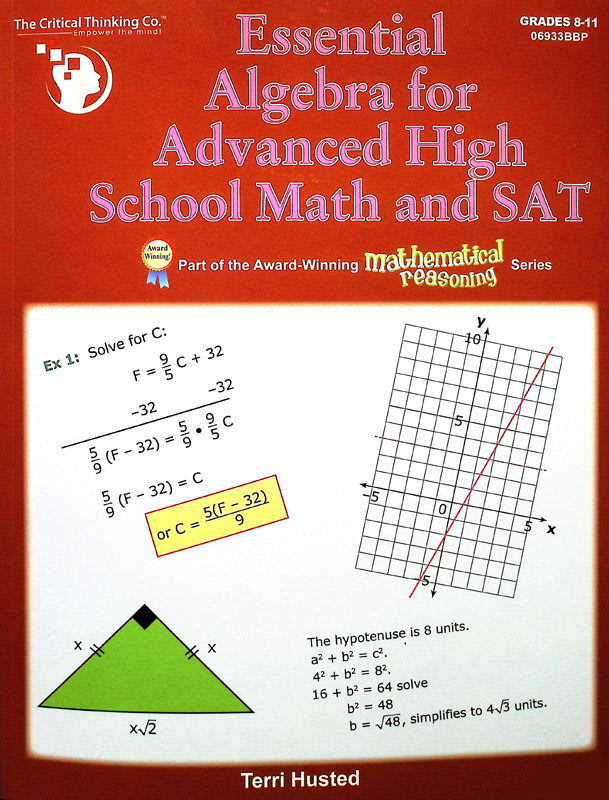

Essential Algebra for Advanced High School Math and SAT, part of the Mathematical Reasoning series, is to be used as a supplement for grades 8 through 11 and will most likely be used over two or more years. It teaches and reviews concepts crucial to algebra, geometry, and advanced math that pose the most common challenges for students. Some concepts need to be mastered before beginning algebra, while others should wait until students are preparing to begin algebra 2 or another advanced math course. Unless a student is reviewing for the SAT or another college entrance exam, lessons should be used over two or more years.
Students who have struggled with math concepts in junior high or high school should benefit from this book, and those using it for test prep should appreciate it as a concise review of the most challenging topics.
Instruction is very easy to follow. Author Terri Husted draws upon years of experience and familiarity with the typical pitfalls students encounter. The instructional portion of the lessons incorporates example problems followed by practice problems, including numerous word problems.
What It Covers
The first three chapters are most useful in junior high before a student tackles algebra. These chapters cover definitions (e.g., terms, variables), the order of operations, all four operations with fractions, the distributive property, types of numbers, absolute value, exponents, factoring, multiplication and division with decimals, scientific notation, square roots, and working with radicals. These concepts should have been thoroughly covered by the time students complete pre-algebra, but if students haven’t mastered them, they prove troublesome when students move into algebra.
Chapters 4, 5, and 6 concentrate on polynomials, factoring polynomials, and solving equations and inequalities, which are typically algebra 1 topics. Students might use these chapters alongside their first-year algebra course.
Chapter 7 covers ratios, proportions, and percents, topics typically covered in junior high. So this chapter might be used before Chapters 4, 5, and 6.
Chapter 8, “How Algebra is Used in Geometry,” is probably best when students take geometry. The final two chapters on “Understanding Functions’ and “Working with Quadratic Equations and Functions” tackle more advanced topics. Some algebra 1 courses teach quite a bit about functions and quadratic equations, but the content of these chapters is more typical of second-year algebra.
An appendix has additional information and strategies without practice problems, such as a page on “Other Roots Besides Square Roots.” Some instruction for using a calculator is included since high school students need to develop that skill.
A 45-page answer key is at the end of the book.
Summary
Essential Algebra for Advanced High School Math and SAT should be a useful supplement for overcoming some of the most challenging aspects of high school math.