
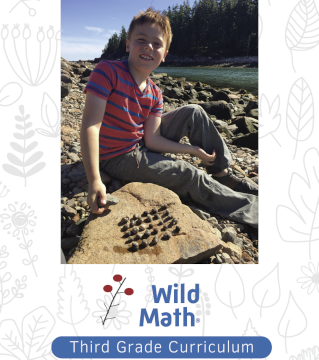
Wild Learning® views outdoor environments as ideal classrooms, even for learning math. Their Wild Math® courses for kindergarten through fifth grade can be used as your core curriculum or as supplements for another math program. Each course is presented in a single book (PDF) with an accompanying Planner file for grades one through five.
Author Rachel Tidd explains that everything doesn’t have to happen outdoors, and even those living in congested cities with no backyard can adapt most activities.
If the weather is inclement, you can bring outdoor elements indoors, apply math in real-life (e.g., cooking, measuring, building), play games, apply math on field trips, and use ideas from the recommended books. For example, this activity from page 12 of Wild Math Second Grade can be done outdoors or brought indoors: “Leaf numbers: Write three-digit numbers on leaves or the bottoms of stones. Turn them all face down. Choose two leaves or stones to flip over and indicate with stick symbols whether they are <, >, =.”
In lesson plans for 36 to 40 weeks per level, the courses describe several types of activities for both outdoors and indoors. Children can repeat their favorites. Word problems are naturally used in hands-on experiences, and actual word problems are used throughout the course books.
The approach is close to unschooling in that suggested schedules are totally flexible, there are no worksheets or tests, play is a major element in learning, and child-directed explorations are encouraged.
Those using Wild Math as their core curriculum should complete the units in order. Suggested weekly lesson plans are included in the kindergarten book and provided in a separate file for the other levels. However, there’s a blank lesson plan page in each course, and parents are encouraged to adapt lessons to suit their situation and their children.
The courses cover the topics that need to be taught at each level, so there’s no worry about children not learning what they would in a traditional math course. These courses even teach subitizing and the use of ten frames—both common elements of current math programs.
Families should create their own “Math Kit on the Go,” which should include small notepads, pencils, index cards, chalk, meter- and yard-long pieces of rope, a permanent marker, two dice, a measuring tape, a protractor, and a timer. For kindergartners and first graders, you would also add two cloth ten-frames. The Math Kit on the Go is just one of several items needed for each course. Children will use found and collected items from nature, along with a math journal and items such as place value sticks (e.g., popsicle sticks or sticks found outside, wrapped in bundles of 10), a trundle measuring wheel, play money, plastic graduated cylinders and beakers, a balance scale with weights, graph paper, and an outdoor thermometer.
Students gradually do more writing. At all levels, students are to keep a math notebook for collecting data, recording problems, and solving problems. Beginning with first grade, Printable Materials pages toward the back of each book include activity pages to be used along with some lessons, such as a multiplication chart, pages of word problems, data recording pages, pages for traditional problem solving, and instructions for projects that involve math. Answer keys for these pages are included when appropriate.
The Wild Math courses teach several ways to arrive at solutions, frequently with hands-on objects or concrete applications. Consequently, students should develop a strong understanding of mathematical concepts.
Supplemental, free videos, available on the Wild Learning YouTube® channel, present another way to teach some of the challenging topics.
What’s Covered at Each Level?
Kindergartners learn to recognize and write numbers, count to 100 by 1s and 10s, compare and sort items, learn basic shapes, and become familiar with the concepts of addition and subtraction up to 10.
First grade focuses on becoming fluent with addition and subtraction; skip counting by twos, fives, and tens; patterns; measurement and data; telling time; identifying coins; identifying fractions; and introductory geometry (e.g., 2-D and 3-D shapes, and line symmetry). Regrouping is not taught this year.
In second grade, students learn counting, reading, and writing numbers to 1,000; skip counting; rounding; addition and subtraction to 1000; regrouping; simple geometry; and identification of fractions.
Third graders practice skip counting and review and expand skills in addition and subtraction. They also learn multiplication and division; reading and writing numbers to 100,000; numerators and denominators; equivalent fractions; fraction comparisons; estimation; the use measurements to create and solve problems; graphs and data; telling and writing time from analog and digital clocks; counting and using money; and geometry (angles, circles, volume, mass, perimeter, and area).
In fourth grade students review arithmetic skills; learn complex multiplication and division; learn to add, subtract, and multiply fractions; learn about decimals with money; apply measurement skills and convert units; work with data and probability; use ordered pairs on a coordinate grid; use parentheses to show the order of operations; and learn geometry fundamentals, such as points, line segments, types of triangles, the circumference of a circle, and polygons.
Fifth graders review multiplication and division and learn decimals, advanced fractions, graphing, algebra concepts, conversion of units in measurement (both metric and U.S. customary), the volume of a rectangular prism, introductory geometry (including three projects), and collecting, organizing, and interpreting data.
Should You Add a Workbook?
Some parents, and even some students, might want supplemental workbooks or online resources for more math skills practice. The amount of practice and repetition with various math skills might vary dramatically from student to student, depending on the time and effort put into the activities. To fill the gap, or just to make learning more fun, the series author, Rachel Tidd, encourages supplementing with books and games that she lists in several places in each course, such as Kate Snow’s book, Multiplication Facts that Stick, Anno’s Mysterious Multiplying Jar by Masaichiro and Mitsumasa Anno, and the Monopoly game. She also includes directions for simple games like Place Value War (played with a deck of cards) and links to free resources such as Fraction Game: My Closest Neighbor – Denise Gaskins' Let's Play Math and Dice and Card Games to Practice Math Facts (free 11-page PDF).
Summary
With Wild Math, children learn through real-life and hands-on experiences. If you’re not sure about using it as your core curriculum for math, try it as a supplement first. You might find that math becomes your children’s favorite subject.