
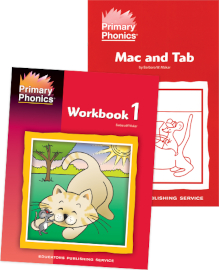
Primary Phonics is a complete program with courses for kindergarten through first or second grade that can also be used for remediation. The program teaches systematic phonics, introducing some sight words early so that children can begin to read short stories. Three teacher’s guides cover the program, which might take up to three years. The courses are Primary Phonics K, Primary Phonics 1-2-3, and Primary Phonics 4-5-6. You might use the courses for kindergarten through second grade, but I think most children will move at a faster rate, perhaps beginning Primary Phonics K in pre-kindergarten and maybe completing courses at a faster pace.
The lessons cover all necessary reading and writing skills for what is typically kindergarten and first grade: phonics, phonemic awareness, comprehension, reading fluency, and vocabulary. They teach some handwriting, but you might want a separate handwriting workbook for more comprehensive instruction and practice.
Student workbooks and readers used with each teacher’s guide are all printed in black and white. An optional Intervention Guide Levels 1-6 can be used with students who need more help.
The lessons are designed for classrooms but adapt easily for homeschoolers. They require teacher presentation, with lessons sometimes telling the teacher to write something on the board. Warm-up activities in the second and third courses often involve games for more than one student, and these are probably the most challenging to adapt for one student. Balancing that out, it’s easier to individualize lessons and keep track of progress for one student than for a group.
Primary Phonics K
The Teacher’s Guide K is used along with Workbook K, Consonant Workbook, More Consonant Workbook, and Color Workbook. This course teaches 17 consonants, skipping the five vowels and the letters q, x, y, and z. The names of colors are taught as sight words, using Color Workbook. An optional Picture Dictionary can be used as well.
The goals at this level are to introduce and develop:
- phonological awareness in general (beginning with consonants)
- familiarity with both the names and primary sounds of the selected consonants
- the idea that words can relate to illustrations
- letter formation for the consonants
- the concept of sight words
The course’s 17 lessons introduce the selected consonants. Lessons in Teacher’s Guide K are scripted for the teacher, even showing when to pause. Workbook K has four practice pages per lesson. On the first page, children practice printing the consonant and then identify and write the same beginning consonants in words that are accompanied by pictures. The next two lesson pages are a two-page illustration for a story read from the teacher’s guide. The teacher asks students to identify images within the illustration of things that begin with the featured consonant. Students go back after the story and write the letter on the images they have identified. The fourth page reviews the newly learned consonant and any others previously taught, with pictures and words that are missing their initial consonant.
The two Consonant Workbooks provide practice in identifying and writing initial consonants for words accompanied by pictures. Color Workbook teaches students to associate appropriate images with colors, primarily to help children recognize color words. Workbook 1 in the next level of the program assumes children have learned these sight words, so it’s not optional. Children should color in images in Color Workbook to reinforce learning. Children can color images in the other workbooks, but it’s not required.
Primary Phonics 1-2-3
Teacher’s Guide 1-2-3 is used along with three essential workbooks titled Workbook 1, Workbook 2, and Workbook 3. Three optional workbooks add the word More before each workbook title. The second set can be used when more practice is needed. Corresponding sets of 10 readers accompany each workbook, although there is no set for More Workbook 3.
Comprehension is taught with the readers and with three Comprehension Workbooks: Thinking about Mac and Tab: 1, 2 and 3, each with about 20 pages. The Comprehension Workbooks have a Teacher’s Guide: Thinking about Mac and Tab with instructions, discussion questions, extension activities, and answer keys for the three sets of readers used with Primary Phonics 1-2-3, plus two of the sets used with Primary Phonics 4-5-6. However, the discussion questions, extension activities, and suggested answers in the guide are repeated in the Teacher’s Guide 1-2-3 and Teacher’s Guide 4-5-6 at the points they are to be used in the lessons. The value of Teacher’s Guide: Thinking about Mac and Tab is in the answer key for the Comprehension Workbooks, which follows the discussion questions for the readers. This answer key might save parents time, but you can probably figure out the answers without it.
A consonant pre-test in the Teacher’s Guide can be used to determine readiness for this course. After the pre-test, Teacher’s Guide 1-2-3 has 30 multi-part lessons, with 10 lessons per workbook, so think of the course in three sections. Each lesson will take at least a few days to complete.
The first section reviews the consonants taught in Primary Phonics K and the color sight words. It then teaches the short vowel sounds and the “sight” words a, in, is, no, an, the, and yes. Blending and sight words are taught beginning in the first lesson, so students immediately start reading the first reader, Mac and Tab, with sentences like “Mac had the ham.” Children gradually learn the phonograms for decodable sight words,
The second section of this part of the course teaches long vowels and vowel digraphs. The third section adds initial consonant blends (e.g., st in stop), final consonant blends, plural s, twin consonants (e.g., ll in gull), ck, x, and compound words.
The jump from Primary Phonics K to Primary Phonics 1-2-3 is large. Students might need to move slowly through the first lesson to grasp blending and the introduction of short-a.
The workbooks rotate through a variety of exercises that involve writing words, labelling pictures, answering yes or no to questions, constructing sentences from word banks to describe a picture, and practicing reading sentences. More Workbook 1, 2, and 3 similar exercises.
While students write primarily in the workbooks, they are frequently told to write on lined paper during the writing component of a lesson.
Teacher’s Guides explain how to use the components and provide easy-to-follow, detailed lesson plans. Some sections are scripted, but most are not. Teachers need to preview the lessons to prepare, especially for warm-up activities and the words or sentences that need to be written on the board. In addition, the teacher’s guide includes frequent suggestions for differentiating instruction that might be useful.
Primary Phonics 4-5-6
The 30 lessons in the Primary Phonics 4-5-6 Teacher’s Guide cover the remaining phonograms, such as tch, th, the various sounds of oo and ou, ey, qu, y, dge, and igh. As with Primary Phonics 1-2-3, this part of the course has three parts, with a workbook, a comprehension workbook, and a set of 10 readers for each part. Just like the teacher’s guide for the first part, the Primary Phonics 4-5-6 Teacher’s Guide explains how to use the components and provides easy-to-follow lesson plans.
Intervention Guide
If older students have not learned phonics or need review, the Intervention Guide Levels 1-6 has complete lesson plans that integrate program components to teach phonics in 60 lessons. You also need the separate book of reproducible blackline masters for student worksheets.
Summary
The Primary Phonics program is both flexible and comprehensive. Once into Primary Phonics 1-2-3, optional resources provide extra practice if needed. Course components are purchased individually, so you can buy only what you need.