


The Reading Safe teaches beginning reading incrementally with Reading Safe boxes and videos. The free, online videos, featuring the program’s creator Jayme Pelerine, walk students through each step of the learning process. There’s no login or signup required to access the videos, so you can check them out before purchasing your first Reading Safe box.
The videos are available in either English or Spanish. This program should be especially good for parents or children with developing English skills, since they can watch lessons in Spanish, while the program teaches children to read English. An English language learner might even watch lessons in both languages.
While videos do the teaching, parents should still listen and watch at least part of the time to ensure children are learning correctly, and they should also have their children read the readers aloud to them several times.
The entire beginning reading course will have six boxes titled Reading Safe 1, 2, 3, 4, 5, and 6. The first two Reading Safes are available now, with the others to follow.
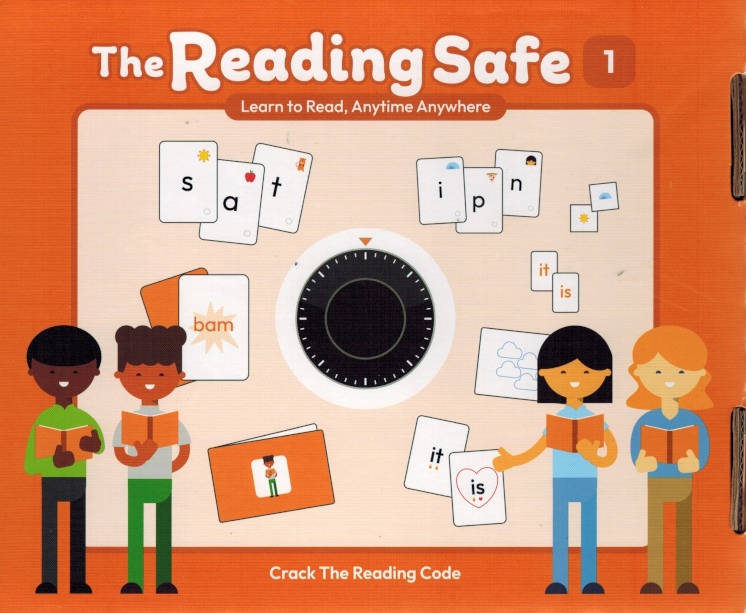
The box for each Reading Safe measures 7” x 8.5” x 1.25,” and some of the pieces are small, but it works fine as long as you don’t lose anything. Each box has textured sound cards with raised letters, small tiles with pictures and sounds, mats for learning activities, a card game, four or five readers, a progress map, and stickers. Components for each lesson are packaged into small pockets so there’s no confusion for children. It’s easy to follow along with the video and find the items needed for each lesson. Children will probably appreciate the pockets and other creative packaging in these boxes.
Reading Safe 1
Reading Safe 1 has six lessons. It teaches the letters s, a, t, i, p, and n, and it also teaches blending and reading a few sight words. Children trace the raised letters on the sound cards as they learn their sounds, so they are also beginning to learn how to write the letters. Children will learn the sounds of the letters first, but learning the names of the letters waits until Reading Safe 6. Children also learn only lowercase letters first, aside from the word I. That means that readers in the first five kits start many sentences and proper names with lowercase letters.
The fourth of the six lessons in the Starter Box teaches blending using smaller tiles and a mat that comes in the safe. Students learn words like pin, sat, and pan.
The sight words one, a, I, and is are taught in the fifth lesson. (in and it are also listed in the scope and sequence as sight words, but students learn these phonetically early in Reading Safe 1.) Sight words on sound cards are written inside a heart, showing that they need to be learned by heart rather than sounded out. A padlock symbol is used throughout the course on stickers, cards, and elsewhere to identify decodable sounds, and a heart beneath a letter indicates that it is to be learned as a sight word or sound.
After the six lessons, children practice reading in four small readers. Children learn the word read as a sight word, to read from left to right, and that periods indicate the end of a sentence. This careful scaffolding throughout the program limits the number of new concepts introduced at a time.
After reading the readers at least once, children practice making words by using removable letter stickers and a mat that comes with the box, which has only the last two letters of 12 words. This helps children practice making consonant-vowel-consonant words and deciding if they are actual words, like pin, tin, nap, and tap. Correct words are on the reverse so children can self-check.
The final activity in the first set uses the deck of cards from the Starter Box to play a “War” game with two players. These cards have words children should have learned, and above each word are one or more padlocks to give a numerical value to each card. Players flip one card each, and the player with the most padlocks gets to try to read the cards first. If correct, the player claims the card. If incorrect, the card goes into a “Bam” pile. When one of the two “Bam” cards in the deck is played, the player gets to try to read the other player’s single card plus any cards in the Bam pile. Gamification makes this a fun way to practice, although a parent playing with a child might need to purposely miss a word now and then to keep their child from getting discouraged.
Reading Safes 2 through 6
The other Reading Safe kits are similar, but with five readers each instead of four and with slightly different activities. Here’s what’s taught in the other Reading Safes:
- Box 2 - sounds: c, k, e, h, and r; sight words: can, see, two, to, here, three, the
- Box 3 - sounds: m, d, o, and g; sight words: sam, dak, and, not, red, she, said, come, my, me, go, make, down
- Box 4 - sounds: b, l, q, u, and f; sight words: run, help, up, big, ben, sam, dak, for, funny, play, look, find, do, blue, little, what, with
- Box 5 - sounds: j, z, w, v, y, and x; sight words: am, jump, where, we, yellow, away, you, liv, kos, zak, luz, val, jaz, kai, fara
- Box 6 - lowercase and uppercase letter names
Note that the words that look like nonsense syllables are names of characters in the readers, shown with lowercase letters since uppercase letters haven’t yet been taught.
Summary
The Reading Safe is carefully structured for beginning readers. It blends phonics with sight words to get children reading quickly.