
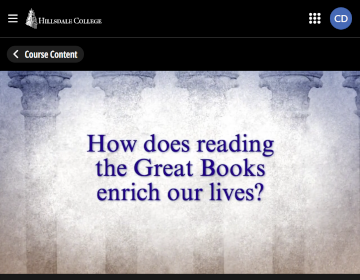
Great Books 101: Ancient and Medieval Literature, a free online course from Hillsdale College, introduces some of the key works from among the Great Books. This is a foundational course for those pursuing a liberal arts education based on the reading of the most important literary works.
The introductory lecture by Hillsdale College president Larry Arnn sets the stage by answering the question “What is literature?” Arnn challenges students working through this course (and other Great Books courses) to think through some of life’s big questions and develop larger aspirations toward positive personal impact for good in the world.
Six different professors then present 10 lectures based on The Iliad, The Odyssey, The Aeneid, Aristotle’s Politics, Sophocles: The Complete Plays, The Canterbury Tales, Confessions, The Inferno, and Sir Gawain and the Green Knight, plus Genesis Translation and Commentary and The David Story, both by Robert Alter. The inclusion of books based on the Bible reflects the course’s assumption of the importance of the Bible as part of the Great Books.
Given that lectures each run from about 40 to 50 minutes, they cover limited aspects of each work. The presenters highlight key themes and ideas to whet students’ appetites to read more. Students are not required to read the entire books, but it is highly recommended that they do so to get the most out of the course. Only one presenter, Professor Patricia Bart, says that she expects students to have read the works she discusses in her two lectures on The Aeneid and Part IV of The Canterbury Tales. Photocopies of the literary works are linked in the course resources below each video.
All lectures, except the introduction, are accompanied by extra resources. A question-and-answer video provides another 20 to 25 minutes with the lecturer discussing the literary work with John Miller. The follow-up videos helpfully expand the discussion and shouldn’t be skipped. A 10-question, multiple-choice quiz completes each lesson. A 50-question exam concludes the course.
While I was already at least somewhat familiar with many of the literary works and the biblical stories, I didn’t read the works before taking the 10 quizzes and the final exam and was able to pass all of them. The quizzes ask questions based on the lectures, so students can pass the course without reading the literary works. That might be sufficient for those who want a lighter introduction to the Great Books, but those who want to get the most from the course should take the time to read the works or at least excerpts from them. A middle way might be to have students read just a few of the complete works and excerpts from others. Any of those approaches will work.
A discounted 10-book bundle of all except Aristotle’s Politics is available through Hillsdale’s bookstore. These are the recommended translations/versions of each book in paperback. Students who want to read the works should invest in physical books since they will be much easier to read than the photocopied versions linked under the lectures.
Summary
Like many online Hillsdale College courses, Great Books 101: Ancient and Medieval Literature should be very understandable for high school students. The flexibility of the course also makes it a practical addition to a student’s curriculum on whatever level they have time for.