



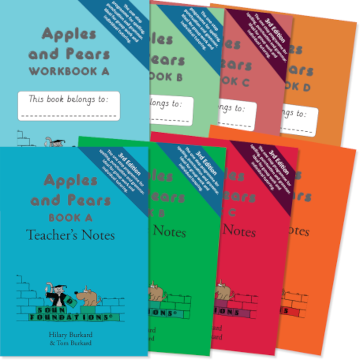
The Apples and Pears series serves as a supplement for reading, writing, and spelling to help children with learning difficulties or others who have fallen behind for other reasons. The series incorporates some features I’ve seen in many resources for teaching children who struggle with reading and spelling: clear structure, direct instruction, and lots of repetition.
The Apples and Pears series consists of four student workbooks, subtitled A, B, C, and D, with companion books for each titled Teacher’s Notes. The series can be used in conjunction with the same publisher’s Bear series (a phonetic approach to reading) or most other phonetic reading programs that move slowly enough for students with learning difficulties. The workbooks are not designated for grade levels and can be used with any student who is struggling or needs remediation for reading, spelling, or handwriting. Spelling seems to me the most targeted skill, and it’s taught based on rules, phonics, and word patterns that also support reading skills. Children learn some handwriting skills, but they are given far more handwriting practice than instruction. Students can start in A, B, or C, and free placement tests can help you determine the correct workbook.
This series was originally written for British students, but the books have been adapted for other countries. Be sure to click on the flag at the top right of the shopping webpages to choose the correct country version. American English Editions are printed on demand in the U.S. and are purchased with U.S. dollars.
How It Works
Within this series, lessons are called levels, and each workbook has 59 to 67 levels. I will refer to levels as lessons in this review, since that’s more familiar terminology.
Children simultaneously work on reading and spelling to become familiar with both decoding for reading and encoding for spelling. Many different types of activities are used to reinforce skills, and the activities change from book to book. However, a mainstay is the analysis of words, first by phonemes (the smallest unit of sound in a language that can distinguish one word from another, such as /fl/ +/a/ +/t/ = flat) and then by morphemes (the smallest meaningful unit of a word that cannot be divided further phonetically, such as hope + less = hopeless). Methods used are reading aloud, responding orally, responding by writing, filling in blanks or boxes, completing exercises such as changing the base of a word when adding a suffix, solving simple crossword puzzles, doing letter or word searches, copying words and sentences, and taking dictation. Sentence dictation also serves to teach vocabulary since it presents words in meaningful contexts. Most lessons have 5 to 10 different exercises, but lessons occasionally consist entirely of dictation.
One lesson should be completed each day, and lessons should take from 10 to 20 minutes. Lessons can be split in half for students who need to move more slowly.
Students write in their workbook while the teacher reads from and directs students from scripted lessons in the Teacher’s Notes. Children do not work on their own but are supervised continually. The teacher is told to try to prevent mistakes, stopping a child before they misspell or write incorrectly. If they do spell or write a word incorrectly, immediate correction and correct reinforcement are critical. If a child is unable to quickly self-correct their spelling, the teacher immediately has the student write the word correctly while the teacher spells it orally. The student then covers the word and spells it orally or in writing. A reinforcement procedure (described on page four or five of each Teacher’s Notes) is also used at the beginning of the next lesson for all words misspelled in the prior lesson.
Note that the teacher writes the day and date for every lesson on a whiteboard or other surface for students to copy into their workbooks to reinforce the correct spelling of the names of days and months. Otherwise, most teaching is presented orally, with the teacher only occasionally writing on a whiteboard.
Mastery tests (about every ten lessons) must be passed before students proceed. Mastery tests consist of 20 words that students are to write from dictation. While sentence dictation is not included in mastery tests, it too serves as an excellent evaluation tool.
What’s Taught in Each Workbook?
Workbook A
Before starting Workbook A, children must be able to recognize the basic sounds of most letters and have the small-motor coordination to trace letters one-half-inch tall. However, the lessons move quickly for a beginning reader in kindergarten or first grade, particularly if they have learning difficulties, so they are usually better for slightly older students.
Students begin with reading and writing individual letters and some three- and four-letter words. As lessons progress, they learn some vowel and consonant digraphs, such as cr, sh, ee, ar, and ch , and longer words such as crash and bleed. They also learn patterns such as the long-e sound in the words me, he, and she; the long-i sound in words like my and why; and frequent patterns such as igh. Some suffixes and prefixes are taught in later lessons in Workbook A. This example of one of the dictation sentences in the last lesson reflects the level to be achieved by the end of this book: “Please put some of your things in the little boxes.”
Workbook B
Workbook B continues with the same types of activities as Workbook A but adds Word Bingo and daily spelling tests. New spelling rules and patterns are taught, and the words are longer and more complex, such as rightfully and storing. In addition, homophones are introduced (e.g., meat and meet), children write more words and sentences by dictation, some elements of grammar are taught (e.g., punctuation at the end of a sentence, commas, apostrophes, and capitalization), children learn to identify and analyze morphemes, and they learn more about changing base words when adding suffixes. An example of a sentence children write from dictation near the end of the course is, “Does your mother have a spare room for their rabbits?” (Teacher’s Notes Book B, p. 135). Children get bonus points for correctly including commas in dictation sentences.
Workbook C
Workbook C reviews the rules and patterns taught in the first two books at regular intervals. It also teaches some words with Greek and Latin components, along with other words that cannot easily be spelled phonetically, such as ghost, through, prettier, fridge, and business. Children continue to identify morphemes, a helpful strategy for some of these difficult words, such as the ceive component in receive, deceive, and conceive.
An example of a dictation sentence from Level 57 is, “You are not supposed to use Kim’s mobile number.” Children get bonus points for correctly using commas and apostrophes in their dictation sentences.
Workbook D
Workbook D continues to review rules and patterns like Workbook C, raises the level of difficulty, and expands the realm of words that students can read and spell. While older students might start in Workbook C, Workbook D does not include all the explanations of previously taught material. For instance, it doesn’t define morphemes for students but assumes they're already familiar with them.
Examples of words taught are disguised, reputation, infectious, peaceable, prescription, caution, and mountainous. A sample dictation sentence from Level 63 is, “The planning officials consistently refused to approve the scheme.” Students are still awarded bonus points for correct commas and apostrophes.
Summary
Apples and Pears might be the solution for homeschoolers whose children continue to struggle with reading or spelling. Its methodology of direct instruction through scripted, step-by-step lessons makes it easy for parents to use, and coupling the instructional methods with plenty of practice and repetition for students should greatly improve students’ reading and spelling skills.