



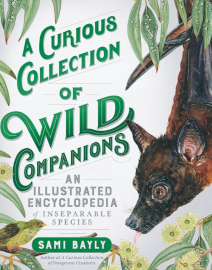
The three books in the Curious Collection of Creatures series are:
- A Curious Collection of Wild Companions: An Illustrated Encyclopedia of Inseparable Species
- A Curious Collection of Peculiar Creatures: An Illustrated Encyclopedia
- A Curious Collection of Dangerous Creatures: An Illustrated Encyclopedia
All three books are written and beautifully illustrated by Sami Bayly, who has an eye for the weird and wonderful. These hardcover books have 128 pages and all share a similar format. A two-page spread is devoted to each creature. The first page features a large illustration, the creature's common name, its scientific name, and a pronunciation key. Dangerous Creatures and Peculiar Creatures introduce the creature with a few descriptive and intriguing paragraphs on the first page. For example, page 10 of Peculiar Creatures introduces the Antarctic scale worm:
From a distance, Antarctic scale worms appear to be beautiful creatures covered in intricate, dazzling gold ribbons. But on closer examination, you’ll find they’re actually quite terrifying! This has a lot to do with the scale worm’s most incredible evolutionary adaptation: a retractable mouth, which at first appears to be a face or head without eyes.
Wild Companions always introduces a pair or trio of creature connections with images on the first page and the introductory text on the second. Different forms of connections are explained in the book’s introduction: mutualism, commensalism, and parasitism. The type of connection is identified on the first page. For example, page 46 of Wild Companions shows an Eastern screech-owl with a Texas blind snake in its beak, and their connection is commensalism. On the second page, it tells us,
While on its nightly hunting rounds, the eastern screech-owl scoops up Texas blind snakes and takes them back to its nest, filled with hungry baby owls. Blind snakes are tiny…small enough to be mistaken for worms—and these birds of prey could easily eat them, but instead they let them live in the nest, where the snakes perform a valuable service. They devour parasites that might otherwise harm the vulnerable baby owls.
The second page in all three books has a paragraph under each of three headings: Where They Live, What They Eat, and Conservation Status. A box with Fun Facts concludes each entry. Dangerous Creatures adds a Danger Factor paragraph to explain their inclusion as dangerous creatures. (Books are also available in Kindle versions, but because children will generally want to view the two-page spreads, these books are better read as physical books.)
The creatures are from all over the world and include those we find on land, in the sea, and in the air. Keep a globe or atlas handy as you read!
All three books are intriguing for both children and adults, but I think they’re likely to appeal most to middle schoolers old enough to read them on their own and understand habitats, ecosystems, and conservation issues. Other reasons for recommending them for middle schoolers are that younger children might find some entries too disturbing, and it’s easiest to use these books as part of your science curriculum before high school.
Summary
The Curious Collection of Creatures books are beautiful and intriguing enough to give as gifts to children fascinated by the world of nature.