

Suburban Science’s Biology course was written for ninth and tenth graders learning through independent study. Self-paced lessons combine online slide presentations with workbook and lab activities. When you purchase a course, you have lifetime access and can reuse it with another student at no extra cost, unless you purchase a printed student book. The course costs more than some other comparable online courses, but if you can use it for more than one student, it more than justifies the expense.
What It Covers
The course is presented in 12 units titled:
- Introduction to Biology
- Chemistry of Life
- Cell Structure & Functions
- Cellular Energy
- Cell Cycle
- Introduction to Genetics
- DNA & Protein Synthesis
- Biotechnology
- Population Change
- Diversity of Life
- Ecology
- Environmental Stability
I list unit titles because the topic concentration differs from other homeschool biology courses. It concentrates on the cellular level through the study of cell structures, biochemistry, genetics, DNA, and heredity. It also spends a great deal of time on big-picture topics, such as biomes, biodiversity, population changes, and ecological footprints. Coverage of various life forms, like plants and animals, is condensed into the tenth unit. (Suburban Science offers a slightly shorter Homeschool Anatomy and Physiology course for those who want to learn more about the human body.) While the course content aligns with the Next Generation Science Standards, it differs from many biology courses that devote more attention to life forms.
Secular and Morally Agnostic Content
The course is secular in its approach. The ninth unit, “Population Change,” deals with evolution, although it generally addresses micro-evolution—change within species, rather than macro-evolution—change from one species into another. Nevertheless, it presents some of the standard arguments for evolution, such as homologous structures, vestigial structures, and common embryonic development for vertebrates. Some other touchy topics are discussed either neutrally or positively. For instance, an article on genetic engineering discusses genetically modified organisms (GMOs) in regard to crops. It acknowledges that some people are concerned about problems but generally takes a positive view. A lesson on Transgenic Organisms and Cloning teaches about mixing genes from different species and duplication of genes through cloning in a non-judgmental manner. It mentions cloning organs, pets, or one parent of an infertile human couple (Chapter 8, Lesson 5). Some parents might find such content problematic.
Lessons
The course’s 12 units (sometimes referred to as chapters) are divided into lessons that can be completed in one day, totaling 145 days' worth of lessons. Each lesson should take about 45 minutes.
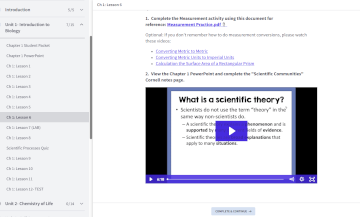 Lessons are delivered via videos that walk students through PowerPoint slides with voiceover. Slides sometimes include images and frequently present information in bullet points. The slides are also available in a complete set for each chapter, a feature I think should be useful for review. The videos and slides need to be viewed on as large a screen as possible for students to see everything and make out the details. (A desktop or laptop is probably best.)
Students will use workbook pages throughout the course. They can download the student packet at the beginning of each unit or purchase a printed 329-page student workbook. Instructions as to when to complete pages are online.
Student workbook pages are used for guided notes, lab activities, analytical activities, Digging Deeper, Data Analysis, research projects, and essays. Most guided notes pages are in the form of Cornell Notes with blanks to fill in with words (bolded on the slides), images to label, and charts to complete. Doodle Notes formats are used on some pages, with images, graphics and plenty of space for students to write, draw, or organize information.
After an introductory PowerPoint lesson, students take a video-based “pre-test” which they must pause frequently to answer questions and fill in information on workbook pages. The pre-test seems to assess reading comprehension and analytical skills rather than prior knowledge. Following this is an online page with General Lab Safety Rules and a workbook page to complete in response.
After this introductory lesson, the online lesson page for each video also tells which notes pages, labs, or other activities to complete.
Digging Deeper and Data Analysis pages included in each unit are used to extend topics for honors students. Digging Deeper activities have students read an article and answer comprehension questions. Data Analysis activities provide a graph, image, or data table to analyze, with questions similar to those on ACT and SAT tests.
Students have several essay and research assignments throughout the course. For instance, students write an opinion essay on amniocentesis and a short essay defending a position on a biotechnology issue. Students research and create slide presentations on amniocentesis and biotechnology.
Occasionally, lessons include links to other websites, such as one to “Click and Clone,” an interactive site where students will try to make choices to clone a mouse.
All of this might sound confusing, but students just need to follow the daily lessons that are clearly presented online.
Aside from the online quizzes, parents need to check answers and evaluate other student work, but this should be an easy course for parents to administer.
Labs
Labs are incorporated as lessons within units, with one to five labs per unit, except for Chapter 8, which has none. Labs include instructions and digital organizers, and many labs require data analysis, answers to questions, or reports.
Many labs are typical for high school biology, such as the Stomata Lab (observing stomata on a leaf through a microscope), Onion Cell Division (observing and analyzing a prepared slide), and Extracting DNA. Some non-traditional labs are included, such as Biodiversity Sampling based on parking lots and types of cars (done by recording data from actual parking lots), and the Sustainable House Project, where students design and build a rough model of a sustainable house from graham crackers, cardboard, or whatever materials they want to use.
Students can watch a video lab in addition to or instead of doing the lab work themselves. However, some colleges and universities require hands-on lab work with formal lab reports, so keep this in mind when deciding which route to take.
Students are not required to complete formal lab reports, but instructions and a template for those who want to do them are available under the section for Additional Resources.
Labs require many household items, such as vinegar, plastic cups, salt, licorice, yeast, and a ruler, as well as scientific resources. Scientific resources include a microscope and a frog dissection kit, plus several inexpensive items like slides, a thermometer, methylene blue solution, litmus paper, and safety glasses. Suburban Science provides weblinks to Home Science Tools for the required scientific resources, although they can be obtained elsewhere.
Optional Website links are occasionally included for further exploration. Honors assignments, included throughout the course, are listed and clearly identified on each lesson’s page. These often require weblink exploration and the Digging Deeper and Data Analysis activities.
Reviews, Quizzes, and Tests
Most units include an online quiz that is generally presented halfway or more through a unit's lessons. These quizzes are automatically graded and can be retaken.
Each unit concludes with a test. Review Task Cards, set up as printable cards in PDF files, are available for study in the lesson before each unit test. The tests are longer and have more difficult questions than the quizzes. Tests come pre-printed if you order a printed student book, or they can be printed from the Parent Resources provided under Additional Resources. Answer keys are on a password-protected website.
Community support
Suburban Science maintains a Facebook group where homeschoolers help each other, share photos or positive experiences, or the publisher weighs in with support.
Summary
Suburban Science Biology should work well for homeschoolers who want a secular course for independent study that includes labs and is tied to national standards. The option to raise it to the Honors level also meets a need for many families.