

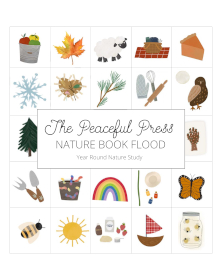
The Peaceful Press Nature Book Flood is a year-round nature study guide that offers Charlotte-Mason-style learning in themed science units based on nature, while also including some art, classical music, poetry, Bible verses, and recipes. Most activities can be used with children in preschool through about sixth grade, and variations are suggested for older children. The book is available only as a PDF.
Despite the title, none of the lessons are about floods. "Floods" is used in the same vein as the Icelandic Jollabokflod, or “book flood,” meaning a stack of lovely books. The study is presented for 48 weeks, with a children’s picture book setting the theme each week. The weekly studies are divided under Fall, Winter, Spring, and Summer, with 12 studies per season. Parents can switch the order, substitute other books, or skip a week or a season if they wish.
The 184-page course book prescribes five activities per week under the headings: Read, Play, Make, Look/Listen, and Nature Walk. A list of required supplies for the week follows the list of activities. Lessons include several pages, among which might be directions, a poem, an artwork image, a recipe, Bible copywork, art templates, and other pages needed for the lesson.
Descriptions of the Lesson Components
Read – lists the title and author of the children’s picture book, which you obtain on your own or access via a link to a YouTube version. There are no specific instructions about the book, but you might read it through a few times for younger children. The Read entry is always listed the same way, while the activities under the other four categories vary.
Play – a hands-on activity or nature experiment. Some examples are a science experiment titled "Why Pinecones Open and Close;” carving or painting pumpkins; creating woodland animals from play-dough; and comparing various flower and vegetable seeds, recording their observations, and planting seeds. Explanations are included for the results of science experiments.
Make – generally arts and crafts or cooking, but sometimes other activities such as tracing a child’s shadow on a sidewalk and having them color it in or making beeswax lip balm. Directions and templates are provided when needed, and recipes are included for cooking things like strawberry shortcake, granola bars, hibiscus tea, and a sunset smoothie. Art activities sometimes include working with items from nature, and they generally require items you are likely to have on hand, such as a hole punch, markers, yarn, coffee filters, cardboard, and a hot glue gun. You might need to obtain less common items like wiggly eyes, wool fabric, beeswax, and a candle wick.
Look/Listen – this might be listening to a specific piece of classical music (from a linked playlist in the introduction), listening to a poem (included in the lesson), reading a scripture verse and memorizing it by singing it to a simple tune, doing a picture study of an included artwork image and creating their own version, and other activities like learning the ditty for remembering the months of the year. Copywork pages for printing practice are included for scripture verses (one verse every four weeks), but copywork isn’t listed in the assignments. The introduction says that older students can copy the verse directly into their journal. Note that the introduction has an incorrect link that’s supposed to go to an explanation of picture studies, so use this link instead.
Nature Walk – Instructions are usually general, such as “Search for wildflowers,” “Pick up trash,” “Look for pinecones and acorns. Nature journal your observations,” “Notice the sky and predict the weather,” and “Plant garden seeds. Nature journal the process.” The introduction says that older students might keep a nature journal in a watercolor notebook, implying that they might do more artwork as part of their journaling.
At the end of the book are formatted pages titled My Nature Journal and Science Lab Report, which can be printed and used many times, and 40 vocabulary cards, with terms and definitions. All three items are especially useful for older students who have the requisite reading and writing skills.
In addition to the weekly lessons, you can choose one of two suggested chapter books per season to read aloud.
An Example Lesson
For example, for a study of trees, the activities are:
- Read Tell Me, Tree by Gail Gibbons
- Play has students use the provided photosynthesis experiment to study how leaves breathe. It also says, “Record your findings on the included observation template,” but there is no template specifically for this. Students might use the My Nature Journal or Science Lab Report pages at the back of the book.
- Make a spring nature tree with their handprint and decorate it with nature findings.
- Look/Listen has them read Psalm 1:3 and sing it to the tune of “London Bridge is Falling Down.”
- Nature Walk has students look for tree parts and label them in their nature journal. (They need to make their own drawing to label.)
The pages for this lesson include the experiment instructions and scientific explanation, the Bible verse printed in segments to fit the “London Bridge” song, and a copywork page with the verse. You can sample pages from other lessons on the publisher’s website.
Summary
The Peaceful Press Nature Book Flood is a gentle science-based unit study that can involve a wide age range and includes many fun family activities.