

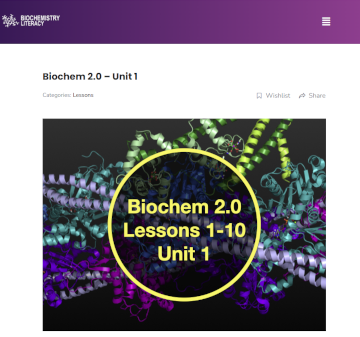
Biochemistry Literacy for Kids consists of two video courses. Biochem 2.0, Unit 1 presents 10 initial lessons that lay the groundwork for the Classic Lessons 1-24 course. The second course builds on the Unit 1 lessons. Chemistry is often taught in a theoretical and abstract manner, but these courses teach using molecular model building and real-life connections. For instance, many lessons relate chemistry to biology, such as the lesson on the structures of proteins and how they work within living creatures.
The Classic Lessons 1-24 were created a few years ago, but they needed more development, especially in the beginning lessons. Biochem 2.0, Unit 1 replaces lessons 1, 2, and 5 in the Classic Lessons 1-24, and students can skip those lessons. Forthcoming Biochem 2.0 units will eventually replace all Classic Lessons. For now, it’s best to think of this as a two-part course, with the Classic Lessons being a continuation of Biochem 2.0, Unit 1.
While these courses work for high school students, they are ideal for students in middle school. Advanced students in the primary grades might also benefit. Fried says regarding his intended audience:
Because this program features material that is far beyond the typical expectations for younger students, student success can mean different things to different people. Very young students can benefit simply by getting a feel for the molecularity of their surroundings, while older or more advanced students may want to master the topics, memorizing more of the molecular names, vocabulary, and concepts. If not every bit of information immediately sinks in, please know that these lessons, as well as my future units, review and expand on the content over and over again, so topics are constantly reinforced and reintroduced over time. (Biochem 2.0 Unit 1 Workbook, p. 3).
Using physical and computerized models, the course approaches biochemistry by looking at the structure of molecules to help students understand biochemistry. Students also become familiar with the periodic table and how elements relate to one another, both through different types of bonds and through common features of elements in columns of the periodic table. For example, in the second lesson of Biochem 2.0, Unit 1, students learn about hydrocarbons, beginning with methane, ethane, propane, butane, pentane, hexane, heptane, and octane in sequence since each molecule adds one more carbon and two more hydrogen molecules to its structure.
The course is presented via online videos, and the course’s creator, Daniel Fried, lectures while using demonstrations and images. Students work with the periodic table, a Custom Molymod kit for creating models, a workbook, worksheets, and a notebook. The Custom Molymod kit was created particularly for these courses and includes pieces used to simulate hydrogen bonding that are not included in other Molymod kits. So you must order the kit through Biochemistry Literacy for Kids.
In addition, Fried recommends that students download the free PyMol modeling software for use with the courses, although this is optional. The software does amazing things, so students should try to work with it.
Biochem 2.0, Unit 1
Unit 1 has 10 multipart lessons and a 70-page workbook (downloadable PDF) that are used along with the model kit. Students will keep a notebook for drawings, answering some workbook questions, and taking notes. Students will make molecules from their kit, draw those molecules according to the models, and draw them using chemical symbols.
Color-coding is important in this course, so students need a set of colored pencils. They are supposed to take photos of models they create to put into their notebooks.
The workbook has some notebook assignments, vocabulary words with definitions, flashcards with images and names of molecules, worksheets, and additional reading (that summarizes key points in the video lessons). Most pages need to be printed out, and some pages need to be printed in color. Flashcards should be printed in color on cardstock.
Biochem 2.0, Unit 1 has two to four videos for each of its 10 lessons. The runtime for the videos varies from about 8 to 30 minutes. Under the video for the first lesson are links for downloading the workbook and instructions for three labs for lessons 6 and 9. (These instructions are also linked under the specific videos where they will be used.) The labs require easy-to-find items like hydrogen peroxide, rubbing alcohol, food coloring, an eye dropper, a 9-volt battery, and two wires (either with stripped ends or alligator clamps on the ends).
The ten lessons in this unit introduce the model-building kit, molecular structures, and the periodic table. This is a prerequisite for the Classic Lessons 1-24 course. It can be used with students in the elementary grades through high school, although young students will need assistance, and I think it’s best for middle school up into high school. For high school, I would use it by itself for students preparing to take a chemistry course, because it will give them a head start on key concepts. Or I would use both courses along with Fried’s online High School Chemistry for a complete course.
Unit 1 teaches about molecules, molecular structures, bonds, the periodic table, and much more. It’s not long before students are building complex models! For example, Lesson 4 has students draw a rough sketch of a hemoglobin protein, which is made up of many molecules. The workbook tells students to include “4 blobs to represent the 4 proteins that make up a complete hemoglobin tetramer, 4 disks to represent the 4 heme molecules, one within each of the 4 proteins of the tetramer,” and "4 O2 molecules, one bound to each of the hemes." Next, they build and draw a simplified heme, an iron connected to five nitrogens, leaving one space for the O2 binding. This might sound daunting, but previous lessons and work with the models make it understandable. This same lesson continues with carbon dioxide binding and gas transport in the body. Unit 1 doesn’t limit the study to biological applications. Students also study topics like hydrocarbons, graphite, and diamonds. It doesn’t require much math, although I spotted at least one use of the concepts of multiplication and percentage, and students learn how to write balanced chemical equations.
In the videos, Fried tells students when to stop and build, draw, or complete worksheets in the workbook.
To ensure that students are learning and understanding, the workbook will sometimes ask them to summarize what they have learned on a topic (and write this in their notebook), such as explaining how oxygen gas and carbon dioxide are moved to and from the lungs on page 27 of lesson 4.
Classic Lesson 1-24
Students should have completed Biochem 2.0, Unit 1 before starting these lessons, and they should skip lessons 1, 2, and 5, which are taught in an expanded form in Unit 1. Among the many topics covered in these lessons are electron orbitals, acids, bases, amino acids, peptides, Avogadro’s Number and the mole, protein folding, ionic bonding, salts and biominerals, fats and oils, biological membranes, polysaccharides, nucleotides, DNA and RNA, isotopes, and radioactive elements.
Videos for these lessons are much longer than those in Biochem 2.0, running from about 22 minutes to 1:47 minutes. (There are also lesson presentation slides for teachers who want to teach the lessons themselves rather than use the videos.)
Below each video is a tab for materials where students can find guided notes pages (PDFs) to download and a list of vocabulary words. The guided notes present several questions and assignments that might include answering questions, drawing, labeling, math applications, creating equations, and recording experiment observations. (Answer keys for guided notes are also under the materials tab, accessible to students.) This section occasionally has corrections to information conveyed on the videos, so make sure students read these notes.
As with Biochem 2.0, Unit 1, these lessons are taught from the videos, and students should pause to write in their notes as they watch the videos. Fried occasionally directs comments to teachers, which implies that they are watching with students. That’s the ideal situation, but most homeschooling students should be able to watch the videos and work on their own, requesting help when they need it.
Questions in the guided notes are usually also shown on the videos. Some videos have students perform simple experiments. For instance, Lesson 10 has students taste a solution of 1 mole/liter sucrose solution, then dilute it to compare sweetness. Students are to describe their observations in their guided notes.
Students or parents need to determine how much to cover each day, since many of the videos by themselves will take more than an hour, not including time for model building, drawing, and writing on guided notes.
The course ends somewhat abruptly with the lesson on radioactive elements. The sidebar for accessing lessons lists Lesson 25: The Chemistry of Stars. Instead of a lesson, the link tells us that this is a forthcoming lesson. (Remember that these courses are being revamped in the format of Biochem 2.0.)
Online Courses
Students can also enroll in live online classes that meet for one hour per week for eight sessions. Classes are available for Biochem 2.0, Unit 1, as well as advanced topics. For example, the High School Chemistry course picks up where Biochem 2.0, Unit 1 and Classic Lessons 1-24 leave off to provide high school students all they need for high school chemistry.
Summary
Chemistry can seem like an abstract, theoretical subject, but these courses take it out of that realm and into concrete, familiar topics. Students who complete the Biochemistry Literacy for Kids lessons should have a huge jumpstart on high school chemistry.