

Suburban Science’s Chemistry course for high school is designed for independent study and includes labs that students can complete at home with the proper equipment. Self-paced lessons combine online slide presentations with workbook and lab activities. When you purchase a course, you have lifetime access and can reuse it with another student at no extra cost, unless you wish to purchase a printed student book.
The course with labs prepares students for college, and optional activities raise it to the level of an honors course.
Lesson Elements
The course’s 10 units (sometimes referred to as chapters within the course) are divided into lessons that can be completed one per day.
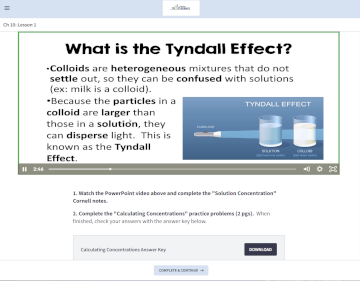
Instruction is presented through PowerPoint slides with voiceover. Slides sometimes include images and frequently present information in bullet points. The slides are also available in a complete set for each unit, a feature that should be useful for review.
Students will use workbook pages throughout the course. They can download and print the student packet at the beginning of each unit or purchase a printed 325-page student workbook. Instructions as to when to complete pages are online.
Lesson Progression
The course introduction begins with safety information and instructions for using the course. After this, each online lesson page has the video, if there is one, and tells which notes pages, labs, or other activities to complete.
The first Unit, “Introduction to Chemistry,” familiarizes students with lab equipment through an online scavenger hunt and a safety video, then teaches about dependent and independent variables, drawing line graphs, units of measurement, measurement conversions, and scientific notation. As they will do throughout the course, students complete both worksheets and hands-on activities. For example, students complete a Measurement Activity by watching a 3:43-minute video, pausing it several times to make calculations and write on their worksheets. This unit also has a four-page Calculation Review that uses three online images and includes an online answer key. Lesson 7 (of 12 in the first unit) provides a fun context for practicing calculations in a three-page activity titled “Shipwrecked: Can You Survive?” Students are given bits of data, such as they have collected a kilogram of seaweed. They have to answer the question, “If you eat 5 oz. of seaweed per day, how long would your seaweed haul last?” This requires a conversion between kilograms and ounces before the problem can be solved. Other calculations also require unit conversions, such as from Fahrenheit to Celsius. A chart of conversion factors is provided on the third page. Contexts like the shipwreck make the course more enjoyable than many other chemistry courses.
This first unit is typical in its creative approach to learning. The rest of the units cover matter, atomic structure, compounds, bonding, the Mole, chemical reactions, stoichiometry, gas laws, and solutions, acids, and bases. Many of the labs in these subsequent units are more traditional, although non-traditional ones are mixed in. For instance, the topic of stoichiometry (relationships between the quantities of reactants and products before, during, and after chemical reactions) is taught with an activity that begins by assigning “scientific” abbreviations to the ingredients for S’mores: G = graham cracker, Ch = chocolate bar, M = marshmallow. Assuming that the perfect S’more is constructed from two graham crackers, one marshmallow, and three pieces of chocolate, it creates a formula of G2MCh3. The molar mass is provided for each item. Students write a balanced equation and perform several calculations, such as filling the blanks for _____ + 21 Ch + 7M = _____. They must determine limiting reactants and excess reactants in several problems. The activity concludes with students applying what they have learned to copper and silver in a silver nitrate solution.
The course requires quite a bit of math, so students must work carefully through the first unit to ensure they understand how to perform the math. The lesson pages sometimes refer students to other websites for practice with math, such as a link to the IXL site to practice working with significant figures.
Workbook Pages
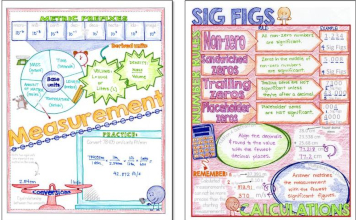 Student workbook pages are used for guided notes, lab activities, analytical activities, Digging Deeper, Data Analysis, and a research project. Many guided notes pages are in the form of Cornell Notes with blanks to fill in with words (bolded on the slides), images to label, and charts to complete. A Doodle Notes format is used on some pages, with images, graphics, and plenty of space for students to write, draw, and organize information. See an example of two completed Doodle Notes pages to the left.
Digging Deeper and Data Analysis pages in each unit extend topics for honors students. Digging Deeper activities have students read an article and answer comprehension questions. Data Analysis activities provide a graph, image, or data table to analyze, with questions similar to those on ACT and SAT tests. Many of these relate to interesting topics like rechargeable batteries, catalytic converters, and the production of aspirin. I would encourage students to try to complete these, even if they are not on the honors track.
The Nuclear Chemistry Research Project at the end of the course requires students to write a research essay and create an infographic.
Honors assignments, included throughout the course, are listed and clearly identified on each lesson’s page. These sometimes require weblink explorations and the Digging Deeper and Data Analysis activities.
Reviews, Quizzes, and Tests
Every unit has an online quiz, usually a little more than halfway through the lessons. Quizzes are automatically graded and can be retaken.
Near the end of each unit, an optional, unnumbered Extra Practice lesson provides downloadable worksheets, answer keys, and an occasional link to another website for more practice. These practice lessons help students master unit content before taking the unit test. In addition, Review Task Cards—set up as printable cards in PDF files—are available for study in the lesson before each unit test. The unit test concludes each unit. Tests come pre-printed if you order a printed student book, or they can be printed from the Parent Resources provided under Additional Resources. Answer keys are on a password-protected website.
Labs Can Be Done at Home
Labs are incorporated as lessons within units, with two to five labs per unit. Labs include instructions and digital organizers, and most labs require data analysis and answers to questions. Students are not required to complete formal lab reports, but instructions and a template for those who want to do them are available under the section for Additional Resources.
Labs require scientific resources plus many household items, such as corn syrup, dish soap, a tape measure, table salt, Epsom salt, rubbing alcohol, toothpicks, a long butane lighter, red cabbage, bleach, and a strainer. The most expensive scientific resources are a digital scale, a portable micro lab burner, and a conductivity tester. Among the many less expensive scientific resources required are items such as a thermometer, a funnel, graduated cylinders, a pipette, Pyrex beakers, calcium chloride, test tubes, and safety glasses. Suburban Science provides weblinks to Home Science Tools for all the required scientific resources, except the conductivity tester (available through an Amazon link), although they can be obtained elsewhere.
For labs that require specialized equipment, students can watch a video and complete the worksheets rather than performing the lab work themselves. However, some colleges and universities require hands-on lab work, sometimes with formal lab reports, so keep this in mind when deciding which route to take.
Community support
Suburban Science maintains a Facebook group where homeschoolers help each other and share photos and experiences.
Summary
Suburban Science Chemistry should work well for high school students who want to learn at their own pace while still completing a college-prep lab course. In addition, the variety and creativity of some of the activities make this course more interesting than many others.