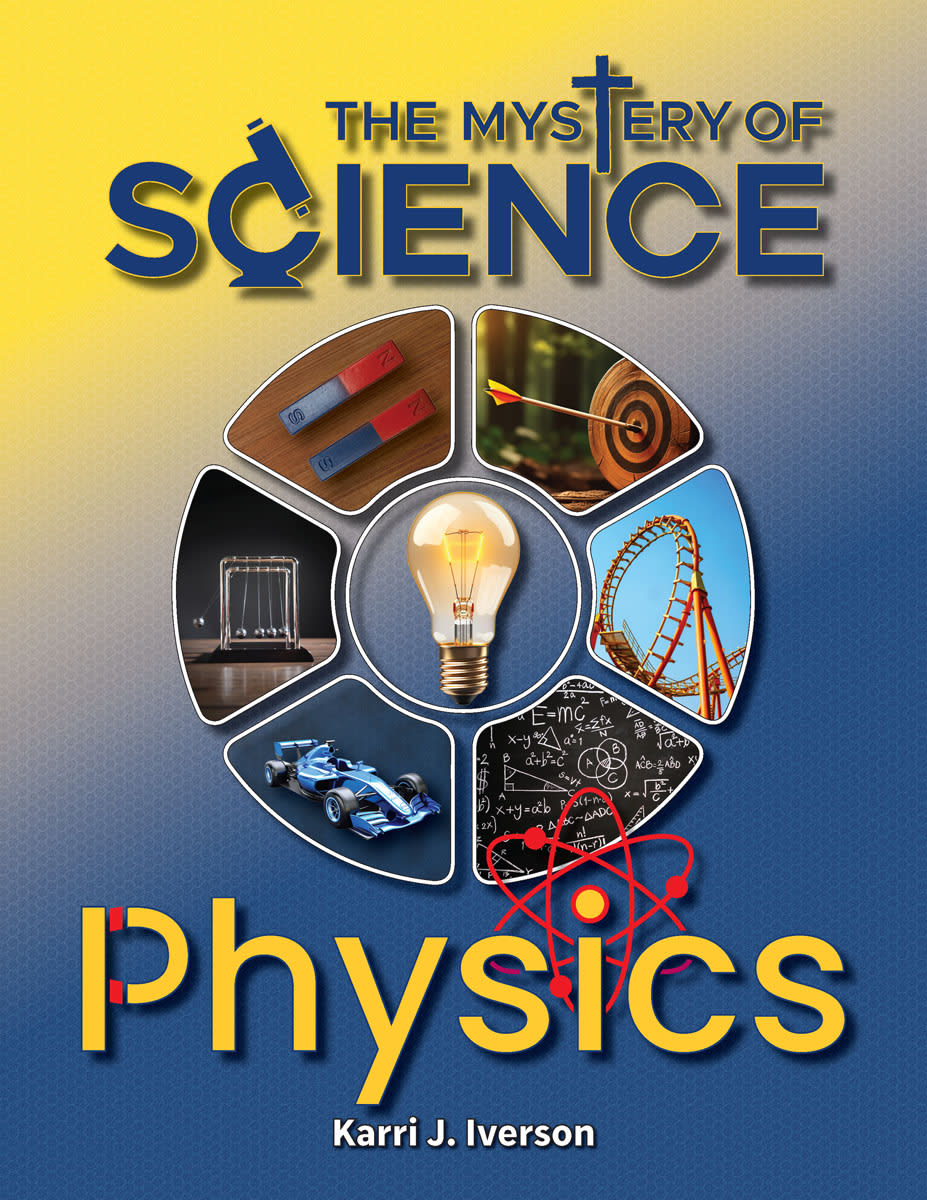



The Mystery of Science: Physics follows the same format as The Mystery of Science: Biology, and both are authored by Karri J. Iverson. Because of their similarities, I will repeat some of the information about the format from my review of the biology course.
The Mystery of Science: Physics introduces the world of physics to students in grades four through eight in a 32-week course. The course has two components: a Student Reader and a Lab Manual. The Lab Manual is a free download for those who purchase the Student Reader. You can also order a printed copy of the Lab Manual as a package of three-hole-punched pages.
Students will also need colored pencils, a charcoal pencil, and markers for their Lab Manual drawings plus supplies for activities and experiments.
Student Reader
The student book is a reader rather than a textbook. Near the front is a section for parents titled “How to Use This Curriculum.” The rest of the book is information for the student to read, presented on colorful, heavily illustrated pages. It also has an extensive glossary at the back. All written work is done in the Lab Manual.
The course has 32 lessons arranged into eight units:
- Foundations of Physics
- Parts and Pieces (about atoms, elements, subatomic particles, molecules, the periodic table)
- States of Matter
- Forces and Work
- Motion
- Energy and the Electromagnetic Spectrum
- Heat and Sound
- Attractive Forces
Each lesson in the Student Reader includes a sidebar with a list of vocabulary words and a scripture memory verse (from the New American Standard Bible). Each lesson also has a sidebar titled Creation Corner that showcases an intriguing example of God’s design in creation, such as the discussion of just a few of the factors that make Earth the “just so” planet that can support life. Following the Creation Corner, a “Meet the Physicist” section presents a brief biographical sketch of a key figure related to physics, such as Marie Curie, Katherine Johnson, Robert Boyle, and Daniel Fahrenheit. The lesson material itself often makes mention of God and points to evidence of a master designer, and God’s plan for salvation is presented after the eighth unit.
Each of the 32 lessons should take one week to complete, requiring two to three hours per week. It’s best if that time is broken into four or five sessions per week so that students can assimilate the material, review vocabulary frequently, and memorize the scripture verse.
The Lab Manual
The 367-page Lab Manual is more than a place for students to write up experiments. It's a critical part of the course, providing a variety of activities that make the course interesting. It’s more than a place for students to write up experiments. In addition to instructions for activities and experiments, it has suggested schedules listing what to do each day, a list of required resources for the activities and experiments, space for taking notes as students read through each chapter of the Student Reader, lines for writing definitions for vocabulary words, questions and charts to complete that review the chapter’s content, boxes for student sketches, questions to help students write their observations and conclusions, “Research It" assignments (to learn about a person or topic and write a short paragraph), and either a quiz or crossword puzzle to review each lesson’s content. Two semester tests are included.
Appendices include metric conversion tables, charts to be completed throughout the course on physicists and formulas, coloring pages, answer keys, formatted sketching and writing pages, and printable memory verse cards.
Very few questions require math, but the math should be manageable for fourth graders, and parents can assist as needed.
The relatively simple lab activities require mostly household and kitchen items, but some additional items students will need are Styrofoam balls, PVC pipe, a thermometer that can measure the temperature of a freezer, a miniature light bulb and light bulb holder, insulated copper wire, a 9-volt battery, and ring magnets.
Students will sometimes sketch the results of lab activities using space provided in the manual. For example, students will create a water molecule with toothpicks and Styrofoam balls then sketch it. In some cases, they can take pictures and paste them onto the pages instead. In addition to the water-molecule model, examples of other lab activities include making a model of a lithium atom with cookie dough and M&M’S; observing the changing volumes of gases with glass bottles, balloons, and hot water; and testing friction using pennies and furniture polish.
Some writing activities can be adapted to suit students’ abilities. For instance, in regard to research assignments, it says on page xi: “Younger students can write a couple of sentences or sketch a picture about what they learned. Older students can write 2-3 paragraphs about the researched topic.” It also suggests having younger students answer some questions orally, while older students write out their answers.
Since this is a printable file, parents can give students pages to complete as needed, and students should accumulate these in a binder.
Parental Involvement
The course is relatively easy to use once you have the necessary supplies on hand. Seventh and eighth graders might be able to complete much of the coursework independently, while younger students or those with weak reading skills should work more closely with a parent. Whatever the age of students, parents should do oral review of vocabulary and scripture memory verses with them. Parents will also need to supervise most of the experiments, evaluate student work, and oversee research assignments.
Summary
The Mystery of Science: Physics teaches physics on a very understandable and practical level that should engage students’ interest. The Lab Manual supports lessons in the Student Reader with an array of activities to reinforce and expand learning. Parents looking for a physics course that honors God should find it an excellent option.