


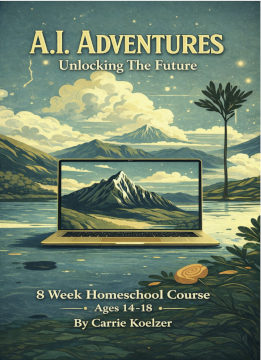
A.I. Adventures, a course designed for students ages 14 to 18 (or older), is structured as a practical, hands-on journey that moves from basic definitions of machine learning to school applications and the creative execution of business plans, podcasts, and blogs using free digital tools. Throughout the text, a strong emphasis is placed on ethical usage, safety guidelines, and parental supervision to ensure students navigate technology responsibly. The course is taught from a 96-page PDF textbook, presented in eight chapters:
- What Is A.I.? (The Big Picture)
- Using A.I. to Study Smarter – applying A.I to practical study skills
- Prompt Engineering – The Secret Language of A.I. The course emphasizes the importance of well-written prompts. An entire chapter teaches how to write prompts, and students are given detailed suggestions for what they might include in prompts throughout the course.
- Using A.I. to Build a Business (Idea & Planning)
- Using A.I. to Create a Podcast
- Using A.I. to Launch a Blog
- Using A.I. to Make a VLOG (Video Blog)
- Putting It All Together + The Future with A.I.
The course requires about three hours per week for eight weeks. Lessons have five components:
- Reading & Exploration – read and learn about the topic
- Hands-On Adventure Quest – start experimenting and working on a project through a series of quests with detailed instructions
- Knowledge Checkpoint – both short- and long-answer questions, followed by an answer key
- Creative Project – applying what was learned in a practical way. This is often a compilation of student work in Hands-On Adventure Quests. This example is from page 30:
Create an A.I.-Powered Study Guide for an upcoming test or challenging topic. Include: (1) A.I.- generated explanation of 3-5 key concepts in your own words (don't just copy A.I.'s response - rewrite it!), (2) 10 practice questions A.I. created for you (with answer key), (3) One mnemonic or memory trick A.I. helped you create, (4) Notes on which A.I. study technique worked best for you and why. Make this a real study guide you'll actually use!
- Base Camp Discussion – discussion questions that help students think through and evaluate what they are learning. Ethical considerations are raised in these discussions. While students complete most work independently, these weekly discussion prompts involve parents in what’s being learned. Parents also need to be present when students first use each new online tool.
What Devices and Online Tools are Required?
The course uses online tools that are free or have a free entry level, such as Google Gemini, ChatGPT, Claude.ai, NotebookLM, NoteGPT, Blogger.com, CapCut, and Canva. Students are not required to subscribe to or purchase anything more for the course! The course doesn’t teach students how to use all the tools. It often suggests two or three options, usually explaining which tools are easiest and which are more challenging but more flexible. While it provides quite a bit of information about using NotebookLM, it generally leaves students to figure out most tools on their own. (NotebookLM, free from Google, was new to me, and I think it's going to be one of the most valuable new tools!)
Students can work on any device with a web browser, but a screen larger than a phone is best for some projects. Students will need headphones or earbuds connected to their device. Access to a printer is helpful, as well as access to a smartphone or camera for weeks five through seven.
Students should keep a notebook as they learn, whether digital or handwritten, and they will create a portfolio and presentation of what they have learned in Chapter 8.
Worth Noting
- The textbook points out that A.I. isn’t perfect, and students must check important facts for accuracy. It also points out that A.I. has biases that must be taken into account.
- The lesson for the fourth week has students come up with a business plan that they can actually put into action, but it doesn’t discuss any legal issues, such as getting a business license, choosing a business name, tax issues, etc. It’s meant to be a primer for a teen business, but some of the ideas generated could actually turn into well-paying ventures, so teens must understand other aspects of starting a business if it has serious potential.
- Regarding starting a business, a podcast, blog, or Vlog, the course doesn’t discuss promotion or marketing, so students need to learn about that aspect elsewhere if they are serious about creating an income stream.
Summary
This A.I. Adventures course doesn’t fit into the standard curriculum, but A.I. skills have already become essential for many careers as well as for use in everyday life. Students need to learn them, and adults who want to be prepared for the A.I. revolution that’s already happening should too.