


Curious about the origin of sayings like “Lock, stock, and barrel,” or the identity of the author of the first English dictionary in America? Can you come up with ten words that begin with sub-? Questions like these—often with multiple-choice answers—are the mainstay of the League of the Lexicon game.
League of the Lexicon is a word game about word meanings, origins, usage, grammar, literature, and linguistics that uses question cards and additional twists to make play interesting.
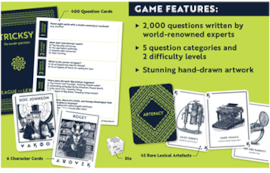
The game comes in a sturdy, partitioned storage box, with 400 question cards (4.75” x 4”), six character cards, 45 artifact cards, a rules booklet, and a custom die. The character and artifact cards are slightly larger than standard playing cards.
The question cards, with 2,000 questions in all, are divided into two levels of difficulty; 300 of the question cards are at the "Tricksy" level of difficulty, and 100 are at the slightly easier “Ticklish” level. The Ticklish level is like an expansion pack, and three other expansion packs are also available, which I will discuss later.
Both Tricksy and Ticklish cards have five categories of questions per card. The custom die is rolled to determine which question a player or team must answer. The “player’s choice” symbol on one side of the die allows the choice of any category.
The five categories are Lexicon Master, Meaning & More, Usage & Abusage, Word Sauce (word meanings and origins), and Wordly Wisdom (definitions, linguistics, literary history, and more).
Examples from each category from Tricksy card 180 are:
- Lexicon: “Name ten names for female animals.”
- Meaning & More: “Which is NOT a unit of measurement for distance?” – multiple choice answers are lot, cubit, league, and rod.
- Usage & Abusage – “Which sentences is considered CORRECT?” Four sentences follow, three of which have grammatical usage errors.
- Word Sauce – "Which origin story is UNTRUE?" It lists four options, the first of which is “‘Deer’ originally referred to any four -legged animal.”
- Wordly Wisdom – “The Chinese writing system is what?” – multiple choice from logographic, phonetic, pictographic, and syllable.
Players win artifact cards by answering correctly, and you can check for correct answers and explanations on the reverse side of each card. Players are likely to do better with some question categories than others, but rolling the die usually eliminates the opportunity to select their favorite category, adding chance to the game. In addition, each player or team has a character card with symbols at the bottom that match some of the artifact cards. The goal is to be the first to acquire five artifact cards that match symbols on your character card. The rules explain ways to exchange cards without matching symbols. Collecting artifact cards adds another chance element because of the potential difficulty in acquiring those that are usable. A “decider question” also must be answered before a player or team can declare victory. Several variations are suggested in the rules booklet for solo play, teams, quicker games, longer games, and more devious games.
The original UK edition, available for any of my readers who speak British English, has the same setup, with slightly different cards.
Expansion Games
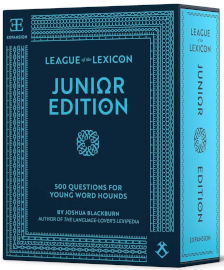 Three expansion games—Junior Edition, Global Edition, and Slang Edition—each come in a sturdy slipcase box with 100 cards (500 new questions) and their own rules book. Rules are pretty much the same for all games.
You could use only the questions in these expansion games without buying the main game, League of the Lexicon, but you would be missing the gamification elements: character cards, artifact cards, and the die.
Of the expansion games, the Junior Edition is the one I recommend to homeschoolers since it’s easier than even the Ticklish level. It’s usable with junior high students and maybe super-bright younger students. Its five categories are slightly different: Lexicon Master, Usage and Abusage, Meaning and More, Word Wise, and Word Play.
I did not review the Global Edition or the Slang Edition, but from what I see on the publisher’s website, I’d save the Global Edition for professional linguists. The Slang Edition is described as “Not for children or the easily offended!”, so I’m not recommending it either.
Summary
League of the Lexicon should appeal to word lovers who enjoy competition.