

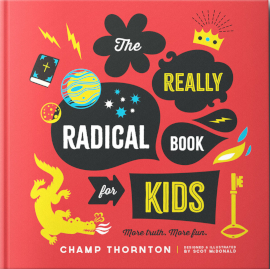
The Radical Book for Kids and its sequel, The Really Radical Book for Kids, are perfect for kids about eight through fourteen. They combine Bible study with inspiring biographies, challenging faith questions, life applications, apologetics, and activities in a graphically rich format. I don’t usually review books like these, but they are so good that my readers need to know about them.
One of the first things to note is that near the front of each book, a presentation page is to be filled in by the person gifting the book to a young person. These are lovely hardcover books that make great gifts for a special event or a rite of passage.
The books assume that the reader is already a Christian, although the second book includes a lesson titled "How to Become a Christian." That might sound counterintuitive, but many young people growing up in Christian homes assume they are Christian without ever making a personal commitment.
Chapters are short and very readable, and they include lots of graphics and full color. They are written directly to young people for personal study rather than for groups. For example, the third lesson in the second book, “Exploring Proverbs,” talks about three types of fools, and how to avoid being any one of them. This sort of lesson in a classroom might instigate teasing about being fools and might inhibit the authentic introspection that’s called for. Even so, the first book has a QR code for a downloadable discussion guide for adults who might want to discuss the lessons with children.
These books have no questions to answer and turn in, and don’t require discussion with a parent or teacher. That makes them perfect for young people who are ready to encounter scripture on a personal level and examine their thoughts, attitudes, and choices in light of what they learn.
While both books are recommended by the publisher for the same age range, I would start with the first book with children eight to ten years old. For example, both books begin with a lesson about the Bible. The first book sums up the message of the Bible in one sentence, keeping it simple. The second book presents three analogies for ways to read and understand the Bible—a more sophisticated approach. The first book presents many lessons about the Bible and church history (from a Protestant viewpoint), while the second book delves more specifically into Genesis, Mark, Proverbs, and Romans, with briefer mention of other Bible passages.
Some lessons can be read out of order, and young people might find some particularly suitable for particular situations. For instance, lessons in the first book, such as, "What to Do When You're Angry" and "How to Clean Your Room," are particularly apt when a child is angry or is overwhelmed by the idea of cleaning their room.
These books are not difficult to read and understand, but they challenge young people to examine their lives, beliefs (even about the existence of God), and actions in light of scripture. They include the message of salvation but go much deeper. For instance, Lesson 27 in the second book, “Exploring Romans,” explains why Paul wrote the letter to the Romans and goes on to present a contrast between the Kingdom of Darkness and the Kingdom of God. Heavy topics are balanced by occasional humor, superheroes, and popular culture. There’s even a chapter in the second book titled, “Humor in the Bible.”
Both The Radical Book for Kids and The Really Radical Book for Kids address many questions that young people often struggle with. They sometimes teach by asking leading questions and leaving students to reflect on their responses. Those who already have firm convictions about their beliefs might learn ways to address these questions when asked by others—good training for apologetics.
The books include inspirational biographies—several shorter ones in the first book about Polycarp, Athanasius, Augustine of Hippo, Amy Carmichael, Lottie Moon, C.S. Lewis, John Huss, Martin Luther, John Bunyan, and Charles Spurgeon, and four lengthier ones in the second book about Hannah More, Pandita Ramabai, Lemuel Haynes, and Eric Liddell.
A few fun activities are included, and they relate directly to lesson content. For instance, Lesson 65 in the first book about weapons in the Bible includes instructions for making a catapult, and Lesson 17 in the second book tells about the cube shape of the New Jerusalem discussed in Revelation 21:16, and then has students construct an origami cube from six 4- to 5-inch squares of paper.
Summary
I found out about these books because Heart of Dakota uses them as part of their Bible component within their Creation to Christ (for ages 9 to 11) and Missions to Modern Marvels (for ages 12 to 14) courses. They tie in beautifully with themes within those courses but can also be used on their own. While both books can be used as Bible curriculum if you don’t need evidence of accountability, they probably work best for personal growth and development.