

The Heart of Dakota program is a comprehensive, Charlotte Mason oriented curriculum in 12 volumes that can be used for preschool through high school. Many of the courses can be extended to cover older students by using additional resources; schedules for those resources are in an appendix in those books.
Titles and grade levels covered are:
- Little Hands to Heaven, ages 2-5
- Little Hearts for His Glory, ages 5-7
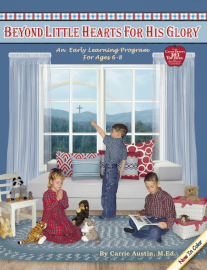
- Beyond Little Hearts for His Glory, ages 6-8
- Bigger Hearts for His Glory, ages 7-9 (extending to ages 10-11)
- Preparing Hearts for His Glory, ages 8-10 (extending to ages 11-12)
- Hearts for Him Through Time: Creation to Christ, ages 9-11 (extending to ages 12-13)
- Hearts for Him Through Time: Resurrection to Reformation, ages 10-12 (extending to ages 13-14)
- Hearts for Him Through Time: Revival to Revolution, ages 11-13 (extending to ages 14-15)
- Hearts for Him Through Time: Missions to Modern Marvels, ages 12-14 (extending to ages 15-16)
- Hearts for Him Through High School: World Geography, ages 13-15 (extending to ages 16-18)
- Hearts for Him Through High School: World History, ages 14-16 (extending to ages 17-18)
- Hearts for Him Through High School: U.S History I, ages 15-17 (extending to twelfth graders)
- Hearts for Him Through High School: U.S History II, ages 16-18
In this review, I will cover the series up through the Hearts for Him Through Time courses. I review the high school courses in a separate review.
The courses are biblically based and are written from a Protestant point of view. While this is obvious in the bible lessons, it also underlies history, science, and other subjects.
Each volume is a one-year curriculum, divided into 33 to 35 units, each of which will take one week to complete. The large book for each course is your primary resource. (First-edition books are perfect bound and printed in black and white, while second and third editions are full-color and spiral bound.) Each book lays out daily lesson plans that cover everything that you need for that level. The subject areas covered and the amount of emphasis upon each vary from volume to volume as is appropriate for each level. Instructions for learning activities are written out in each book.
While some of the activities at lower levels for math and grammar direct you in the use of other resources, at upper levels most of the math and grammar is learned through other resources. Read-aloud assignments also rely upon other books.
In every volume, each daily lesson plan is divided into two parts: Learning the Basics and Learning through History. Each subject area is presented in a box with between nine and twelve boxes per daily lesson plan. This makes it very easy to see what needs to be done for each area. Lessons begin with history each day. The Learning through History parts of the lesson on the left-hand page are designed like a unit study. Daily assignments for history tell you which pages to read in the history book or Bible storybook (or your own Bible) and the key idea upon which to focus. That key idea is also incorporated in Bible, art, thinking skills, science, or some of the other lessons for that day. Learning the Basics activities on the right-hand page don’t necessarily relate to the theme, but they cover language arts, math, fine arts, and other necessary subjects. For all subject areas, specific pages (tracks in the case of audio CDs) are assigned in each day’s lesson plans for the other required resources. This is a huge time saver.
The guides from Bigger Hearts for His Glory and up require a separate set of student notebook pages. These are printed in full color and are not reproducible, so a set will be needed for each student. These pages include map work, graphic organizers for students to complete, plus space for writing assignments.
Beginning with Bigger Hearts for His Glory, extension resources and activities are listed so that you can accommodate older learners and teach more than one child the same subject matter, at least part of the time. Reading schedules are included in an appendix in each volume rather than within the lessons.
Author Carrie Austin says that completing all the activities should take about 1.5 hours a day for Little Hearts, 2 to 2.75 hours per day for Beyond Little Hearts, and about 3.5 hours per day for Bigger Hearts. It becomes much more difficult to predict time requirements for upper-level volumes. This is because students do more independent work, and you will have several choices depending upon the needs of each student. Although the assumption is that you will complete all subject areas each day, you will find that skipping a subject now and then won’t cause lasting harm, particularly in the first three volumes.
Science experiments and activities are included in all volumes, and you are referred to other books for additional science reading at each level. Science notebooking assignments are added beginning with Bigger Hearts, while recording data and observations with lab work are added at upper levels. In the elementary grades, science focuses on fewer topics per year than we typically find in textbooks, but science lessons do a great job of covering those topics interestingly and in-depth with plenty of observation and experimentation.
For the youngest levels, hands-on math activities are given in the manuals, then assignments are made from Singapore Math books at the appropriate level. Heart of Dakota also offers courses from Exploring Creation with Math, Math with Confidence, and several other options for math. Programs for middle school drop the hands-on activities. Math assignments are very specific, with alternative page assignments at the back of the book for the different levels of Singapore Math books that you might be using. While schedules for some math programs are included in the Heart of Dakota volumes, most other math programs purchased through them come with schedules. (You can always substitute any other math program if you prefer.)
Details for Heart of Dakota Courses
Little Hands to Heaven
Little Hands to Heaven serves as a preschool program teaching letters, sounds, numbers, pre-reading and pre-math skills, music, art, and Bible—all with lots of physical movement and hands-on activity.
Little Hearts for His Glory, 2nd edition
In Little Hearts for His Glory, the subjects and skills covered are history, Bible, language arts, phonics, math, art, story time, dramatic play, music, thinking skills, and both fine and gross motor skills. History readings come from the Christian Liberty Press (CLP) books History for Little Pilgrims, History for Little Pilgrims Coloring Book, and History Stories for Children, as well as a Bible storybook and a series of 30 Visual History picture books. The Visual History books are scheduled in a box titled "Picture the Past." The colorful storybooks tie directly with the historical timeline of the course to help children visualize people, events, and places. Picture the Past bookmarks—one per picture book—have discussion questions on one side and a "Picture Hunt" on the reverse. The bookmarks engage children more deeply in the content of each book. Children learn a great deal of Bible history and U.S. history in Little Hearts! Even if you use only the Visual History books and Picture the Past bookmarks, it would provide a great introduction to the story of history for young children.
In addition to Bible stories that are read in relation to history, children memorize a Bible verse in each unit that coordinates with a song from Hide 'Em in Your Heart V.1, and parents read aloud from the devotional book, The Magnificent Names of Jesus. Heart of Dakota's colorful Scripture Memory Cards help students visualize the verses and include a section to color.
Minimal instruction is given for phonics directly within Little Hearts. Instead, suggestions are made for the number of pages or lessons per day to complete in Learn to Read Activity Book, Reading Made Easy, Learn to Read/REAL Phonics, or The Reading Lesson. You may also use another phonics program of your choice. See my separate reviews of the options for reading programs. Storytime books add read-aloud picture books to expand children's exposure to good literature, and guiding questions in the lesson plans help children get the most from these books.
Math boxes in the lesson plans specify assignments from Essentials Kindergarten Math A & B, Singapore Primary Mathematics 1A &1B (both courses are from Singapore Math), Math With Confidence K or 1, and Apologia Math Level 1.
Other required resources are one of two Rod and Staff workbooks for fine-motor skills and a handwriting book from either the Getty-Dubay Italic Handwriting series or A Reason for Handwriting series,
Appendices in Little Hearts include pacing instructions for the phonics options, descriptions of both the Storytime and Visual History books, and a “Rhymes in Motion” section with rhyming songs that incorporate large muscle movements.
Beyond Little Hearts, 2nd edition
Beyond Little Hearts covers history, Bible, devotions, geography, timeline, art, science, poetry from classic poets, grammar, spelling, copywork, literature study with read-aloud books, math, and music. The overall plan is very similar to Little Hearts, but the level of difficulty and time required for each subject are greater.
Required history resources include three Christian Liberty Press titles with an early American history theme and the Visual History set. The Visual History set of 29 picture books correlates with history coverage in the three CLP books. Assignments for Visual History are in the Beyond Little Hearts guide, in a box titled "Picture the Past." The Visual History set includes 29 Picture the Past bookmarks—one for each book—with discussion, comprehension, and narration questions on one side and a "Picture Clues" activity on the reverse. Picture the Past activities help provide history coverage while also working on several language arts and critical thinking skills.
Beyond Little Hearts offers reading plan options depending on whether a child is a beginning, emerging, or independent reader. For beginners, it recommends Real Phonics, Reading Made Easy, or The Reading Lesson. For emerging readers, Heart of Dakota publishes their Emerging Reader's Sets for two levels. Emerging Reader's Set 1 might be used along with Beyond Little Hearts for students who have completed phonics instruction and are beginning to read on their own. Spelling lists (two for each unit) are found at the back of the book along with an annotated bibliography of storytime read-aloud books that correlate with each unit. Copy the Classics, a new book from Heart of Dakota, has a poem for each unit along with copywork exercises.
Bigger Hearts for His Glory
Bigger Hearts for His Glory again advances in difficulty and skill levels as well as in the time required for lessons. While each day’s lesson is still presented on two pages, there are now ten boxes per day with a smaller font size used to fit more information. Bigger Hearts covers history, biblical character traits, history, timeline activities, art, geography, math, hymns, English, spelling, vocabulary, and classic poetry. It has literature study plans for read-aloud books. For science, students learn from real books and experiments, responding with oral narrations and the creation of a science notebook. Options for teaching cursive handwriting are included.
For English, lesson plans are included for your choice of two levels of Rod and Staff's English courses: Preparing to Build: English 2 or Beginning Wisely: English 3. An appendix titled “Poetry and Rhymes” presents one poem for each unit.
The first edition of Bigger Hearts has a detailed schedule of reading for emerging readers that gradually increases in difficulty. But Heart of Dakota now publishes their Emerging Reader's Sets for two levels, either of which might suit children at this level. Emerging Reader's Set 1 can be used with students who have completed phonics instruction and are beginning to read on their own. Emerging Reader's Set 2 is for students ready to start reading easy chapter books. You might instead use Drawn into the Heart of Reading: Level 2/3.
Dictation passages, spelling lists, and suggested read-aloud titles are found in the appendices. The read-aloud books are much more than supplemental bedtime stories. These are carefully correlated with the rest of the program to cover different genres of literature and to teach story elements, character traits, and narration skills.
The study of American history continues up through the 1970s using more of a biographical approach. A separate set of full-color notebooking pages is used to reinforce history and geography. These gorgeous pages make the notebooking assignments easy since students get to work on pre-printed pages rather than from scratch.
Preparing Hearts for His Glory, 2nd edition
Preparing Hearts for His Glory adds beginning research skills and guided written narrations. Students have a set of beautifully illustrated Student Notebook pages in three sections: written narrations, vocabulary, and timeline cards.
For Bible, students read A Poetic Retelling of John Bunyan's Classic Tale, The Pilgrim's Progress and a retelling of the story of the prodigal son in The Long Road Home. Scripture verses related to both stories are printed on a set of 35 Quest Scripture Cards—one side has the verse, and students copy the verse onto the reverse side. Students track their progress on the included Quest Charts by affixing stickers. They also learn 12 classic hymns (including a few that are patriotic) in Hymns for a Kid's Heart, Volume Two—a beautiful book and CD combo.
History and geography stretch from creation to the end of the twentieth century using A Child’s History of the World, Indescribable Atlas Adventures, several read-aloud books, the set of Visual History picture books for independent reading, and Visual History notebook pages for copywork, drawings, and listing information from the picture books. Students draw and write on the Timeline cards in the course's Student Notebook, then cut them apart and mount them as directed.
Science corresponds loosely with history studies. For example, the study of the stars correlates with reading about the magi mentioned in the Bible, as well as with the study of ancient civilizations where astronomy played an important role. For science, students read biographies of Columbus, da Vinci, and Einstein, along with several other books. They will maintain a science notebook with answers to questions, brief written entries, drawings, and notes on weekly experiments and observations.
For language arts, literature, grammar, composition, handwriting, and spelling are taught from several recommended options. Vocabulary practice words and activities on Student Notebook pages are drawn from history stories. Dictation activities help develop spelling skills, and spelling word lists are included in the appendix for those who prefer a practice, drill, and test approach. Classic poems by Robert Louis Stevenson (also found in the appendix) are used for several activities described in the Poetry box of the lesson plans.
Students are expected to do more independent study at this level than at younger levels, and there is an increased emphasis on academics.
Hearts for Him Through Time: Creation to Christ, 3rd edition
Hearts for Him Through Time: Creation to Christ expands student research skills and builds independent reading and self-study into the lessons. Self-study assignments include reading, listening to audio CDs, and the completion of written assignments, projects, timeline activities, copywork, map work, painting, and more.
Creation to Christ covers both ancient and biblical history using resources such as The Story of the Ancient World, both Ancient Greece and Ancient Rome from the Streams of History series, and A Child’s Geography Vol. II. Students will also work on a hands-on project three days per unit.
The science package, completely redone for the third edition of Creation to Christ, explores many facets of life science with books, cards, and kits. Resources in the package include Home (a gorgeous book by Isabelle Simler about wildlife homes), Nature School, Nature School: the Workbook, God's Big Book of Animals, An Illustrated Adventure in Human Anatomy, Creature Card Snapshots: 60 Collectible Creature Cards, and two kits. The Human Body: Anatomy Adventure Kit has eight hands-on activities related to human body systems. The Creation to Christ: Science Kit (created with Creature Crew specifically for this course) has five mini-kits (with many activities), binder dividers and large cards with information, and five colorful, 12-page magazines with even more information and activities. Nature School is an information book that concludes each of its five units with several hands-on activities. You can read my review about the information book, but that review does not describe the companion Nature School: The Workbook, which supports the information book with writing, drawing, worksheets, games, and hands-on activities. The Creature Card Snapshots have an image on one side, and the reverse has formatted sections for students to write detailed information, such as the classification order and family, and a description. Note the frequent mention of hands-on activities in several resources. All the science resources are coordinated in a very organized fashion through the daily "Science Exploration" boxes in the Creation to Christ guide. (This science kit provides a close to perfect blend of colorfully presented information, active learning, and written work.)
Language arts lessons rely on the use of either the fourth or fifth level of Rod and Staff's English series, Writing and Rhetoric (both Book 1 and Book 2), and Drawn into the Heart of Reading. Spelling is addressed through dictation and copywork. Three different levels of dictation passages are included in the appendix. Copywork is from poems by Robert Frost, which are presented in Paint Like a Poet. Watercolor lessons in this same book have students paint scenes that correlate with the poems. Heart of Dakota offers three different book sets to choose from for read-aloud storytime. Older students can follow an independent reading schedule of history-related titles that is found in the appendix.
The Radical Book for Kids, The Bible Study in Stereo: Philippians 2 CD, a set of Scripture Cards for learning Philippians 2, and either The Illustrated Family Bible or your own Bible are used for Bible study and memory work, but many other resources, such as the audio CD What in the World? Volume 1, also teach about the Bible.
Schedules for several different Singapore Math courses are in the appendix, but courses from Apologia Math and Math with Confidence are also recommended.
Hearts for Him Through Time: Resurrection to Reformation
Hearts for Him Through Time: Resurrection to Reformation continues to move students toward more independent learning. This level also turns attention toward becoming a Godly young man or woman with a biblical Christian worldview. To that end, it leads students in a study of Philippians along with either Boyhood and Beyond or Beautiful Girlhood. History study uses a distinctly Christian approach to cover the period from the Resurrection through the Reformation. Earth science is the theme for science studies with different options available depending upon which books have been used in previous years.
Other resources included in the basic package are Redemption: The Church in Ancient Times; Reign: The Church in the Middle Ages; The Story of the Middle Ages; Famous Men of the Middle Ages; The Mystery of History: Volume 3; What in the World?: Romans, Reformers, and Revolutionaries (audio); Draw and Write through History; a collection of read-aloud books; World History Atlas; Map Trek Atlas; Map Trek Outlines; Lamb’s Tales from Shakespeare; Shakespeare Student Notebook; Looking at Pictures; Drawn into the Heart of Reading; either Building With Diligence or Following the Plan (Rod and Staff English); Writing and Rhetoric! Book 3 and Book 4; Exploring Creation with Astronomy; A Child’s Geography; and Exploring Planet Earth.
Hearts for Him Through Time: Revival to Revolution
Hearts for Him Through Time: Revival to Revolution begins with the mid-1700s and continues through the 1900s. While it covers some world history, U.S. and church history dominate. Optional study of the 50 states is included. Science highlights inventors and physical science.
Key resources are Renewal: The Church That Expands Outward, George Washington’s World, The Story of the Great Republic, The Growth of the British Empire, The Story of Napoleon, a collection of read-aloud books, Drawn into the Heart of Reading, Who Is God? And Can I Really Know Him?, What in the World? Vol. 3, Heroes of Faith: The Hidden Treasures in Hebrews, Draw and Write Through History, United States History Atlas, Map Trek Atlas, Map Trek Outlines, Scripture Cards: Hebrews 11:1 – 12:3, either Following the Plan or Progressing With Courage, Imitation in Writing: Fairy Tales, a composer study package, and a science package that includes 10 biographies and books related to inventions plus the Exploration Education Standard Physical Science kit. Students ready for a higher level of science can substitute the Exploration Education Advanced Physical Science kit.
Hearts for Him Through Time: Missions to Modern Marvels, 3rd edition
Hearts for Him Through Time: Missions to Modern Marvels covers the 1890s through modern times. In this volume, U.S. history is interwoven with world history along with stories of Christian heroes and modern missions. A Bible Quiet Time, new with the third edition, ties in somewhat with the historical theme. Among the required resources for history are The Story of the World: Volume 4, Hero Tales (Volumes II and III), and Map Trek: Missions to Marvels. A President Study and an optional Individual State Study are included.
Bible Quiet Time requires two books and a set of Scripture Cards. The books are Best News Ever: Your 100-Day Guide to the Gospel of Mark and The Really Radical Book for Kids. Students read from the Bible as directed by assignments in these books, and they write in a blank journal in response to questions posed in Missions to Modern Marvels regarding lessons in both books. Students use the set of Scripture Cards with passages from Mark's gospel for memorization and recitation. The cards have complete verses on one side and the same verse with some blank lines on the reverse to help quiz students.
Assignments under "Worthy Words" have students read, analyze, and evaluate famous speeches from Book of Great American Speeches for Young People. This helps tie together history and language arts.
For language arts, you are given several choices, among which are Drawn into the Heart of Reading, Progressing with Courage: English 6 (Rod and Staff), Writer's Roundup, and Writer's Gold Mine. However, you can substitute other resources for literature, grammar, and composition if you wish.
Science topics focus on an introduction to chemistry as well as on creation versus evolution from a Christian viewpoint. Some of the required resources are Exploring the World of Chemistry by John Hudson Tiner, Chemistry C500 Experiment Kit by Thames and Kosmos, Genetics & DNA Experiment Kit by Thames and Kosmos, and Evolution: The Grand Experiment (DVD and book set).
For math, schedules are included for Mastering Essential Math Skills, either Book 2 or Pre-Algebra, and Principles of Mathematics, either Book 1 or Book 2. Additional math options are suggested near the front of the book.
Assignments for poetry and art are combined in a box in the guide titled Nature Painting. Heart of Dakota's Paint Nature's Palette provides the poems, photographs, and a beautiful layout for students to insert their completed watercolor projects. The book Watercolor in Nature is a beginner-friendly book that teaches watercolor skills through specific projects that correlate with the poems. (The watercolor instruction covers many skills and is also suitable for adults.)
Economics and Bible study are also covered using Common Sense Business for Kids, Whatever Happened to Penny Candy?, and Faith at Work: Romans, Galatians, & James.
Summary
I like the way Carrie Austin has combined elements of unit study, living books, and textbooks in a format that makes it very easy for the parent or teacher to know exactly what to do each day. Art and math lessons might take a little more preparation time than other subjects, but other than that, lesson prep time is very minimal. The variety of learning methods should appeal to children of various learning styles.
While courses follow a historical chronology, you can begin at any level. For each course, you can purchase the main lesson plan book by itself and gather the other resources on your own, or you might want to purchase one of the economy, basic, extension, or deluxe packages from Heart of Dakota. Package options become increasingly complex as you move up to higher grade levels. See the publisher's website for all of the options.