

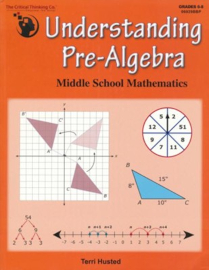
Understanding Pre-Algebra: Middle School Mathematics is labeled as a course that can be used with grades six through eight. However, it follows Mathematical Reasoning: Level G, which is designated for sixth grade, so it’s most likely to be used in grades seven or eight. Students completing this course should be prepared for an algebra 1 course, particularly Understanding Algebra I by the same author. (You might want to supplement with the first half of another book by this author, Essential Algebra for Advanced High School Math and SAT, which provides more in-depth work on the most troublesome topics.)
Understanding Pre-Algebra is self-contained in a 442-page book that includes a final exam and a 68-page answer key. Its 15 chapters teach the following topics:
- Family of Numbers
- Working With Integers
- Working With Rational Numbers
- Ratio, Proportion, and Percent
- Percent Applications
- Algebraic Expressions
- Equations and Solving Word Problems
- Inequalities and Applications
- Understanding Square Roots and Irrational Numbers
- Two-Dimensional Geometry
- Understanding Volume and Surface Area
- Graphing on the Coordinate Plane
- Transformations and Congruency
- Understanding Functions
- Probability and Statistics
Author Terri Husted explains in the introduction that the course is standards-based and “organizes concepts in a logical fashion, stressing practice and critical thinking.” Connections are made between concepts to form a foundation for further math studies. Husted also teaches strategies for solving word problems, again, working toward understanding concepts rather than just learning mathematical procedures. Critical thinking is required more than in most other pre-algebra courses. For instance, even the first lesson has practice problems that require thinking skills, such as the fifth problem, which asks, “Show why 51 and 57 are not prime numbers. Explain your thinking.” The phrase, “Explain your thinking,” appears at the end of many problems in this course.
Chapters include only problems on topics taught in that chapter. Even the end-of-chapter reviews limit questions to chapter topics. Only the 69-question final exam has questions drawn from all chapters.
Lessons follow the standard sequence of instruction, examples, and practice problems. Early in the course, lessons review concepts relating to fractions, decimals, and percents. New concepts are introduced incrementally. When it teaches algebra, it presents only problems with one variable. The numbers involved in the problems are kept simple enough that students can learn concepts without being distracted by arithmetic processes with large numbers. For example, page 171 presents a word problem with an illustration of a rectangle with sides labeled 2w and w. The problem asks, “In this rectangle, the length is twice the width. What are the biggest integer dimensions possible if the rectangle has to have a perimeter that is less than 120 feet?” This type of problem introduces students to algebraic thinking in a simple manner, and they might be able to solve it in their heads. Students are allowed to use a calculator when needed, but it should be used sparingly.
The last three chapters on transformations, congruency, functions, probability, and statistics include some material generally covered in algebra 1 and geometry. The short chapter on functions, Chapter 14, primarily teaches the nature and use of functions, serving as a preview rather than a deep dive into the topic. Chapters 13 and 15 are lengthier and delve more deeply into their subject matter than is required for junior high. I wouldn’t recommend skipping the entire chapters, but parents might skip some subtopics within those lessons for now.
The book’s pages feature a relatively large font and are uncrowded. Students should have room to answer problems in the book. Even questions that require Cartesian grids provide grids immediately beneath the problems. Problems sometimes include illustrations that make it easier for students. For instance, pages 225 and 226 present six problems under the question, “Find the area of these circles. Leave your answer in terms of PI. Label your answers.” Each problem shows a circle with either the radius or diameter drawn in and labeled. These problems could have provided only the lengths without illustrations, but the illustrations help students differentiate the two types of measurement and become familiar with how to use them with the formula for the area of a circle. All these features make the course appear less intimidating than many other math courses for junior high.
Summary
Understanding Pre-Algebra might be useful for the advanced sixth grader or for average seventh and eighth graders, depending upon their previous learning. Some pre-algebra courses go further than Understanding Pre-Algebra to include work with two or more variables and more in-depth applications of exponents and roots. The author’s Understanding Algebra 1 and Understanding Geometry (which might also be used in junior high) courses might be the easiest route to follow for students who need less demanding high school math courses. Nevertheless, students should be prepared for most algebra 1 courses from other publishers.