

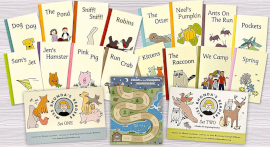
Miss Rhonda’s Readers were originally designed for Montessori programs, but they can be used alongside most phonics programs. There are two sets with eight readers per set (each four to eight pages long) and two chapter books with 70+ pages each. All the readers, including the chapter books, feature large illustrations and no more than two sentences of text per page. The illustrations generally provide context clues that might help children figure out the words.
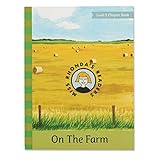
The content is wholesome. The short readers feature topics such as a pig, a pond, Spring, and camping. The Level 2 Chapter Book: On the Farm presents six stories related to farm life, and Miss Rhonda’s Readers 3: Around Town with Miss Rhonda features five animal stories and one about sources of light used when the power is out.
All the readers are very colorful and have a high-quality feel. Much of the artwork is done in earth tones and natural colors. The short readers are printed on sturdy cardstock, while the pages of the chapter books are heavyweight paper. The font is easy to read, and the letters a and g are printed like a and g, similar to what children learn to print.
The introduction of words with phonetic elements is similar to a systematic phonics program, but the readers include some more difficult words earlier than strictly vocabulary-controlled readers do. The short books are for beginning readers but don’t limit the vocabulary in the first few readers to consonant-vowel-consonant words and words like an, on, and is as we usually find in beginning phonetic readers. Instead, the first reader, Pink Pig, uses the more difficult words pink and cool, and the second reader, The Pond, uses words like pond, still, stick, jumps, and swims. This means that the readers need to be introduced after students have begun to learn some words with consonant digraphs and other phonograms that are beyond the first part of a reading program, or else learn these as sight words.
Heart of Dakota Connection
The publisher doesn’t offer instructions for using these readers, so you might consider following plans from Heart of Dakota. I was sent these readers to review as part of Heart of Dakota’s phonics program options for kindergarten and first grade. They have created schedules and instructions for using these readers alongside the two volumes of Learn to Read Homeschool Version and the single-volume The Reading Lesson. The schedules direct the use of the first Miss Rhonda Reader with Learn to Read Book 2 or beginning in Lesson 6 of The Reading Lesson. The second set of readers can be used starting with Lesson 9 in The Reading Lesson. The two chapter books correlate with The Reading Lesson as it moves on to more complex reading skills in Lessons 14 through 20. The work Heart of Dakota has done to integrate these resources is very helpful.
Heart of Dakota’s comprehensive programs, Little Hearts for His Glory (for ages 5-7) and Beyond Little Hearts for His Glory (for ages 6-8), both list several options for reading programs, including Learn to Read, The Reading Lesson, and Miss Rhonda’s Readers. However, they also sell the reading programs on their own. In addition, Heart of Dakota sells two progress charts with stickers: “Climb to the Campsite” is used with the first two sets of Miss Rhonda’s Readers, and “Up, Up, and Away” is used with the two chapter books.
Summary
Miss Rhonda’s Readers have a lovely feel and look, and their content makes them usable alongside most reading programs. However, the integration might be tricky if you don’t have a plan to follow.