

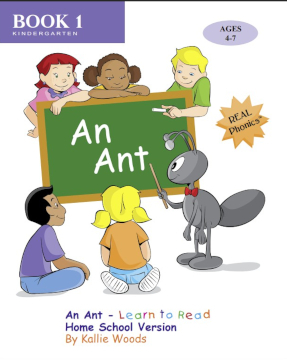
Learn to Read is a set of two books: Book 1: An Ant – Learn to Read Home School Version and Book 2: Learn to Read with Real Phonics Homeschool Version. Book 1 is recommended for ages four through seven and Book 2 for ages five through seven. Homeschoolers will usually begin Book 1 in pre-kindergarten or kindergarten and finish both books before first grade. The approach used in these books is trademarked under the name REAL Phonics™.
There are no separate teacher guides. The required flashcards can be cut out from the full-color pages at the back of each book, but you might want to purchase flashcards printed on cardstock.
These books differ from most other phonics programs in a few ways. The approach used in these books is trademarked under the name REAL Phonics™. Letter recognition is taught apart from the letter’s sounds. Book 1 teaches reading, writing, and sentence structure from the beginning and through stories rather than having children first master phonograms such as ba, bi, and bu. Teacher and student material is contained in a single book, and no advance lesson preparation is required. Lessons should be kept to no more than 10 or 15 minutes at a time.
Book 1 has 145 pages, and it teaches the short vowels, most of the consonants, and 96 words. It includes only four sight words: a, of, to, and the. Book 2 has 146 pages and adds instruction for long vowels, the rest of the consonants, consonant digraphs and other phonograms, syllables, more suffixes, and 156 new words. Only two more sight words are taught: her and they. Book 2 also incorporates some spelling practice. These books provide all you need for kindergarten language arts. If kindergartners haven’t mastered Book 2, they should continue with it in first grade.
How it Works
Children need to recognize letters of the alphabet prior to the first lesson. The introduction to Book 1 tells parents to teach children the ABC song and introduce flashcards to practice letter recognition. Sounds of the letters are not taught until students start the book’s lessons.
After students can recognize and name letters of the alphabet, they are to use pages 8 through 13 in Book 1 to learn to write both uppercase and lowercase letters. These pages can also be downloaded for free from the publisher’s website. I need to point out that the lines are more crowded than is typical of beginning writing worksheets, and you might want to use a different resource for learning to print the letters. Students need not master printing all the letters before beginning the reading instruction on page 14.
The first page introduces several concepts and might need to be spread over several days. It teaches the five vowels; the sounds of the letters a, n, t, and s; both uppercase and lowercase letters; the curved mark above the letter a to indicate a short vowel (without naming it as a breve); and blending the sounds to make the words Ann, ant, and ants. This page has student material on the top half and teaching instructions on the bottom. No separate teacher manual is required.
The second page reviews the content of the first and adds the letters d and h. This sounds a bit overwhelming, but it shouldn’t be if parents allow children enough time to grasp the concepts. They don’t have to master everything since there is plenty of review and practice throughout the book.
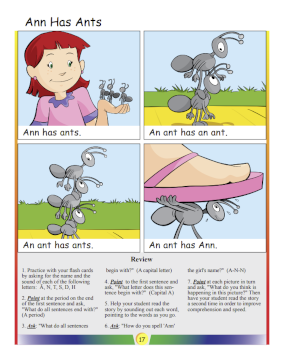 After the first two lesson pages, the rest of the lessons consist primarily of pages laid out like comic books. They have four panels with pictures, but a sentence printed beneath each one. From this point on, students learn to read through simple stories. As with the first two pages, instruction information is at the bottom of each page. Basic sentence structure is taught beginning with the first story. Children learn that sentences begin with capital letters and end with a period, a question mark, or an exclamation mark. They also learn the suffix s, apostrophe-s, and rhyming words.
Periodically, a Writing Practice page is inserted between stories. These can also be downloaded from the publisher’s website.
Complete Course through Heart of Dakota
The two books do not cover all of phonics, leaving phonograms such as the various sounds of ou and oo for later. Heart of Dakota offers options for their kindergarten and first-grade programs that incorporate the Learn to Read books and follow up with the last half of The Reading Lesson to teach the remaining phonetic concepts. Miss Rhonda’s Readers are available for use along with the other three books. They also provide pacing schedules for these resources that lay out a structured, complete phonics program.
Summary
The two Learn to Read books present an easy-to-use, colorful phonics program that includes plenty of repetition and review.