
Compass Classroom’s Middle School Literature is available as a self-paced video course for Christian students. It’s taught by Maggie Purifoy and is based on techniques for studying literature taught by Adam and Missy Andrews in Teaching the Classics.
Students will need eight literary works, four short stories and poems, Writing & Rhetoric 9, and Writing & Rhetoric 10. The last two books are for composition instruction, and parents need the Teacher’s Edition for both books to evaluate student work with answer keys and rubrics.
Purifoy starts the first lesson with a discussion of the children’s picture book, A Bargain for Frances. This lays the groundwork for the more extensive analysis applied to more challenging literature in this course.
The literary works studied are:
- Johnny Tremain by Esther Hoskins Forbes
- The Adventures of Tom Sawyer by Mark Twain
- Across Five Aprils by Irene Hunt
- The Hiding Place by Corrie Ten Boom
- A Christmas Carol by Charles Dickens
- Murder on the Orient Express by Agatha Christie
- The Fellowship of the Ring by JRR Tolkien
- “The Captured Shadow” by F. Scott Fitzgerald
- Much Ado About Nothing by William Shakespeare
- “Sonnet 116” by William Shakespeare
- “The Lake Isle of Innisfree” by WB Yeats
- “Spring” by Gerard Manley Hopkins
The poems, short stories, and works by Shakespeare are available for free on the internet.
Two more forms are needed throughout the year: the Blank Story Chart and the two-page Conflict, Theme & Literary Devices reference resource. They can be downloaded by clicking on the course materials tab, and they are linked after every lesson. Students will probably also want to print out the Course Assignment List: Middle School Literature.
Lectures
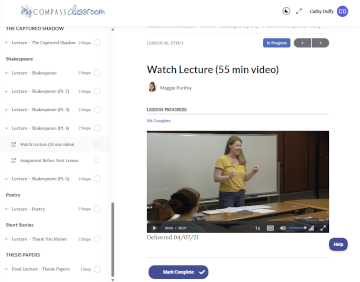
Purifoy was videotaped while teaching a small, very talkative group of students who participated in the lessons. We can generally hear their comments, but not always. Nevertheless, student participation enhances the lectures. Purifoy does a good job of keeping the class on topic or pulling it back in when it strays, sticking closely to about one hour per lecture. The setting seems relaxed and friendly and should be encouraging to students.
The course’s 28 lectures are watched one per week, and the reading and writing assignments are to be completed during the rest of the week. The reading load is significant, so students might want to get a jump start on some books over the preceding summer.
Assignments
Students need to be sure to open the “Assignment Before Next Lesson” button that follows most lectures. These provide reading assignments, background information, maps (when appropriate), links to internet videos or websites for information, things for students to notice as they read, questions to direct their attention to important points, writing assignments, and other helpful information, along with specific assignments in the Writing & Rhetoric 9 and 10 books. These two workbooks are essential for the course and cannot be skipped.
Purifoy assigns lesson material from both Writing & Rhetoric courses but does not assign all of it. The workbook lessons provide further instruction and assignments in a structured fashion, making them easy for students to work through on their own. Students are welcome to complete the entire books as a complement to this literature course.
Students complete a writing assignment every week, either based on an “Assignment before the Next Lesson” or following instructions from one of the Writing and Rhetoric books. Most writing assignments are a paragraph to a page long, and a few take more than one week to complete. Students will write a thesis paper during the last month. Students also learn how to cite sources using the MLA format.
What grade levels is it for?
The course is designated for middle school students, but I think the reading load and maturity level required are best suited for advanced sixth graders and those in grades seven and eight. High school students who have not learned literary analysis and the writing of a thesis paper might also use this course.
Summary
Middle School Literature uses a collection of great literature and provides worthwhile assignments to teach both literary analysis and writing skills, and the Writing & Rhetoric books are excellent choices to support the course’s lessons. Students can subscribe to just this course (18-month access), but they might want to choose a membership with access to additional courses.