The Peaceful Press is a literature and project-based curriculum for grades PreK through six, based on the philosophies of Maria Montessori and Charlotte Mason. It incorporates children’s literature, non-fiction books, nature learning, art, projects, songs, and practical life skills. The curriculum teaches in themed units to help children make connections across the curriculum.
There are separate programs for preschool and kindergarten and for grades one through six. While preschool courses teach introductory math and phonics skills, you need to add your own math program for all other levels, and some language arts resources for older students.
All courses have a parent guide with over 200 pages and a large file of printable student pages. The parent guide includes articles about planning and scheduling plus practical suggestions for implementing Montessori and Charlotte Mason methodology and for training children in practical skills. Some courses include articles to help parents identify the family’s vision for education in terms of overarching values, principles, virtues, and goals.
The bulk of each parent guide is lesson plans, laid out in unit introductions (with book and supply lists); hymns, readings, poems, and quotations used in the lessons; weekly grid charts showing each day’s activities; and daily specific notes.
All Peaceful Press products are digital, and samples of some are available so you can check it out before purchasing. When you purchase a course, you receive the parent guide, students sheets in several different formats as described below, and a file of art images.
You will use a large number of literature and non-fiction books for each course, which you can borrow from the library or purchase.
Preschool and Kindergarten
The curriculum has separate programs for preschool and kindergarten that focus on literature and introductory phonics and math, as well as the Bible, both fine and large motor skills, practical-life skills, art, and nature. The preschool and kindergarten programs are:
- Peaceful Preschool
- Peaceful Preschool Volume 2
- Nourishing Nature Kindergarten
Projects and activities are frequently used along with a few worksheets, but the program leans toward hands-on learning and uses children’s literature rather than traditional curriculum.
Citing research about the importance of play for early learning, series author, Jennifer Pepito, says, “We realize that it takes a lot of bravery to spend as much time in your day on projects and play as on workbooks, but when you do so you provide your young children with a very balanced start to their education (The Precious People: Parent Guide, p. 7).
Preschool
Two courses are available for preschool: the original The Peaceful Preschool course and The Peaceful Preschool Volume 2. Pepito recommends using them in order since Volume 2 teaches “more advanced phonemic awareness” beyond what it taught in the first course. Both courses are for ages three to five and take 26 weeks to complete. The original course bases each week’s lessons on a letter of the alphabet, while Volume 2 is nature-based with seasonal lessons. The parent guides for these courses include readiness checklists.
Each course includes a downloadable file of printables for flashcards, craft templates, worksheets, and other activities—109 pages for the first course and 132 pages for the second.
In the first course, three or more children’s picture books are read each week, with parents leading a Charlotte-Mason-style discussion for some of them. The preschool courses take a gentle approach to academics, although they teach both uppercase and lowercase letters and numbers 1 through 10. Most learning is accompanied by hands-on activity. For example, during the week preschoolers learn about the letter C, they make the letter with glitter glue, by drawing it in salt, and with clay. They gather coins and count them. They gather and organize caps (and hats) from around the house, and they make whipping cream. They climb and participate in many more activities, most related to the letter C. The second course also teaches letters and numbers.
Kindergarten
Nourishing Nature Kindergarten program is a 32-week course that was created from eight nature unit studies that are also sold separately. This course costs as little more since it has more content: a 276-page parent guide, 200 printable pages, and another 77 handwriting pages that teach printing of uppercase letters and numbers. Children can start with the kindergarten program, since it, too, teaches the letters of the alphabet and numbers 1 through 20. However, it moves beyond the preschool programs to teach more phonetic concepts and the concept of addition, and it introduces some social studies topics. While the program includes some math and phonics, if children want more, Pepito recommends using separate programs, such as All About Reading, Explode the Code, Right Start Math, and Handwriting Without Tears.
Lessons are presented for eight months under the unit titles Tree, Farm, Sky, Mountain, Meadow, Garden, Rainforest, and City. Some poetry is included within the parent guide, and the majority of the read-aloud books are non-fiction titles such as Nature Anatomy, A Child’s Introduction to Natural History, and Up in the Garden and Down in the Dirt.
Each week of the eight units has one or more subthemes. For instance, the unit on Meadow features the themes of flowers, butterflies, and birds for the first three weeks, then devotes the fourth week to larger animals, like the fox and the beaver, with investigations of animal prints and habitats.
Kindergartners might also benefit from The Peaceful Press: The Picture Words Card Bundle. The Word Cards Bundle has a picture, letter, and word cards for each letter of the alphabet plus 26 rhyme cards to be used for games and activities.
You might also add The Peaceful Press: Chore and Routine Pack or The Peaceful Press Homeschool Cookbook.
The programs for preschool and kindergarten are meant to be usable by all families, but they will appeal more to families of faith since they have occasional references to God. The kindergarten course includes “The Parable of the Sower” from Matthew 13: 1-23 as the read-aloud selection for a lesson in the Garden unit and a poem that mentions God in the Rainforest unit. Nevertheless, families who want a secular program can easily substitute other readings in these rare instances.
Elementary Courses
Each of the elementary courses focuses on a history or geography theme, and the themes are developed across the curriculum through the recommended reading and assignments in a unit-study fashion.
The courses for grades one through six in the publisher’s suggested sequence are:
- The Precious People World Geography
- The Playful Pioneers Volume 1
- The Kind Kingdom Volume 1
- The Precious People World History
- The Playful Pioneers Volume 2
- The Kind Kingdom Volume 2
Subject areas covered are history, science, literature, some language arts, Bible, art, and practical skills. Math can be taught with the program of your choice.
Some of these courses can be used down to the kindergarten level as long as you supplement beginning math and reading skills. You can use the courses in whatever order you wish, teaching all students in grades one through six from the same course. However, younger students should usually start with Volume 1 of a title, while those in fourth grade and above might begin with Volume 2.
These courses schedule activities for four days per week for 30 weeks, leaving Fridays for field trips, catch-up, or extra activities.
The influence of Charlotte Mason is more evident in these courses than in those for younger students, with copywork, narration, art picture studies, nature walks, the use of literature and information books to teach both history and science, and instruction in practical skills. While the focus on academics increases, the program continues to stress projects, life skills, cooking, and play for all students. Students are also encouraged to read on their own, and suggestions for free reading time are included each month for two different levels.
Students should create a notebook or binder pages for science, history, copywork, drawings, timeline cards, photos, and other coursework.
History & Geography
History is taught through literature, so in-depth coverage is selective, as is true for most similar unit studies. However, students generally recall what they learn through stories and activities that relate to one another better than when they read only traditional history textbooks. Learning is also reinforced with timelines and mapwork. These courses provide good coverage of the U.S. in The Playful Pioneers courses and European history in both of The Kind Kingdom courses. They get an overview of broader world history and geography in The Precious People courses.
Research activities are included for history from time to time, although these are best for older students.
Optional Timeline files have black-and-white cards with dates, text, and space for students to draw or insert their own images. Blank cards are included for adding information from literature, scientific discoveries, or other events that students want to add.
Science
According to Charlotte Mason, science is of lower priority than history for the elementary grades. Consequently, Peaceful Press courses generally group science with history in the lesson plan charts rather than assigning it a separate block. (It’s incorporated with Bible in Precious People: World Geography.) Like history, science is taught through literature, nature study, journaling, and activities, without the typical textbook emphasis on memorizing information. Science isn’t scheduled every day.
While students sometimes have formatted worksheets to complete for science, more often students create science journal pages. For instance, page 195 of Precious People Volume 1: Parent Guide has students try to grow fruits or vegetables from seeds and record progress on a notebook page.
Language Arts
Literature is taught through living books, most of which can be borrowed from the library. Read-aloud time is scheduled in every course, although older students might read on their own. Parent guides include many poems and other readings from the public domain that are used within the lessons. Children develop memory skills by memorizing Bible verses, quotations, and poems.
Narration is used throughout these courses, and the parent guides have a clear explanation of the various ways to approach narration in the Welcome! Section. Illustrated copywork pages (in the printable student pages) have images to color and passages to copy that are drawn from Bible verses, poems, and literary works. Several style options are available for copywork for each course: print, cursive, varied-sized lines, and either more or fewer coloring images. Sets of pages for all options are included with each purchased course.
You might want to use additional resources to cover language arts in a more sequential fashion. More phonics instruction might be added for younger students. Copywork helps reinforce correct spelling and grammar, but since it doesn’t provide a structured approach for learning those subjects, you might add resources for spelling or grammar. Composition skills need to be taught separately with resources like IEW’s Structure and Style program. Children might have sufficient instruction within the Peaceful Press courses for handwriting, although some might need separate handwriting books for learning cursive letter formation and joins. The publisher recommends RightStart Math, Math with Confidence, Teaching Textbooks, Math-U-See, or CTC Math for math. For language arts for fourth grade and above, they recommend IEW Structure and Style for composition skills and Fix It! Grammar courses. All About Spelling or Explode the Code can be used to strengthen phonics and spelling skills.
Bible
The biblical component is stronger in the elementary programs than in those for prekindergarten and kindergarten. Bible verses are used for copywork and memorization, and a hymn is learned each month. Some courses include spiritual reading, and church history (from a Protestant viewpoint) is included to some extent. Skipping religious content eliminates substantial parts of lessons, so I recommend these courses for Christian homeschoolers.
Art
Art images are included with each course, and picture study is scheduled for every Monday. Art images are also available within the optional Morning Time Menu for each course. The Morning Time Menu consolidates content already included elsewhere: Bible verses, poems, songs, quotations, and the art images.
What's Covered in Each Course?
The Precious People Volume 1, World Geography
The Precious People Volume 1, World Geography is the best course to use after Nourishing Nature Kindergarten or if you are starting the Peaceful Press courses with children in kindergarten or the primary grades. It’s a gentle introduction to the seven continents and world history that uses information books, children’s fiction, poetry, fables, and the Bible. Children will research and create country reports for some units. Faith and geography are jointly studied as you read aloud throughout the course from Indescribable Atlas Adventures: An Explorer’s Guide to Geography, Animals, and Culture Through God’s Amazing World by Louie Giglio, as both a daily devotional and for coverage of science.
The study begins with a four-week introduction to world geography that includes learning about the seasons and the planets. The next seven units focus on the continents, while introducing subthemes on topics such as the sky, pyramids, and holidays. Lessons include coverage of individual artists, art forms, and music that relate to each continent. A children’s chapter book is read aloud each month—books like A Bear Called Paddington, The Boxcar Children, and Where the Mountain Meets the Moon.
Among the student pages are mapwork, copywork, journaling pages, formatted country report pages, a family tree page, a phonogram chart, a few phonics-related pages, and other specialized worksheets.
Science coverage is light in this course, with sporadic coverage of science topics. However, under Art/Practical Skills, every week it says “Take a nature walk,” sometimes adding details such as “and notice the direction of the sun” or “ and identify seasonal changes.”
The Playful Pioneer Volume 1
The parent guide for this course has a master book list at the beginning that I find very helpful. The primary read-aloud books are all from either The Little House series or the Little Britches series. For religion, books used are The Ology by Marty Machowski (very introductory systematic theology for children) and The Jesus Storybook Bible by Sally Lloyd-Jones. While many other books are used for history and science, a few used throughout the course should be purchased: Farm Anatomy, Nature Anatomy, Golden Guide to Trees, and Golden Guide to Birds. Many of the other books are history-based, historical fiction, biographies, and non-fiction science titles, such as The Life and Times of a Honey Bee by Charles Micucci.
The Kind Kingdom Volume 1
In The Kind Kingdom Volume 1, history focuses on Europe from the Middle Ages through the Cold War, with an overarching theme of character traits, such as honor, endurance, bravery, and mercy. Our Island Story by H.E. Marshall, A Favourite Collection of Grimm’s Fairy Tales illustrated by Anastasiya Archipova, some of C.S. Lewis’s Narnia books, Beautiful Stories from Shakespeare for Children by E. Nesbit, Draw Europe by Kristin J. Draeger, and the Bible are used throughout the course, along with many other books. This course should be used after Volume 1 of the other two courses since some topics are not appropriate for children in first and second grade. Children should have some knowledge of world history before starting this course so they can place events within contexts. Also, topics like the holocaust, WWII, and the ironic approach to forms of government in Animal Farm should generally be reserved for middle school or later. The course can work for third and fourth graders, but the readings should be used selectively with them.
Science topics are diverse, including astronomy, sailing, scientific explorations, inventions, flight, and various topics covered in the Christian Liberty Nature Reader 4.
The Precious People Volume 2, World History
The Precious People Volume 2 teaches about ancient cultures, Jewish feasts, early Christian missionaries and saints, selected events from world history, animals, the human body, engineering, birds, and insects. It also highlights some cultural aspects of Asia, Africa, and Latin America.
It includes alternate books to read for those who might choose to cycle through that course a second time. However, since there are already six courses for six grades, there’s no longer a need to cycle through a course twice. The parent guide includes articles on maintaining a biblical rest and celebrating Jewish feasts.
Only three books are used throughout this course: The Gospel Story Bible by Marty Machowski, the Bible (choose your version), and Draw the World by Kristin Draeger (also used with The Kind Kingdom Volume 1). However, many more books are used for short periods.
The Playful Pioneers, Volume 2
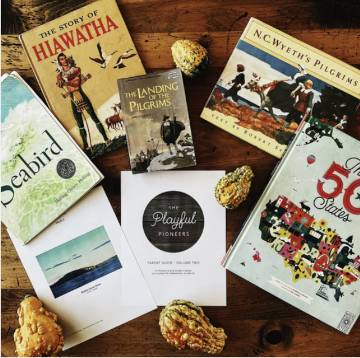
Volume 2 of The Playful Pioneers explores the United States by regions and adds a two-week study of the Constitution. Along the way, students learn about American artists, poets, and folk songs. Map and timeline activities support history and geography.
The Bible and The 50 States by Gabrielle Balkan are used throughout the course, along with many other books. Several science-related books by Holling C. Holling are used--Seabird, Paddle to the Sea, Minn of the Mississippi, Tree in the Trail, and Pagoo. The Holling books, written as stories, are the perfect gateway to unit studies since they tie in many science, history, and culture topics.
This course does not cover all of American history, nor does it cover topics chronologically because of the arrangement of units by regions. Nevertheless, its an excellent introductory study of the U.S.
The Kind Kingdom Volume 2
The Kind Kingdom Volume 2 parallels The Kind Kingdom Volume 1, with both covering European history from the Middle Ages through the Cold War. Younger students can work in the first volume, while older students use the second. Older students will probably do much more reading on their own.
Some books are repeated in both volumes, and alternatives are suggested for those who want them. Our Island Story by H.E. Marshall is used in both volumes, but different chapters are assigned each year. Explorers: Amazing Tales of the World’s Greatest Adventures by Nellie Huang is used over a few months. The Bible is used throughout the course, Andersen’s Fairy Tales replace Grimm’s Fairy Tales, and Tales from Shakespeare by Charles and Mary Lamb are read in several units.
Botany is the primary science topic, as students read and do activities from Exploring Creation with Botany by Jeannie Fulbright over several months, along with other resources, such as A Year in the Big Old Garden.
Summary
The Peaceful Press courses, strongly influenced by Charlotte Mason’s ideas, rely on literature and projects far more than we find in traditional programs. Subject area coverage purposely does not align with national standards. While that might worry some parents, this approach generally produces students who are both well-educated and eager to learn more.