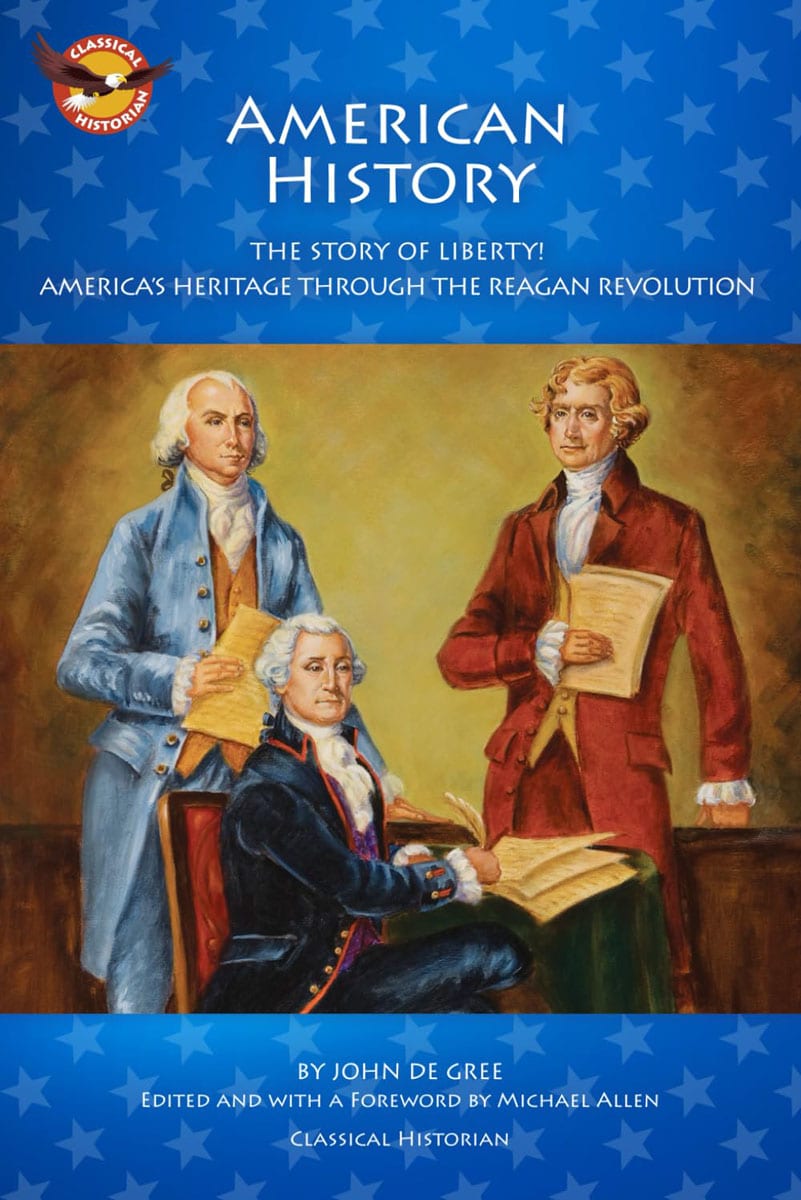



John DeGree’s Classical Historian history curriculum continually expands and improves. Most of his Take A Stand guides for history courses have been dependent on history books written by other authors. The textbooks used for some of his American history courses in the past were written for older audiences and were challenging for many junior high and high school students. To help solve that problem, DeGree has written his own textbooks for American history. He began with The Story of Liberty: America’s Heritage Through the Civil War and created all the course materials for using that book in junior high. More recently, he completed the second half of American history with Modern American History: The Story of Liberty! Reconstruction Through the Reagan Revolution. You can now also purchase a single book that contains both books, titled American History: The Story of Liberty! America’s Heritage Through the Reagan Revolution. All three are suitable for junior high and might also be used for high school.
The complete American History book has 130 short chapters, with the longest running seven or eight pages and the rest from two to five pages. The chapters are grouped within 24 units. The Story of Liberty (the book covering only the first half) has the first 11 units, and Modern American History contains the last 13 units. None of these books has an index.
 Junior high students can easily complete American history in two years, using either half of the complete textbook each year or the two separate books. More ambitious junior high students might finish the complete course in a year. High schoolers should definitely use the complete book (or both halves) in one year.
You can read my separate review of The Story of Liberty. This review concentrates on Modern American History. Course guides and student books for Modern American History are still under development, and I will add those to this review when they are published. There are no questions or assignments in the textbooks, so in the meantime, you might use a resource like The Giant American History Timeline: Book 2, 1870s-Present, which has activity pages that can be used with most American history courses or “Modern American History Lessons and Resources,” available for free at historyskills.com. The latter includes online quizzes.
Modern American History should be very readable for junior high students, and high schoolers should find it easier to read than many high school history textbooks. This is because De Gree keeps his sentences short, writes very clearly, and uses a relatively large font. Even though the complete book has 582 pages, students will be able to read it more quickly than most high school history textbooks. The following sample from page 185 is typical:
The economic situation in 1932 was undoubtedly grim. After the Great Crash in 1929 and four years of Hoover, the United States was in crisis. By 1933, 9,000 banks had closed. Americans lost over $1.36 billion in deposits from these failed banks. In 1932, the unemployment rate was 23 percent. Millions were homeless. Hoovervilles, or shanty towns, sprang up outside of major cities. Built of scrap wood or boxes, these houses provided little relief. Two million men took to the road, constantly searching for food and work.
Viewpoint
The viewpoint expressed in the textbook is clearly conservative and in favor of a limited government. For example, he writes on page 311:
LBJ believed that he had a mandate to completely revamp the relationship between the federal government and the individual. In his second term he embarked on America's greatest expansion of government and strongest incursion against individual liberties since his hero FDR's "New Deal." Indeed, FDR created the entitlement state and LBJ expanded it exponentially. Johnson, other Democrats, and many liberal Republicans believed that a big federal government could somehow do away with poverty, end racism, and create a "Great Society" through legislation, confiscating money from the successful and doling it out to those they deemed to be needy. Tragically, this false belief in big government led to increased crime, divorce, poverty, and a weaker military.
Part of DeGree's preference for limited government includes criticism of government intervention and political corruption that advanced the interests of big business at the expense of laborers, small businesses, and consumers. So, for example, he criticizes government support of businesses against labor interests in the 1900s.
DeGree often pits progressivism against small government and more libertarian views, describing it on page 105:
Progressives believed that the government should be managed by the smartest, most capable people, and government should regulate businesses to provide Americans with what Progressives decided was the best. Progressives trusted "science" and "experts" and distrusted the common man's ability to make his own decisions. For instance, Progressives wanted to make alcohol illegal and make government a force for curing all social ills. They also believed that America had the right to exert its influence on the rest of the world to make sure that everything ran better. Moreover, Progressives tended to be racist and believed in Social Darwinism, the idea that the fittest rose to the top in society.
While this is not an overtly Christian textbook, it presents Christianity and the work of Christians in a positive light. Social issues are not addressed with Bible verses but are discussed through a Christian lens. For instance, Margaret Sanger and her work to promote eugenics and birth control are presented negatively, and this section concludes with commentary on the huge numbers of abortions provided even today by her organization, Planned Parenthood. (pp. 142-145).
Also on the moral front, DeGree sometimes addresses character issues related to key historical figures, both positive and negative. For instance, in talking about Grover Cleveland, he mentions that he was "the last President to answer the door himself at the White House, and the last President to pay for White House bills out of his own account" (p. 98). On the other hand, he mentions the extramarital affairs and other personal failings of presidents Franklin D. Roosevelt and John F. Kennedy (pp. 184 and 297).
The textbook stops after the Reagan administration, leaving a significant amount of modern American history untouched. This is not that unusual, since most history textbooks treat the most recent history briefly as we have not had enough time to get an accurate perspective. Nevertheless, you might want to cover events during this interim, and The Giant American History Timeline: Book 2, 1870s-Present extends further, continuing up through the war in Iraq, and “Modern American History Lessons and Resources” covers through the Cold War. For very brief coverage of recent history, students might watch the last part of the more than four-hour video, The ENTIRE History of the United States of America (start at 4:02 for the 1990s and beyond), or the more liberally slanted Crash Course U.S. History series #44 through #47 that takes us through the Obama administration. For more complete course material covering recent American history from 1980 to 2020, students might use Unit 9 of Khan Academy’s U.S. History course.
Summary
Even though complete course materials are not yet available, I thought it important to let homeschoolers know about Modern American History and the complete American History books since they are likely to appeal to many of my readers for both their viewpoint and their easier reading level.