
Steadfast is a four-year high school program based on a biblical worldview. It covers history, geography, government, literature, and composition, along with other topics that fall under the humanities: art, political theory, philosophy, apologetics, and religion. Students will need to use other resources to cover math, science, and economics.
History is the organizing theme, and the development of literature, art, architecture, philosophy, music, and other disciplines is taught within their historical contexts.
To a limited extent, this is a classical curriculum since it has classical elements such as the reading of some of the Great Books and primary source documents, a historical study of art and architecture, and copywork. However, it is heavily weighted with books that promote and defend a Christian worldview, and literary works, art, and architecture are studied from a worldview perspective. Other points of view are included given the use of a secular textbook for the study of Western civilization and frequent use of videos from Crash Course and other channels that express secular viewpoints. The occasional inclusion of competing viewpoints is a plus since it exposes students to a broader range of ideas.
The biblical worldview is conservative Protestant, reflecting a belief in the inerrancy of the Bible and a young earth. For example, Steadfast Year One: History & Humanities teaches a six-day creation, saying on page 14, “God’s Word is the ultimate authority and absolute standard by which we should live.” This viewpoint is also evidenced by many of the resources used, such as Year Two: History & Humanities’ inclusion of a lengthy study of Martin Luther’s commentary on the book of Galatians with no counterpoint to his anti-Catholic criticisms. Also, while the course teaches about competing worldviews, it does so to show they are false. Francis Schaeffer also seems to be a major influence, with the inclusion of some of his books and many of his ideas throughout the course. To help students apply what they have learned, apologetics is taught as a strand in both Year 1 and Year 4.
Each year has two courses: one titled History & Humanities and the other titled Literature & Composition. While each year’s Literature & Composition course is worth one credit, each History & Humanities course is worth from 3 to 3.75 credits since it covers additional areas such as art, geography, philosophy, worldview, government, political theory, and humanities. (Suggested credits for each course are provided near the front of each book.)
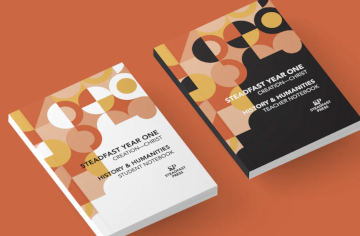
Each course has a consumable student book, a teacher notebook, and a book of weekly lesson plans. The teacher notebooks have all the content of the student books, plus three or four pages of teacher notes near the beginning and answers (and their point values) printed after questions. Teacher and student books are each around 500 pages in length, but large-font headings and open space for student responses make the amount of text to be read less than the page count might imply.
Students might study only one of the courses each year, but they complement each other by following the historical timeline. Interestingly, U.S. History is split over Years 3 and 4 and is taught in conjunction with world history to some extent. Literature is presented in conjunction with the historical timeline and is not divided into the typical categories of American, British, and World Literature.
Students will need many additional resources. Those used over all four years are Western Civilization (11th edition) by Jackson Spielvogel, The Universe Next Door (6th edition) by James W. Sire, The Philosophy Book: Big Ideas Simply Explained by DK, Art That Changed the World by DK, Map Trek by Terri Johnson, and Steadfast Press’s History at a Glance Blank Timeline. Francis Schaeffer’s How Should We Then Live? is also used for the last three years.
Numerous additional books are used each year, along with YouTube® and occasional Amazon Prime® videos. Each course book lists the required books at the beginning, and videos are listed within lessons.
How the Courses Work
Student books are designed for independent work, but the courses serve well for classes where students can discuss questions for which answers will vary, discuss literary works they read and videos they watch, and compare viewpoints presented in the various resources.
The lessons are so well laid out in both student notebooks that students can work through them without lesson plans. However, the Student Weekly Plans let students know exactly what to do each day for four days a week and include check boxes to mark upon completion of each assignment. Weekly plans also divide work under subject area subheadings so parents or supervisors can easily see what is accomplished for core areas and electives. So I recommend purchasing the Student Weekly Plans books.
Student workbooks have space for students to answer questions, complete charts, take notes, and write short compositions. Lengthier compositions and projects will be done elsewhere. Mapwork for geography will often be done on maps from Map Trek, and students will make entries in their timeline book as directed within the lessons. Most timeline entries are from history and humanities, but some are from literature studies. Steadfast Press does not sell timeline figures, so students can draw their own, use figures from elsewhere, or just write about the people and events.
Lessons include complete instructions that tell students which resource to use and how to respond. Books are assigned a section at a time, with questions to answer, charts to fill in, or space to take notes. Videos sometimes have specific questions but often list topics under which students are to take notes and write their own observations. Assignments also include memorization and recitation, plus several projects. Projects assign students a topic, like the Reformation, and allow them broad latitude as to which aspect to address and the manner in which to present it. There are no tests, but students are graded on their answers to questions and on their projects. Rubrics are included for project evaluation.
Discussion is not required for the courses, but it can be a valuable component. Carol McCoy, one of the course authors, let me know they have some upcoming features that will add a structured discussion component. They are “refining class lesson plans for once-a-week co-op use,” so teachers in that setting will have specific plans that include discussion. Also, they are “developing ‘Table Talk,’ an optional companion book designed for home use one day per week. This resource facilitates meaningful discussions between parents and students about their learning.”
Lesson content varies greatly from day to day in both courses. I’ll first discuss the History & Humanities courses.
General Comments: History & Humanities
Lesson assignments are under headings for the strands included in the course each year, but not all strands have assignments every day, or even every week. For instance, the headings for History & Humanities: Year Two are Western Civilization, Religion, Worldview, Geography, Philosophy, Humanities, and Political Theory. Daily assignments will usually be under just a few of these headings. Sometimes a particular topic under one or two headings dominates a week’s lessons. For example, lessons for the first two weeks of Year Two are under only four headings: Religion, Worldview, Western Civilization, and Geography, but all four areas are not covered every day. Geography is just once a week, and Western Civilization is two days per week. Week-three lessons switch two of the categories, skipping Geography and Worldview and inserting Humanities and Philosophy.
Points to Ponder, which appear sporadically at the bottom of the pages, ask thought-provoking questions, make connections to previous topics of study, and add interesting information. Students should read these, although they are easy to skip past.
General Comments: Literature & Composition
Literature & Composition coursebooks include some shorter literary works, such as poems, short stories, and primary source documents, but students will need to acquire other literary works and locate a few readily accessible videos.
While students can complete lessons on their own, they need an editor to review and evaluate their written assignments. Rubrics are included, and requirements are clearly stated.
The Student Weekly Plans for Literature & Composition have three categories for lesson activities: Literature, Composition, and Memory.
Literature and composition lessons build upon one another from year to year. Students learn a skill one year and apply it in subsequent years.
Literature lessons introduce students to a wide variety of literary genres, most of which are also studied through the lens of a biblical worldview. Students learn literary analysis on several levels through questions, annotation charts (provided in the books), and writing assignments.
Composition lessons include copywork, poetry, prose, and journaling, but the major emphasis is on learning to write essays. Students learn formal outline structures in Year 1, and they learn to write essays based on the analyses they’ve written on annotation charts. Essays are to include citations. Composition skills are taught in a structured manner that should be easy for students to learn. Even journaling assignments have some specified requirements.
All four years have memory and recitation work for lengthy passages from the Bible. All except Year 4 include memory and recitation from speeches from Shakespeare’s plays, an excerpt from the Declaration of Independence, and the Preamble to the Constitution.
While there is no regular vocabulary work, students are sometimes asked about the meanings of words. For instance, on page 276 of Year 1, the third question asks, “In lines 59-62 [of The Odyssey], what common emotion do the words ‘infest,’ ‘sick,’ ‘swilling,’ and ‘squander’ evoke?” This is a more sophisticated approach to vocabulary than typical vocabulary exercises.
Likewise, grammar is not taught explicitly, but students are sometimes asked about particular parts of speech, with the assumption that students already know them.
Summary
The Steadfast curriculum offers solid college-prep coverage that goes beyond typical coursework and is designed to inculcate a Bible-based, Protestant worldview and prepare students to defend and promote their faith. It requires students to work at challenging levels of reading, thinking, analysis, and writing.
Read on for details about each course.
Year One
In addition to Western Civilization and the other core books I listed near the beginning of this review, Year One: History & Humanities uses Plato’s Republic, the Bible and other books that are related to the Bible or worldviews: Genesis in Space and Time by Francis Schaeffer, The Miracle of the Scarlet Thread edited by Dr. Richard Booker, A Path Through Suffering by Elizabeth Elliott, and Cold-Case Christianity by J. Warner Wallace.
Studying the period from creation to about AD 300, students learn about the civilizations that helped shape Western civilization and begin to explore how philosophical ideas and religious beliefs impact all areas of life. Under geography, students learn about landforms and geographical features; the locations of some significant countries, territories, cities, etc.; how to analyze geographic data; map reading; and how physical geography can influence historical developments.
Bible is an independent strand only in Year 1, and Bible study is significant enough to be worth one credit. The heavy emphasis on the Bible is intended to lay a foundation for the ensuing courses. Some of the goals for Year 1 are that students learn the main characters and events of the Bible and learn key theological concepts. The worldview and apologetics strands for this year help students think through and apply biblical knowledge. The philosophy strand introduces a few ancient philosophers.
Literature & Composition uses reading material that supports the historical timeline and worldview content in History & Humanities with the books Adam and His Kin by Ruth Beechick, Mythology by Edith Hamilton, The Iliad and The Odyssey by Homer, Julius Caesar by Shakespeare, The Aeneid by Virgil, and Flight by Chuck Black (an allegorical Christian fantasy). Students also listen to an audio dramatization of Ben Hur and the audio Bible Eyewitness Hall of Faith, and they watch the DVD Risen. This year, students begin literary analysis, and the composition lessons teach essay writing structures.
Year 2
History & Humanities Year 2 covers 300 to 1799 and requires five books in addition to those I’ve already listed that are used for multiple years: The Screwtape Letters by C. S. Lewis; No God But One: Allah or Jesus? A Former Muslim Investigates the Evidence for Islam & Christianity by Nabeel Qureshi; Virtue, Power, and Governance: Writings by Augustine, Erasmus, and Machiavelli edited by Carol McCoy, Commentary on Galatians by Martin Luther, and Rooted: The Apostles’ Creed by Ray Cannata and Josh Reitano.
The course provides one credit each for history and religion, one-half credit for humanities, and quarter credits for geography, worldview, political theory, and philosophy.
Literature & Composition: Year 2 continues to teach essay writing and adds some creative writing. Students read prose, poetry, and plays from the coursebook and the following resources: Beowulf, The Lantern Bearers, The Death of King Arthur, The Annotated Shakespeare: Hamlet, The Divine Comedy Volume I: Inferno, The Fellowship of the Ring, The Pilgrim’s Progress, Paradise Lost and Paradise Regained, and Robinson Crusoe.
Year 3
History & Humanities: Year 3 requires several additional books, including many related to American history and government, since it is covered along with world history from 1700 to 1900. The titles of the additional books are American History, Volume I by Thomas Kidd; Resolute Reader compiled by McCoy and Exum; The Everything American Government Book by Ragone; Our Constitution Rocks by Turner; Real Christianity by Wilberforce; Holman QuickSource Guide to Christian Apologetics by Powell; Whatever Happened to Justice? by Maybury; Are You… Liberal? Conservative? Or Confused? by Maybury; and What’s Your Worldview? by Anderson. Note that a limited-government perspective is presented in the two books by Richard Maybury.
Coverage of world history, American history, apologetics, and American government and civics earns students one-half credit each, and a quarter credit each is earned for political theory, worldview, geography, and philosophy.
In Literature & Composition: Year 3, students read poetry, nonfiction, and fiction from the short works included within the coursebook and from the following literary works: The Scarlet Letter, Sinners in the Hands of an Angry God, The Autobiography of Benjamin Franklin, Great Expectations, Jane Eyre, A Tale of Two Cities, Adventures of Huckleberry Finn, 12 Years a Slave, and Resolute Reader. Note that the Resolute Reader is also used with the history course.
Students continue to learn to analyze various types of writing and write essays. Lessons include SAT and ACT essay practice and the composition of a poem.
Year 4
History & Humanities: Year 4 covers world history from 1900 to the present, providing one credit, and American history from 1877 to the present for one-half credit. Students also earn one-half credit each for humanities, apologetics, and worldview, and a quarter credit each for geography, philosophy, and political theory. Books added this year are Saving Leonardo by Pearcey; Manifesto of the Communist Party by Marx and Engels; We Will Not Be Silenced by Lutzer; America and the World: Foreign Affairs in Political Cartoons, 1898-1940 (free ebook); I Don’t Have Enough Faith to Be an Atheist by Geisler and Turek; Another Gospel by Childers; Why Social Justice is Not Biblical Justice by Allen; Christianity, Cults, & Religion by Rose Publishing; Counter Culture by Platt; Altar Ego by Groeschel; God’s Crime Scene by Wallace; Mere Christianity by Lewis; and Tactics by Koukl.
For Literature & Composition, students read Hinds Feet in High Places, George Washington Carver: His Life and Faith in His Own Words, Animal Farm, 101 Great American Poems, Great Speeches of the 20th Century, Room of Marvels, Fahrenheit 451, So Good They Can’t Ignore You, The Hiding Place, Night, To Kill a Mockingbird, Old Man and the Sea, God’s Smuggler, There Will Come Soft Rains, Joni, The Insanity of God, This Present Darkness, and Facing the Giants. They will also watch and write about Our Town and The Chosen series.
Author of the literature and compositions courses, Jennifer Exum, explains in the Teacher Notes how this course differs from the first three courses, saying:
The reading focus is on engaging texts which include speeches, poetry, nonfiction, and novels, and instead of analyzing them, students respond to them in reader response journals. It is more about what they think about the text and what they learned from it in a reflective format. The writing focus is for students to apply elements of fiction, style and persuasion in their own compositions instead of analyzing them in someone else’s text (p. viii).
Given this description, I wasn’t surprised to find that there are fewer questions with predictable answers because many questions require individualized responses. In addition to writing in response to the literary works, students will write a personal narrative, creative non-fiction, a descriptive essay, a script (and its digital presentation), a resume and cover letter, and a few other types of essays. The composition assignments are designed to prepare students for a college 101 writing course as well as test essays.
While all the Steadfast courses would benefit from discussion, that applies most to Literature & Composition: Year Four, because of both the open-ended nature of many assignments and the literary works and assignments themselves, which often address key worldview ideas.